Colombia Oil-Gas Extraction Falls 2.7% as Gas Hits Record Low
Colombia · Energy
Key Facts
—Q1 contraction: Colombia oil and gas extraction fell 2.7 percent year-over-year in the first quarter of 2026, the seventh consecutive quarter of contraction since the third quarter of 2024 and the longest such sequence since the 2014-2016 oil-price-collapse cycle, according to the Cámara Colombiana de Petróleo, Gas y Energía industry group, known by its short name Campetrol.
—Petroleum output: Average daily petroleum production reached 740,622 barrels in the first quarter, down 2.26 percent from the same period in 2025; the March print was 740,500 barrels per day, off 1 percent year-over-year but up 0.8 percent month-over-month from February’s 734,900 barrels per day on recoveries at the Índico field and new wells in Casanare and Meta.
—Gas at historic low: Colombian natural gas production averaged 1,168 million cubic feet per day in Q1 2026, down 9.74 percent year-over-year; the March reading of 1,151 million cubic feet per day was the lowest monthly output in the country’s recorded history, driven by aging field decline, pressure loss and water cut increases at strategic reservoirs.
—Import dependency rising: Imported gas accounted for 22.4 percent of national gas supply in March 2026, equivalent to 202.5 million cubic feet per day; Campetrol and consultancy Corficolombiana have separately warned the dependency could reach 50 percent or higher within years without major new domestic projects coming online.
—Brent backdrop: The international Brent crude reference rose to an average $117.30 per barrel in April 2026, up 72.2 percent year-over-year on the Iran-war energy-supply disruption, creating a paradoxical situation in which Colombian exporters benefit from the price spike but the country pays sharply more for imported gas at the same time.
—Refinery offset: The broader hydrocarbon sector, which combines extraction and refining, grew 0.4 percent in Q1 2026 because refining activity expanded 7.6 percent year-over-year; the headline sector number masks the structural extraction-side contraction that Campetrol describes as a “technical recession” with consecutive negative variations across all relevant operating metrics.
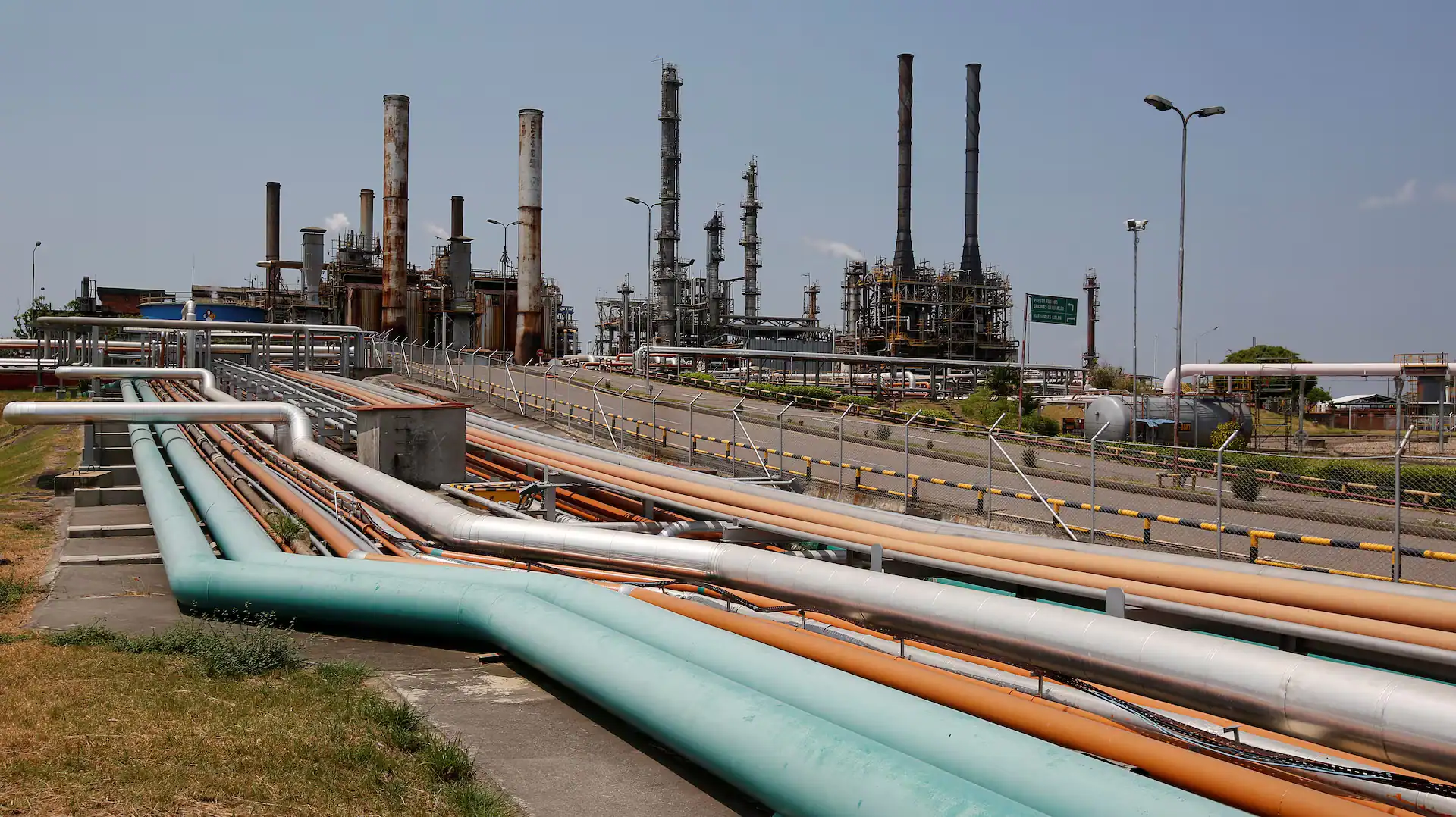
The print confirms that Colombia is now structurally short of domestic hydrocarbons and increasingly dependent on imports during a global price spike, with the May 31 first-round presidential election making the political response uncertain.
What did the Colombia oil and gas Q1 data show?
The Rio Times, the Latin American financial news outlet, reports that the Cámara Colombiana de Petróleo, Gas y Energía, the industry chamber known by its short name Campetrol, published the consolidated first-quarter 2026 production figures this week, showing extraction-side output down 2.7 percent year-over-year. The petroleum component averaged 740,622 barrels per day in the first quarter, a decline of 2.26 percent compared to the same period in 2025. The gas component averaged 1,168 million cubic feet per day, down 9.74 percent year-over-year, with March specifically posting 1,151 million cubic feet per day, the lowest monthly reading in Colombia’s recorded production history.
There was modest sequential improvement in petroleum, with March 2026 output up 0.8 percent month-over-month from February’s 734,900 barrels per day on recoveries at the Índico field in Casanare and new wells in Mateguafa and Castilla Norte in Meta. But the year-over-year picture continues to deteriorate, and the gas contraction shows no sign of bottoming as aging-field decline rates accelerate at strategic reservoirs in the Valle Inferior del Magdalena and elsewhere. Campetrol attributed the gas weakness to a combination of natural field depletion, pressure loss at mature reservoirs, increased water cuts at producing wells, and operational issues including equipment maintenance windows.
Why is the gas trajectory more alarming than oil?
The structural difference between the two products is decisive. Colombian oil production has been declining slowly for years but remains broadly exportable, generating foreign exchange through the international Brent linkage and offsetting some of the macroeconomic damage from volume losses, while gas is different: domestic Colombian demand exceeds domestic supply, and the gap is filled by liquefied natural gas imports through the SPEC regasification terminal in Cartagena and through a smaller import infrastructure being developed. In March 2026, imported gas accounted for 22.4 percent of national supply, up sharply from less than 3 percent during 2015-2023.
Consultancy Corficolombiana has projected the gas supply deficit will reach 20 percent in 2026, rising to 41 percent by 2028 and 57 percent by 2030 without major new domestic production coming online. The Sirius offshore field, a joint Ecopetrol and Petrobras discovery in the Caribbean, is the only project at scale that could structurally close the gap, with initial production capacity of 400 to 500 million cubic feet per day representing more than 50 percent of current domestic commercialized output. But Sirius faces multiple prior-consultation processes with affected communities, full environmental licensing, and offshore infrastructure development that put first production years rather than months ahead.
Live Market IntelligenceColombia — Live Market Board
Rio Times · Live Market Intelligence
Colombia — Live Market Board
-0.19%
177,547.57
+2.44%
67,298.78
+0.88%
11,009.22
+0.50%
3,379,771
+2.98%
2,297.00
-0.19%
57,575.02
—
| Instrument | Last | Change | YoY | Prev. | High | Low | Volume |
|---|---|---|---|---|---|---|---|
| COLCAP | 2,297.00 | -0.19% | — | 9.04 | 9.05 | 9.02 | 4,133 |
| USD/COP | 3,205 | -0.70% | -21.27% | 3,227 | 3,205 | 3,200 | — |
| BRENT | 96.12 | +2.18% | +40.30% | 94.07 | 96.47 | 94.88 | 3,809 |
| WTI | 88.12 | +1.49% | +35.05% | 86.83 | 88.67 | 87.32 | 35,284 |
| ECOPETROL | 16.69 | +0.97% | +87.11% | 16.53 | 17.07 | 16.58 | 2,286,712 |
| BANCOLOMBIA | 84.66 | +1.22% | +88.26% | 83.64 | 85.15 | 83.61 | 246,223 |
| GRUPO AVAL | 5.04 | -0.98% | +70.85% | 5.09 | 5.11 | 4.99 | 108,834 |
| TECNOGLASS | 45.24 | +0.20% | -42.92% | 45.15 | 46.06 | 44.87 | 167,536 |
| CREDICORP | 393.43 | +0.60% | +66.11% | 391.10 | 394.27 | 386.20 | 669,485 |
| BUENAVENTURA | 32.09 | +2.69% | +81.81% | 31.25 | 32.80 | 31.66 | 1,027,567 |
| SOUTHERN COPPER | 195.48 | +3.97% | +100.94% | 188.01 | 196.43 | 187.88 | 1,225,320 |
What is the price-volume cross-current?
The international price environment is making the volume contraction more expensive for the Colombian economy in two directions simultaneously. The Iran-war energy-supply disruption pushed the Brent crude reference to an average $117.30 per barrel in April 2026, up 72.2 percent year-over-year. For petroleum exports, this is a partial cushion: Colombian first-quarter 2026 petroleum exports reached $3.438 billion, up only 0.8 percent year-over-year despite the volume decline, with the March print specifically up 7.2 percent year-over-year and 78.8 percent month-over-month on the price effect.
The cross-current is that the same global price spike is making imported gas substantially more expensive at the moment Colombian import dependency is rising. Liquefied natural gas spot prices have moved in sympathy with crude, and the Colombian retail gas tariff structure transmits a meaningful share of import costs to household and industrial bills. Campetrol president Nelson Castañeda has criticized recent political decisions for complicating the investment environment and warned that the dependency trajectory will continue without faster regulatory approvals and stronger security in producing regions, where pipeline attacks have hit Arauca and Cesar in particular.
How does this fit the May 31 election?
Colombia holds the first round of its 2026 presidential election on May 31, with President Gustavo Petro term-limited. The Petro government’s 2022 moratorium on new exploration contracts is the proximate political input to the current production decline, since the contracting freeze removed the new-acreage pipeline that would normally backfill aging-field depletion at the four-to-six-year horizon. The candidates’ positions on whether to lift that moratorium are now a central dividing line in the energy-policy debate, with the broader macroeconomic implication that a moratorium reversal would take years to translate into incremental barrels even if implemented immediately.
The fiscal arithmetic adds urgency. Campetrol estimates that Colombia left approximately 9.6 million barrels unproduced in 2025 due to the annual shortfall, with a treasury cost in the range of $660 million at prevailing prices; the petroleum sector still delivers approximately 10 percent of government revenue and 35 percent of export earnings, and proven oil reserves cover approximately six years of consumption at current extraction rates. Without sustained reserve additions through exploration and discoveries, the asset base depletes on a timeline that the next administration must address regardless of political orientation.
What should investors and analysts watch next?
- May 31 first-round result: The lead candidates’ positions on the exploration moratorium and the broader hydrocarbon-licensing framework, and whether any candidate makes lifting the moratorium an explicit campaign commitment ahead of the second round.
- Sirius offshore field progress: The status of prior-consultation processes with affected communities and the environmental-licensing pathway, given that Sirius is the only Colombian gas project at scale that could close the structural supply gap before the end of the decade.
- El Niño 2026 second-half: Meteorological forecasts for the second half of the year, since an El Niño event would lift thermal-power demand sharply and absorb much of the additional import capacity coming online in 2026 and 2027.
- Active drilling rig count: Campetrol’s monthly rig-count releases, with 112 rigs projected for the May-July period; meaningful upward movement would signal early investor response to a potential policy pivot.
- Q2 export revenue: Whether the petroleum-export dollar value continues to track higher despite volume declines, providing residual foreign-exchange support, or whether the volume effect catches up with the price effect.
- Banco de la República rate path: The next monetary-policy meeting decision, since electricity and gas tariff pressures interact with the central bank’s persistent-inflation problem and currently held policy rate of 11.25 percent.
Frequently Asked Questions
What is Campetrol?
Campetrol, the Cámara Colombiana de Petróleo, Gas y Energía, is the principal industry chamber for goods and services suppliers to the Colombian oil and gas sector. Its monthly and quarterly production reports, drawing on Agencia Nacional de Hidrocarburos data, are the most-watched private-sector measure of the Colombian hydrocarbon sector’s operating performance.
Why is Colombia importing so much gas?
Colombian gas reserves have been depleting faster than new discoveries have been replacing them for years, while domestic demand has held firm or grown. The result is a structural deficit that the SPEC regasification terminal in Cartagena fills with imported liquefied natural gas, with imports rising from below 3 percent of supply during 2015-2023 to 22.4 percent in March 2026.
What is the Petro exploration moratorium?
The Petro government announced in 2022 that it would not sign new exploration contracts, framing the decision as part of an energy-transition policy. The moratorium did not affect existing producing contracts but removed the new-acreage pipeline that would normally backfill aging-field depletion at the four-to-six-year horizon, contributing to the current production decline.
Could the next government reverse course?
A new administration could resume signing exploration contracts at any point through executive action, but the lead time from contract signing to first barrels typically runs four to six years, meaning the production trajectory through 2028 to 2030 is broadly locked in. The relevant variable for the late-decade outlook is whether the next administration acts quickly after taking office in August 2026.
How large is the fiscal cost of the decline?
Campetrol estimated that approximately 9.6 million barrels were left unproduced in 2025 due to the annual shortfall, with a treasury cost of approximately $660 million at prevailing prices. The petroleum sector still contributes approximately 10 percent of government revenue and 35 percent of export earnings, making the production trajectory a meaningful constraint on Colombian fiscal flexibility.
Connected Coverage
The Q1 print extends the trajectory documented in our coverage of the January 2026 production data, complements the structural gas-supply analysis in our Colombian gas crisis and Sirius field guide, and connects to the macro picture in our Colombia economy 2026 investor guide.
Read More from The Rio Times