Venezuela Deports Maduro’s Top Financier Alex Saab to the U.S.
Key Facts
—The handover. Venezuela’s migration agency SAIME confirmed on Saturday May 16 the deportation of Alex Naim Saab Morán, a Colombian-Venezuelan businessman long described by US officials as Nicolás Maduro’s principal financial operator.
—The flight. A Gulfstream jet with US registration N550GA flew Saab from Caracas’s Simón Bolívar International Airport at Maiquetía to Opa-locka Executive Airport in Miami-Dade, landing at roughly 9:00 PM Saturday under DEA escort.
—The agencies involved. The operation was coordinated by the DEA, FBI, CIA, US State Department, and Justice Department.
—The legal implications. Saab is expected to face a federal district court in Miami on bribery, money laundering, and corruption charges tied to the CLAP food-import scheme. He may also become a key witness against Maduro and Cilia Flores in their ongoing narcoterrorism trial in Manhattan.
—The political signal. The handover was authorised by acting Venezuelan president Delcy Rodríguez, who replaced Maduro after his January 3 capture by US special forces. Saab had been Industry Minister until January 17, when Rodríguez dismissed him.
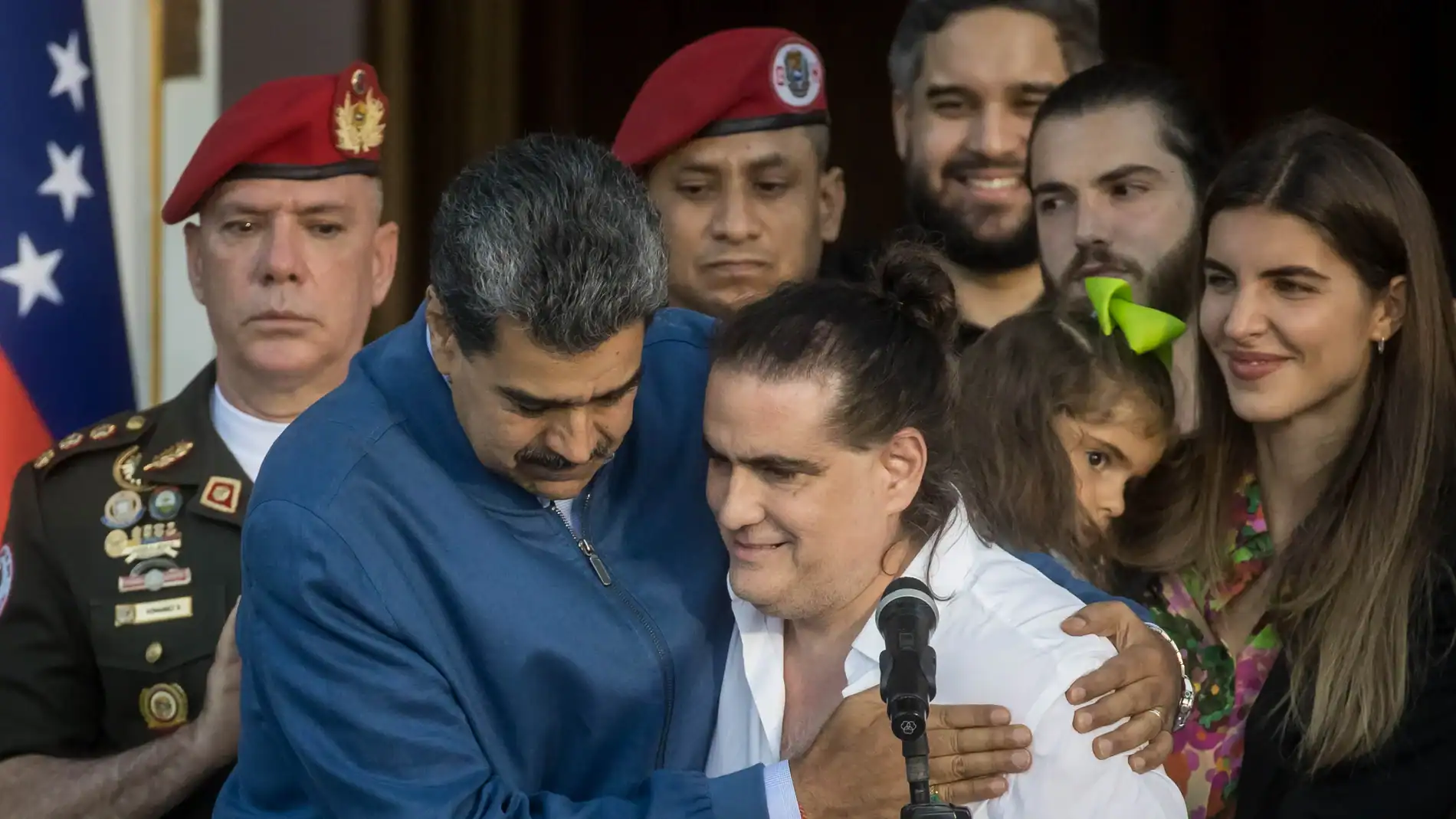
The man who Maduro fought tooth and nail to bring home in 2023 has now been handed back to the United States by Maduro’s own former vice-president. Alex Saab’s deportation is the single sharpest signal yet that Delcy Rodríguez is rebuilding Venezuela’s relationship with Washington on the corpse of the political project she once defended.
What did Venezuela formally announce?
Venezuela’s Administrative Service for Identification, Migration, and Foreigners (SAIME) confirmed in an Instagram statement on Saturday that “the Government of the Bolivarian Republic of Venezuela reports the deportation of the Colombian-nationality citizen Alex Naim Saab Morán, carried out on May 16, 2026, in compliance with the regulatory provisions of Venezuelan migration law.” The statement framed the move as a deportation, not an extradition. Venezuelan law prohibits extradition of its nationals; classifying Saab only as “Colombian citizen” sidestepped that legal obstacle. The Rio Times, the Latin American financial news outlet, reports that the language matters because it places the transfer inside domestic rules while still acknowledging Saab’s US criminal exposure.
Saab was taken from the El Helicoide intelligence prison in Caracas to Fort Tiuna in the days before the flight, then transferred to the international airport at Maiquetía. The Gulfstream N550GA entered Venezuelan airspace and departed for Miami within hours. DEA agents escorted Saab from the aircraft on arrival at Opa-locka. He is expected to appear before a federal district court for arraignment on bribery, money-laundering, and corruption charges tied to the CLAP food-import programme.
Who is Alex Saab and why does he matter?
Saab, 54, is a Colombian-born businessman who became one of the most important financial operators inside Nicolás Maduro’s inner circle. US officials have described him as Maduro’s “bag man,” accusing him of orchestrating contract schemes that diverted hundreds of millions of dollars from Venezuelan state resources. The most prominent allegation centres on the CLAP food-import programme, which Maduro launched in 2016 to deliver subsidised food boxes to Venezuelan households amid acute scarcity. US prosecutors allege Saab and partners set up shell companies that secured CLAP contracts at inflated prices, bribed officials, and laundered proceeds through international banking circuits.
Saab was first arrested in June 2020 in Cape Verde during a refuelling stop on a private jet bound for Iran on what Caracas described as a humanitarian sanctions-evasion mission. Cape Verdean authorities extradited him to the United States in October 2021. He was held in Miami on bribery and money-laundering charges. In December 2023, President Joe Biden agreed to free Saab in exchange for the release of ten US citizens detained in Venezuela and the surrender of a fugitive defence contractor. Saab returned to Caracas, was celebrated as a national victory by Maduro and Rodríguez, and was appointed Minister of Industries and National Production in October 2024. He held that post until Rodríguez merged the ministry into the Ministry of National Commerce on January 17, 2026, two weeks after Maduro’s capture.
Why did Delcy Rodríguez authorise the handover?
The political logic centres on Rodríguez’s repositioning. After Maduro’s capture on January 3, she took over as acting president and immediately began dismantling the inner circle most exposed to US criminal investigations. Saab’s dismissal in January was the first signal. His deportation in May is the operational confirmation. Venezuelan media outlet 3eraVoz reported the move forms part of broader negotiations between Washington and the interim government in Caracas, which already include the renewal of the Chevron-PDVSA joint venture in February, the April 14 OFAC General License 57 authorising banking transactions with the BCV and three other state banks, and the IMF and World Bank’s return to engagement with Caracas.
The cost to the Chavista narrative is severe. Rodríguez personally celebrated Saab’s 2023 return as “a resounding victory” for Venezuela over US “lies and threats.” Her three-year reversal is the clearest evidence that the post-Maduro political settlement no longer treats sanctions-era loyalties as binding constraints. Cuban state TV host Michel Torres Corona, an ideological ally of the Cuban Communist Party, reacted with public indignation: “Either Maduro is corrupt or the Rodríguez siblings are traitors.” The framing inside chavista circles is now public, and its terms are no longer reconcilable.
The Alex Saab case in numbers
| Indicator | Reading |
|---|---|
| Date of handover | May 16, 2026 |
| Aircraft | Gulfstream N550GA |
| Route | Maiquetía to Opa-locka, Miami-Dade |
| Saab’s age | 54 |
| First arrest | June 2020 (Cape Verde) |
| First US extradition | October 2021 |
| Biden release date | December 2023 (prisoner swap) |
| Industry Minister tenure | Oct 2024 to Jan 17, 2026 |
| Days between Maduro capture and Saab arrest | 32 (Jan 3 to Feb 4) |
Saab also carries a separate Italian money-laundering conviction tied to the purchase of a luxury apartment in Rome. His Italian lawyer Luigi Giuliano said on Saturday he does not handle Saab’s US cases and could not confirm the deportation. His Miami-based attorney, Neil Schuster, declined to comment. The Justice Department did not immediately issue a public statement.
What does Saab’s testimony mean for Maduro’s trial?
Maduro and Cilia Flores are detained at the Metropolitan Detention Center in Brooklyn and face trial in the Southern District of New York on four counts including narcoterrorism conspiracy, cocaine-importation conspiracy, machine-guns and destructive-devices possession, and a fourth offence under the superseding indictment unsealed January 3. They have pleaded not guilty. The next hearing is scheduled for June 30. The original 2020 indictment was expanded to include Diosdado Cabello Rondón, former Interior Minister Ramón Rodríguez Chacín, Maduro’s son Nicolás Maduro Guerra, and Tren de Aragua alleged leader Hector Rusthenford Guerrero Flores.
Saab is identified in the original 2020 indictment as “Co-Conspirator 1,” alleged to have helped set up shell companies that bribed a Maduro-aligned governor in exchange for CLAP contracts to import food boxes from Mexico at inflated prices. His direct testimony would substantially strengthen the prosecution’s narrative of state-backed corruption, particularly because he was inside the inner circle on the financial side. Maduro’s defence has already complained that US sanctions prevent the regime from financing legal counsel; Saab’s cooperation would amplify the asymmetry in evidentiary terms.
What should investors and analysts watch next?
- Saab’s arraignment. The Miami federal district court hearing will signal whether he is being treated as a defendant facing immediate prosecution or as a cooperating witness with negotiated terms.
- Cabello, Maduro Guerra, Niño Guerrero. The other four named indictment defendants remain in Venezuela. Saab’s transfer raises the question of whether Rodríguez extends the same logic to them.
- OFAC perimeter. Watch whether the US Treasury widens General License 57 or issues additional licences for energy and banking transactions as a quid pro quo for Caracas cooperation.
- Chevron-PDVSA and Erebor. The bilateral architecture being built around Venezuela’s reopening now has political confirmation. Subsequent commercial deals will be priced inside it.
- Cuba comparison. Rodríguez handing over Saab arrives as Cuba’s regime considers a US $100 million aid offer. The contrast between Caracas’s pragmatism and Havana’s resistance is sharpening.
More: Latin America news in English, every day from The Rio Times.
Connected Coverage
This story sits at the centre of our Venezuela transition cluster. The Maduro capture on January 3 is detailed in our political transition tracker. The Erebor banking lifeline is framed in our Erebor-Venezuela banking readout. The OFAC General License 57 framework is in our sanctions-easing note. The Chevron-PDVSA renewal is in our Chevron renewal analysis. The PDVSA drilling-contract pitch is in our PDVSA contract readout.
Reported by The Rio Times — Latin American financial news. Filed May 17, 2026.
This article was produced by The Rio Times’ automated newsroom system. How we use AI · Report an error · Editorial responsibility: Matthias Camenzind, Editor-in-Chief
In depth
Frequently Asked Questions
Was this a deportation or an extradition?
Legally, Venezuela called it a deportation. Saab holds Colombian citizenship, and Venezuelan law prohibits extradition of its nationals. The deportation framing allowed Rodríguez to transfer Saab without acknowledging Venezuelan citizenship. In practice, the result is identical to extradition: Saab arrives in US federal custody to face the original 2020 indictment.
Will Saab testify against Maduro?
Likely, although no formal cooperation agreement has been announced. US prosecutors have flagged Saab as Co-Conspirator 1 in the original indictment. Any plea agreement would almost certainly include cooperation terms. His direct knowledge of financial flows inside the Maduro inner circle makes him a substantial evidentiary asset.
What is the CLAP programme?
The Comités Locales de Abastecimiento y Producción were Maduro-era subsidised food-box distributions launched in 2016 during Venezuela’s worst scarcity. US prosecutors allege Saab and partners diverted hundreds of millions of dollars through inflated import contracts. The programme became one of the central pillars of allegations against the Maduro government in US courts.