Bolivia Sends 3,500 Troops as Protesters Demand President Resign
Key Facts
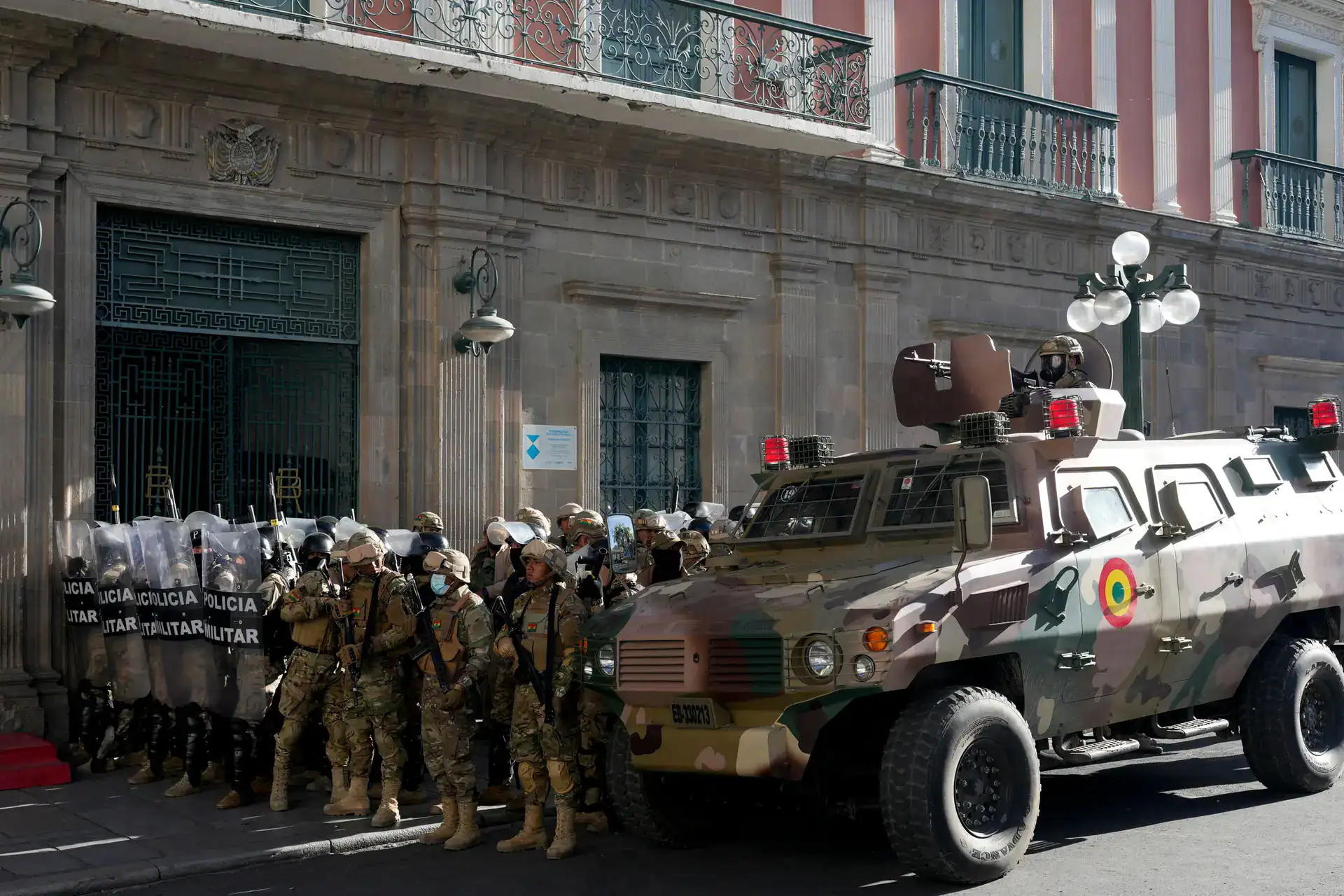
—The operation. Bolivian police and armed forces launched joint operation “Corredor humanitario” on Saturday May 16, deploying 2,500 police agents and 1,000 soldiers to clear main blockaded roads in the Andean zone after eleven days of pressure.
—The trigger. Three deaths attributed to road closures, including a 56-year-old tourist from Belize, after ambulances and emergency vehicles were blocked from reaching medical care.
—The economic cost. The National Chamber of Industries estimates daily losses of $50-60 million. Roughly 5,000 heavy trucks stranded carrying fuel, livestock, and soy export shipments between La Paz, Cochabamba, and Oruro.
—The coalition against Paz. The Túpac Katari peasant federation, Central Obrera Boliviana (COB), Ponchos Rojos indigenous movement, mining cooperatives, and Evo Morales followers, who have begun a 190-kilometre march toward La Paz from Caracollo (Oruro).
—The international response. Eight Latin American countries signed a joint declaration on Friday addressing the “humanitarian situation” in Bolivia as the country marks six months under Paz’s government.
Six months after Rodrigo Paz took office promising to fix Bolivia’s economy, the army is in the streets clearing roadblocks while peasant federations, miners, and the indigenous Ponchos Rojos demand his resignation. The political question is no longer whether Bolivia faces a crisis. It is whether the constitutional order can hold through the next two weeks.
What did Bolivia’s government do on Saturday?
The Bolivian Police and Armed Forces launched joint operation “Corredor humanitario” on Saturday morning, deploying approximately 2,500 police agents and 1,000 military personnel to clear the main blockaded roads in the Andean zone. Police commander Mirko Sokol and Armed Forces commander Víctor Hugo Balderrama personally supervised the deployment. Sokol said the operation has “the sole purpose of clearing” the roads “so that food, medicine, ambulances, and medical oxygen can enter” La Paz, the seat of government. The Rio Times, the Latin American financial news outlet, reports that the use of military force to break domestic protests marks the most aggressive state response under Paz’s six-month-old administration.
The Túpac Katari peasant federation and Central Obrera Boliviana had spent eleven days choking the approaches to La Paz, with at least 22 simultaneous blockade points reported on Wednesday by the Bolivian Roads Administration (ABC). The blockades cut off transport to Peru and Chile, generated shortages of food and medical supplies including hospital oxygen, and produced three deaths attributed to delayed emergency response. Among them: Anna Enns, a 56-year-old Belizean tourist who died in Desaguadero, and a 40-year-old woman whose ambulance from Guanay was prevented from reaching La Paz.
How did Bolivia get here?
Rodrigo Paz took office in November 2025 after almost 20 years of governments led by the Movimiento al Socialismo (MAS), first under Evo Morales and then under Luis Arce. He inherited an economy with 14% year-on-year inflation, dollar shortages, fuel scarcity, and the worst macroeconomic position in four decades. His response was a textbook shock programme: ending the fuel subsidy that had operated for more than twenty years, cutting public spending, seeking external financing, raising the minimum wage 20%, and authorising banks to return dollar deposits frozen since 2023.
The fragmentation surfaced almost immediately. Teachers struck for salary increases. Transport workers blocked roads over poor-quality diesel that damaged more than 10,000 vehicles. Amazon-region indigenous groups protested a land-conversion law, which Paz formally repealed this week. The COB, historically aligned with MAS governments, abandoned its salary demand and joined the calls for outright resignation. The Túpac Katari peasant federation built a campaign without specific demands beyond Paz’s departure.
Where does Evo Morales fit?
Government spokesman José Luis Gálvez has named former president Evo Morales as the principal organiser, claiming the protests are “financed from the Trópico de Cochabamba” and form part of “a macabre plan” allegedly tied to drug-trafficking interests. Morales, who governed from 2006 to 2019, is currently cornered in his Chapare stronghold to avoid an outstanding arrest warrant on trafficking-related charges involving a minor. He has rejected the accusations and posted on X that “the indignant ones are moved by their social conscience and their anger at a government that betrayed its voters from day one.” A 190-kilometre march of Morales supporters from Caracollo (Oruro) is now under way toward La Paz.
Analysts caution against the single-villain narrative. Journalist Rafael Archondo told El Comercio that the protests cannot be attributed only to evismo, noting that the COB and the Túpac Katari federation maintain independent agendas. Sociologist Luciana Jáuregui has described Morales as functioning narratively as “a ghost that mobilises the fears of traditional middle classes” rather than as an actual coordinating centre. The recent subnational elections did show Morales retains regional electoral influence, particularly in Cochabamba.
The Bolivia crisis at a glance
| Indicator | Reading |
|---|---|
| Days of road blockades | 11+ |
| Joint operation deployment | 2,500 police + 1,000 soldiers |
| Reported daily economic losses | $50-60 million |
| Trucks stranded | ~5,000 |
| Deaths linked to blockades | 3 |
| April inflation (YoY) | 14% |
| Length of Morales-aligned march | 190 km (Caracollo to La Paz) |
| Latin American countries signing joint statement | 8 |
Tourism losses run to 150 million bolivianos since the start of the protests, according to the La Paz transport chamber. Truck operators in the Cámara Departamental de Transporte estimate daily losses above $720,000 for their sector alone. Hospitals in La Paz and El Alto have reported critical shortages of medical oxygen.
What does Paz say, and what does his vice-president say?
Paz convened dialogue this week and signalled openness to negotiate. Public Works minister Mauricio Zamora, considered his closest political ally, said flatly: “The President is not going to resign. What do they want, to remove him by force? That is an antidemocratic measure. This is conspiracy.” Paz himself has framed the country’s social fabric as suffering from a “Stockholm syndrome” after twenty-five years of MAS governments, saying citizens “keep looking for their kidnappers” rather than embracing new freedoms. He has also warned that destabilisation attempts will face “legal consequences.”
Vice-President Edmand Lara has positioned himself differently from Paz. He told media that “the resignation of the president is not the solution” but also distanced himself from harder government messaging, stating that Paz is “not my enemy” and that the executive should listen to demands. Some blockades have explicitly demanded Lara assume the presidency and call elections, an option Lara himself has not endorsed. The internal executive distance is one of the most under-covered fault lines in the crisis.
What should investors and analysts watch next?
- Outcome of “Corredor humanitario.” Whether the joint operation clears roads without producing fatalities defines whether the government recovers operational authority or loses it.
- Arrival of the Morales march. The 190-kilometre advance from Caracollo is timed to reach La Paz next week. Its scale on arrival will signal whether the Chapare base can still mobilise nationally.
- Hydrocarbons and Mining Laws. Paz’s ten-law economic package, including the Hydrocarbons Law and Mining Law, is the structural prize for international capital. Whether Congress moves on it during the crisis matters for lithium, gas, and gold investors.
- Vice-President Lara’s posture. Any further distance between Paz and Lara could trigger a constitutional handover scenario, even without resignation.
- Regional response. The eight-country joint declaration is the first multilateral signal. Whether Brazil, Argentina, Chile, or Peru escalate to formal calls for dialogue or sanctions matters for regional risk pricing.
More: Bolivia news in English, every day from The Rio Times.
Connected Coverage
This story sits inside our running Andean political cluster. Paz’s November 2025 inauguration and economic platform are detailed in our Paz-takes-office readout. The Bolivian lithium investment landscape is framed in our lithium and mining-law analysis. The Evo Morales legal situation is in our Morales legal tracker. The broader Andean political map sits in our regional shifts readout.
Reported by The Rio Times — Latin American financial news. Filed May 16, 2026.
This article was produced by The Rio Times’ automated newsroom system. How we use AI · Report an error · Editorial responsibility: Matthias Camenzind, Editor-in-Chief
Frequently Asked Questions
Is President Paz going to resign?
The government has categorically rejected resignation. Public Works minister Mauricio Zamora called the demand “antidemocratic” and framed it as conspiracy. Paz himself has refused to negotiate his departure but has invited dialogue on substantive demands. A forced resignation would require either congressional impeachment, sustained street pressure beyond current levels, or military intervention, none of which is currently in play.
Why are the protests happening now?
Three factors converge. Paz’s shock-therapy economic reforms hit traditional MAS-aligned constituencies hardest. Evo Morales remains politically active despite an arrest warrant and is using his Chapare base to pressure the government. The recent subnational elections showed Morales retains regional electoral relevance, which has emboldened mobilisation. The combination produced both organic discontent and organised political pressure.
What is at stake for foreign investors?
Bolivia holds the world’s largest lithium reserves, significant natural gas deposits, and growing gold output. The Paz Hydrocarbons Law and Mining Law are designed to attract foreign investment after two decades of state-led management. Political instability threatens both passage of those laws and the operational environment for existing concessions. A reversion to MAS-style management would materially change the investment calculus.