Key Facts
— — Chinese President Xi Jinping broke his public silence on the Hormuz crisis Monday, using a rare phone call with Saudi Crown Prince Mohammed bin Salman — their first in over three years — to call for immediate ceasefire and full restoration of Hormuz transit.
— — The April 7 US-Iran two-week ceasefire expires tomorrow, April 22, with Tehran signaling it will not send a delegation to planned Islamabad talks after the US seized an Iranian cargo ship carrying what Trump described as a Chinese “gift.”
— — Hormuz shipping currently runs at approximately 5% of pre-war volume, with Iran charging up to US$2 million per vessel for transit; Latin American exposure concentrates in Brazilian fertilizer imports, Panama Canal freight routing, and oil-exporter revenues across Colombia, Ecuador, and Venezuela.
— Deep Dive
— For the complete picture, see our guide: Iran War and Hormuz Crisis 2026.
The Hormuz diplomacy timeline has compressed into a final 24-hour window. Chinese President Xi Jinping’s decision Monday to personally intervene on the Strait of Hormuz crisis marks the most significant diplomatic escalation since the April 7 US-Iran ceasefire was announced. The two-week truce expires Wednesday, April 22.
The Rio Times, the Latin American financial news outlet, reports that three diplomatic tracks are running in parallel heading into the expiration: Xi’s personal intervention through Saudi Arabia; the stalled Islamabad peace talks mediated by Pakistan; and the US naval blockade of Iranian ports that Tehran cites as disqualifying for further negotiation.
The Latin American exposure runs through three primary channels: Brazilian fertilizer imports, the Panama Canal freight routing that has absorbed the global shipping disruption, and oil-exporter sovereign revenues tied to Brent prices that have remained elevated through the conflict.
Xi’s Intervention: The Rare Call
Xi’s April 20 phone call with Saudi Crown Prince Mohammed bin Salman was the Chinese leader’s first public statement on Hormuz since Iran’s February 28 closure and his first direct conversation with the Saudi de facto ruler in more than three years. The Chinese Foreign Ministry quoted Xi as saying the strait “should remain open to normal transit, which is in the common interest of regional countries and the international community.”
The routing of the intervention through Saudi Arabia is diplomatically significant. China brokered the 2023 Iran-Saudi rapprochement and retains credibility with both capitals that neither Washington nor European governments can match. Beijing, the world’s largest importer of crude oil and LNG through the Gulf, has concrete economic motivation to see Hormuz reopened.
The Saudi side has not publicly disclosed details of the call. Riyadh has been balancing relations with Washington, Tehran, and Beijing throughout the Iran war, consistently stating that regional stability is essential for global energy security while avoiding explicit alignment with either combatant.
Trump’s Posture: “Under No Pressure”
President Trump’s Monday remarks were calibrated to project maximum leverage rather than compromise. “We’re in a very, very strong negotiating position,” Trump told reporters, adding that he was “under no pressure whatsoever” to make a deal. He said he would bomb Iranian bridges and power plants if no agreement materializes, framing the threat as “not my choice but it will also hurt them.”
The hardline posture sits uneasily with the operational reality. The US Navy seized the Iranian vessel Touska over the weekend, saying it had failed to comply with warnings and was attempting to evade the blockade of Iranian ports. Trump characterized the cargo as a Chinese “gift” to Tehran, though specifics have not been made public.
The blockade itself is the central Iranian grievance. Iranian Ambassador to Pakistan Reza Amiri Moghadam wrote on social media Sunday that “as long as the naval blockade remains, faultlines remain,” making clear that Tehran views continued US interdiction of Iranian shipping as incompatible with the ceasefire framework.
The Islamabad Track
The first round of Islamabad talks, held April 11-12, ended after 21 hours without agreement. The 300-member US delegation led by Vice President JD Vance and special envoys Steve Witkoff and Jared Kushner met a 70-member Iranian team led by parliamentary speaker Mohammad Bagher Ghalibaf and Foreign Minister Abbas Araghchi.
Vance emerged from the first round saying the failure was “bad news for Iran much more than it’s bad news for the United States of America.” Ghalibaf countered that Iran had raised “forward-looking initiatives” but the US side had failed to gain the Iranian delegation’s trust after experiences of the two previous wars.
The second-round status was uncertain Tuesday morning. Pakistan, led by Prime Minister Shehbaz Sharif, Foreign Minister Ishaq Dar, and Field Marshal Asim Munir, has prepared for multi-day talks. Reuters reported Tuesday citing Iranian state TV that no Iranian delegation has departed for Islamabad, contradicting international media reports that a team was traveling.
Hormuz Diplomacy Faces Its Operational Reality
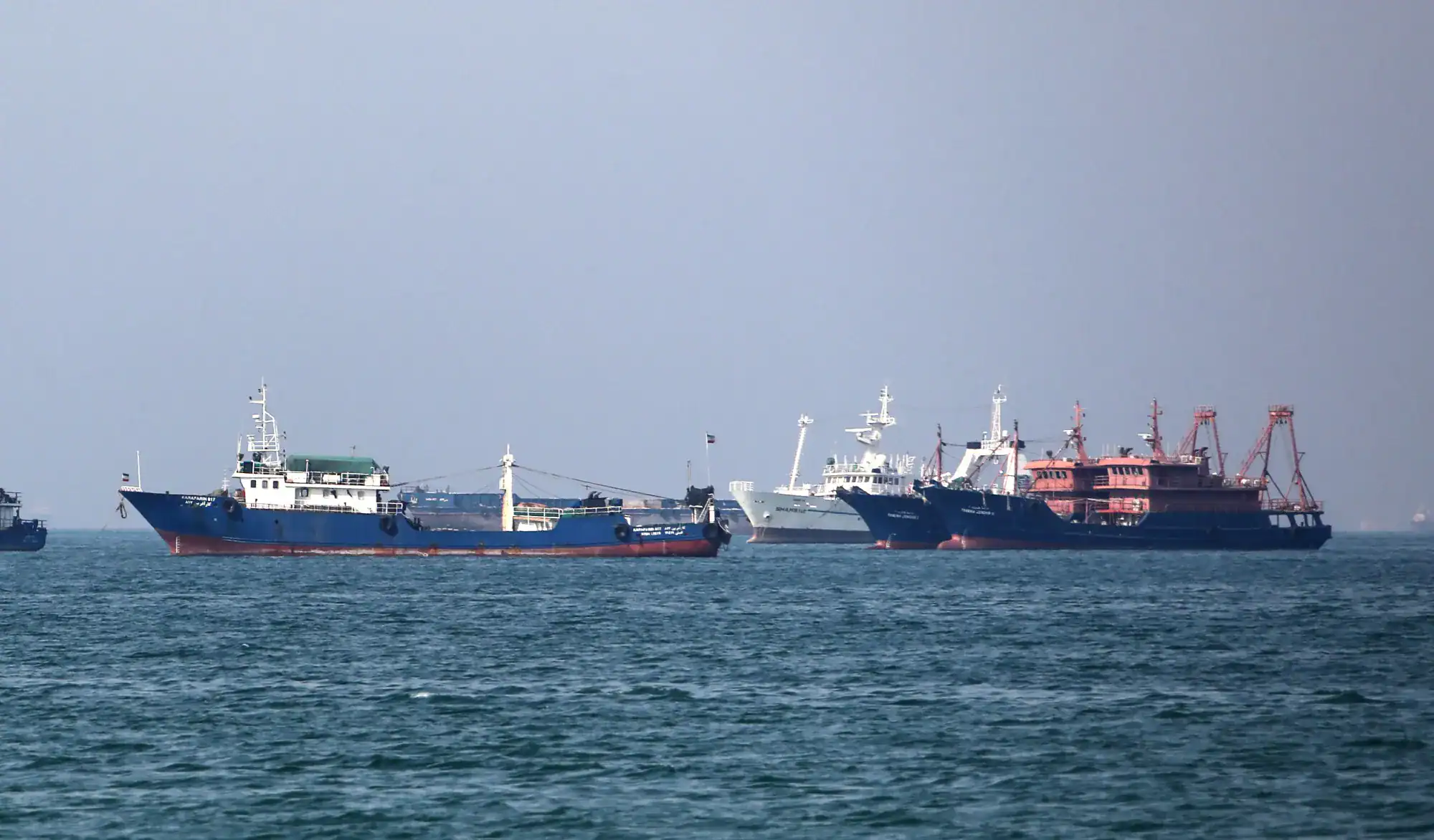
The operational state of the strait is worse than public statements suggest. Maritime tracking data shows only about 5% of pre-war shipping volume is currently transiting Hormuz. Iran has been charging up to US$2 million per vessel for passage, with Iran and Oman reportedly planning to earmark the fees for post-war reconstruction.
The April 17 Iranian announcement that commercial passage would reopen during the Lebanon truce was immediately undercut when Trump clarified that the US blockade of Iranian ports remained in effect. Iran cancelled the reopening, and on April 18 Tehran again formally closed the strait. IRGC guidance specifies that transit is prohibited for any vessel bound to or from US, Israeli, or UK ports.
Roughly 20% of global oil traffic normally passes Hormuz. The sustained blockade has pushed Brent oil prices to elevated levels, with related consequences for fertilizer, natural gas, and shipping-rate transmission into commodity markets worldwide.
The Latin American Transmission
Latin America’s exposure runs through three documented channels. Brazilian fertilizer imports run 41% through Hormuz according to Agrinvest data, with Iran alone supplying 17% of Brazil’s urea; as Rio Times coverage of Petrobras’s fertilizer revival has documented, Brazil’s planned UFN-III nitrogen facility will not come online until 2029, leaving the country exposed through the current agricultural planting window.
The Panama Canal is the second transmission channel. As Rio Times’s Panama Canal 2026 Guide documents, the Hormuz disruption has reshuffled global LNG routing, with carriers preferring Cape of Good Hope over the now-saturated Panama route. Canal FY 2025 revenues hit US$5.7 billion with 13,404 vessel transits, but LNG segment volume remains 73% below pre-drought levels because of the routing shift.
The oil-exporter revenue channel benefits Brazil, Colombia, Ecuador, Venezuela, and Mexico’s Pemex asymmetrically. Brent prices elevated above US$90 support Petrobras earnings and Ecopetrol cash flow, but the inflation pass-through is compressing central bank flexibility across the region. As Rio Times coverage of the Brazilian Focus Bulletin has shown, Hormuz-driven food and energy prices have pushed 2026 IPCA projections to 4.80% for a sixth consecutive week.
What to Watch in the Next 24 Hours
First, whether an Iranian delegation boards the flight to Islamabad. The Al Jazeera reporting line from Tuesday morning was that Iran was unsure about joining despite the US delegation already in place. Pakistan has committed to mediating multi-day talks if Tehran attends.
Second, any signal on whether the US blockade will be relaxed as a gesture to bring Iran to the table. The blockade is the single issue Iran has publicly defined as disqualifying; any measured US concession would reopen the negotiation space.
Third, the Xi-MBS call follow-through. If Riyadh publicly endorses the Xi position within 48 hours, the Chinese intervention gains multilateral weight; if Saudi silence persists, the call becomes a Chinese domestic signal more than a diplomatic inflection. For Latin America, the next 24 hours will determine whether the Hormuz diplomacy stabilizes the oil, fertilizer, and freight corridors that have anchored the region’s 2026 economic risk or whether the ceasefire expiration unleashes a second leg of the commodity-price shock.
This article was produced by The Rio Times’ automated newsroom system. How we use AI · Report an error
Read More from The Rio Times