Colombia Investment Falls to 16% of GDP, Lowest in Decades
Key Facts
—The headline. Investment in Colombia now stands at roughly 16% of GDP, against 23% a decade ago, per Corficolombiana analysis cited by Bloomberg Línea on May 14.
—The diagnostic. Drivers include capital cost rising on higher risk premium, tax burden, regulatory uncertainty in infrastructure, energy, housing, hydrocarbons, and physical security deterioration.
—The data point. Q1 2026 GDP releases today, May 15, by DANE. Bancolombia projects 2.5% annual growth, Corficolombiana 1.9%, with investment expected to contract again.
—The political calendar. First-round presidential vote is May 31, with Iván Cepeda leading Invamer at 44.3%, followed by Abelardo De La Espriella at 21.5% and Paloma Valencia at 19.8%.
—The fiscal frame. Corficolombiana estimates a 2026 fiscal deficit of 6.8% of GDP. César Pabón calls for a $65 trillion-peso adjustment over the next administration to restore the fiscal rule.
Reactivating Colombia investment is the single biggest economic task waiting for the next president. The collapse from 23% of GDP a decade ago to roughly 16% today is structural, not cyclical, and the three leading candidates are running on visions of recovery that diverge sharply on tax policy, hydrocarbons, and the role of the state.
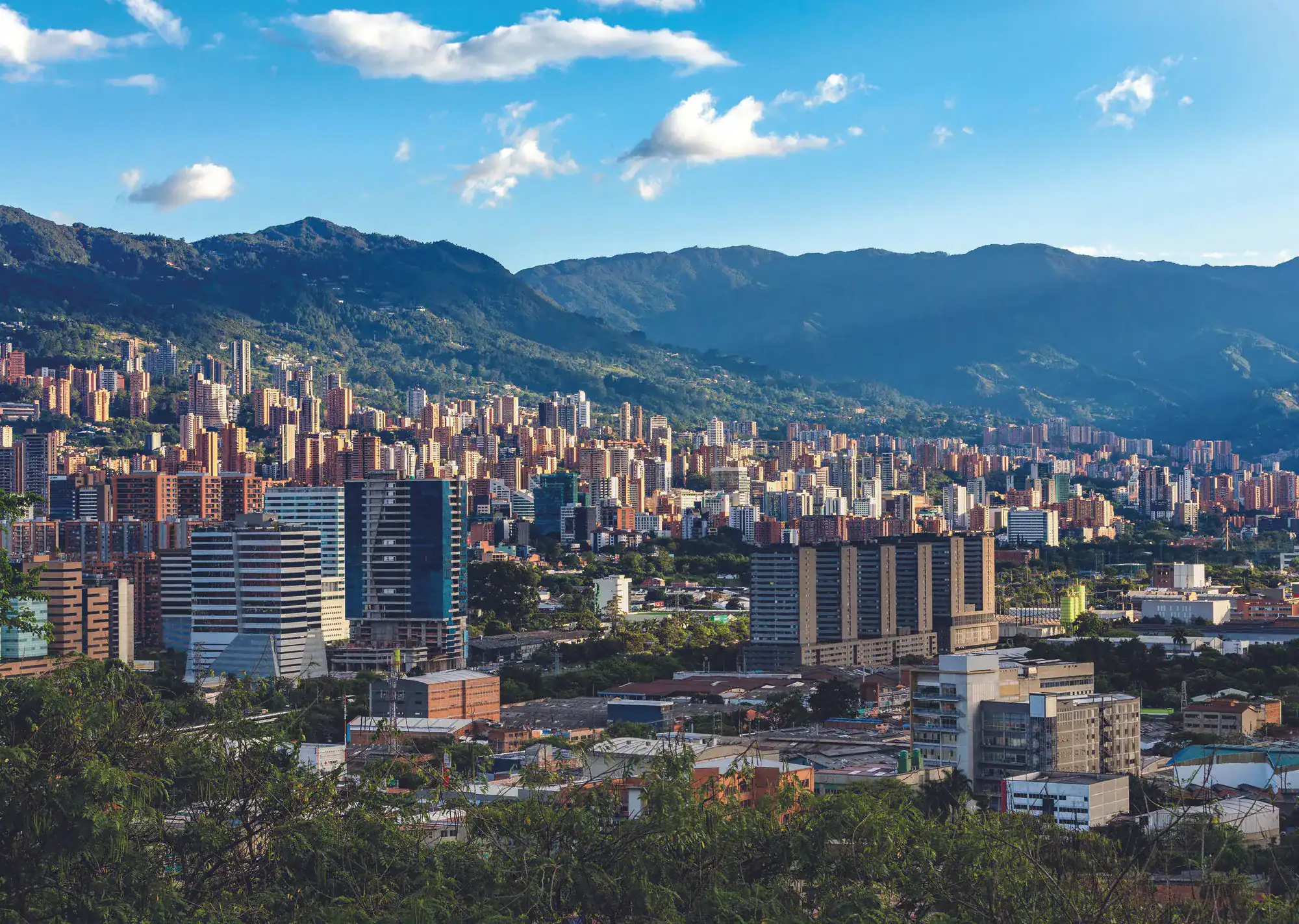
How bad is the investment collapse?
Colombia investment as a share of GDP has fallen to roughly 16%, against 23% reached a decade ago, according to a Corficolombiana analysis cited by Bloomberg Línea. With a persistently low investment rate, potential growth is unlikely to exceed 2.5%, limiting productive modernization and reducing the capacity to close income gaps relative to regional peers. César Pabón, director of Economic Research at Corficolombiana, calls this the principal brake on Colombian growth and a defining task for the August 7 administration handover.
The Rio Times, the Latin American financial news outlet, notes that Corficolombiana’s diagnostic identifies five drivers: substantial increase in the cost of capital, fueled by risk premia above the regional average; a heavier tax burden; regulatory uncertainty in infrastructure, energy, housing, and hydrocarbons; and a significant deterioration in physical security. La Silla Vacía data shows that since the 2022 tax reform made the wealth tax permanent and more onerous, 28% of taxpayers reporting assets above 11 billion pesos stopped declaring in Colombia or transferred capital abroad.
What does today’s Q1 GDP release add?
DANE publishes the first-quarter 2026 GDP report today, Friday May 15. Financial-sector consensus expects roughly 2.5% annual growth. Laura Clavijo, head of Economic Research at Bancolombia, projects “moderate growth of 2.5% real annually,” with internal demand as the main pillar and household consumption resilient despite inflation and monetary pressures. Investment, by contrast, “would have shown an important contraction, similar to what we have seen in prior quarters.”
César Pabón’s call is more cautious: a Q1 print of 1.9%, with the implied trajectory pulling full-year growth below 1.5% if the pace holds. Analysts attribute the deceleration in part to the central bank’s contractionary cycle, with 200 basis points of rate hikes between January and March 2026 to contain inflation pressures. Inflation rose to 5.68% in April from 5.10% in December, with Corficolombiana attributing 88.2% of the move to indexation and demand factors and only 11.8% to supply shocks.
What do the three leading candidates propose?
| Candidate | Fiscal approach | Hydrocarbons | Growth target |
|---|---|---|---|
| De La Espriella | 70 trillion-peso adjustment; reduce state by 1/4; eliminate two rules per new one | Fracking pilots, Ecopetrol depoliticization | 7% annual |
| Valencia | Reduce taxes on PYMES; regional free trade zones; expand FTAs with Asia | Reactivate exploration, support fracking | 5% GDP, 6% infrastructure/energy |
| Cepeda | Progressive taxation, wealth tax expansion, Republican Austerity Law | Continuation of Petro transition policy | Not specified; social investment focus |
Abelardo De La Espriella, of the Defensores de la Patria movement, frames his program around the proposition that “the state is too big, taxes are too high, and legal certainty is non-existent.” The 70 trillion-peso fiscal adjustment and the reduction of state size by a quarter form the centerpiece. His running mate is José Manuel Restrepo, former Finance Minister, reinforcing fiscal orthodoxy credentials. He proposes reforming public-private partnerships to expand concessions and infrastructure investment, plus a special regime for digital entrepreneurs with tax exemptions and zero-rate technology credit.
Paloma Valencia, candidate of the uribismo, shares the pro-market orientation with emphasis on reducing tax burden for small and medium enterprises, promoting regional free trade zones, and expanding free trade agreements particularly with Asia. She proposes converting the Foreign Ministry into a Foreign Trade Ministry. Her program promises to attract and unblock at least $2 billion annually in foreign direct investment, with growth targets of 5% GDP and 6% in infrastructure and mining-energy sectors. Valencia also proposes subsidizing 30% of the minimum wage for 12 months for companies hiring youth aged 18 to 28.
Iván Cepeda, of the leftist alliance, proposes progressive taxation with broader base, taxes on large fortunes, and reduced exemptions for large companies. The additional revenue would finance social programs and expanded public services. His program includes a Republican Austerity Law to reduce bureaucratic spending, formalization through expanded labor rights, strengthened Colpensiones, and a guarantee fund for credits up to 50 million pesos for 200,000 family microenterprises. Science and technology spending would rise to 1.5% of GDP with mandatory annual increases of 0.2 percentage points.
What do the polls show for May 31?
The latest Invamer poll, published by Noticias Caracol, shows Cepeda leading the first round with 44.3% intention, followed by De La Espriella at 21.5% and Valencia at 19.8%. In second-round simulations, Cepeda would win against either right-wing candidate: 51.2% to 46.6% against Valencia, and 54.6% to 42.6% against De La Espriella. The arithmetic structure suggests a runoff between Cepeda and either right-wing candidate, with a competitive second round most likely against Valencia.
The fiscal context behind these poll numbers is severe. Colombia’s 2025 fiscal deficit reached 6.4% of GDP, with Corficolombiana projecting 6.8% for 2026 and the gap widening absent corrective action. To return to compliance with the fiscal rule by 2028, the next government would need to make an adjustment equivalent to 3 to 4 points of GDP, representing the largest fiscal correction in modern history. The August 7 inauguration will frame whether that adjustment is gradual or front-loaded.
What should investors and analysts watch next?
- DANE Q1 GDP release today. A print below 2% confirms the deceleration trajectory and gives the candidates a fresh anchor for their reactivation pitches.
- May 31 first-round result. If De La Espriella outperforms polling, the market interprets it as a stronger fiscal-orthodoxy signal and the peso firms; a clean Cepeda first-round win is the bearish path.
- Foreign direct investment monthly print. Q1 IED data published by Banco de la República will show whether the wealth-tax-driven outflow is continuing or stabilizing.
- Banco de la República June rate decision. If inflation continues above 5.5% and the bank holds rates, the disinvestment cycle deepens; cuts would only land if disinflation accelerates.
- August 7 inauguration adjustment package. The first 100 days will signal whether the new government targets the 3-to-4 point GDP correction or postpones it, with the COLCAP and TES curves reflecting the decision.
More: Colombia news in English, every day from The Rio Times.
Frequently Asked Questions
When does the new Colombian president take office?
August 7, 2026. The first-round vote is May 31. If no candidate exceeds 50%, a runoff is held on June 21 between the top two finishers. The Invamer simulations point to a Cepeda-Valencia or Cepeda-De La Espriella second round.
Why is investment falling now?
The Corficolombiana diagnostic identifies five structural drivers: rising cost of capital from higher country risk premia, heavier tax burden after the 2022 reform, regulatory uncertainty across infrastructure, energy, housing, and hydrocarbons, and physical security deterioration. The Petro government’s hydrocarbons policy and tax reform are the most-cited proximate causes.
Is De La Espriella’s 7% growth target realistic?
Most economists view it as aspirational. To achieve 7% sustained growth, investment would need to rise above 25% of GDP, requiring a multi-year shift that even his proposed fiscal adjustment and regulatory streamlining would take years to deliver. The campaign function of the number is to signal ambition.
What is Cepeda’s economic model?
Continuation of the Petro framework with stronger redistributive emphasis. The wealth-tax expansion and progressive base broadening would shift the tax burden upward. Public investment would replace some of the private investment shortfall, financed in part by the Republican Austerity Law’s spending cuts.
Connected Coverage
Colombia investment intersects multiple Rio Times clusters. Ecopetrol’s worst quarter since the pandemic, partly tied to the same hydrocarbons regulatory frame the candidates dispute, is detailed in the Iran War 2026 guide. The external debt at 55% of GDP that constrains the next administration is covered in our LATAM Pulse on Colombian fiscal stress. The Catatumbo and Guaviare security developments add the physical-security dimension to the diagnostic, with broader regional security analyzed in our LATAM Pulse on regional security and markets.
Published May 15, 2026 / Updated May 15, 2026 / Dateline: Bogotá, Colombia
This article was produced by The Rio Times’ automated newsroom system. How we use AI · Report an error
In depth
Read More from The Rio Times