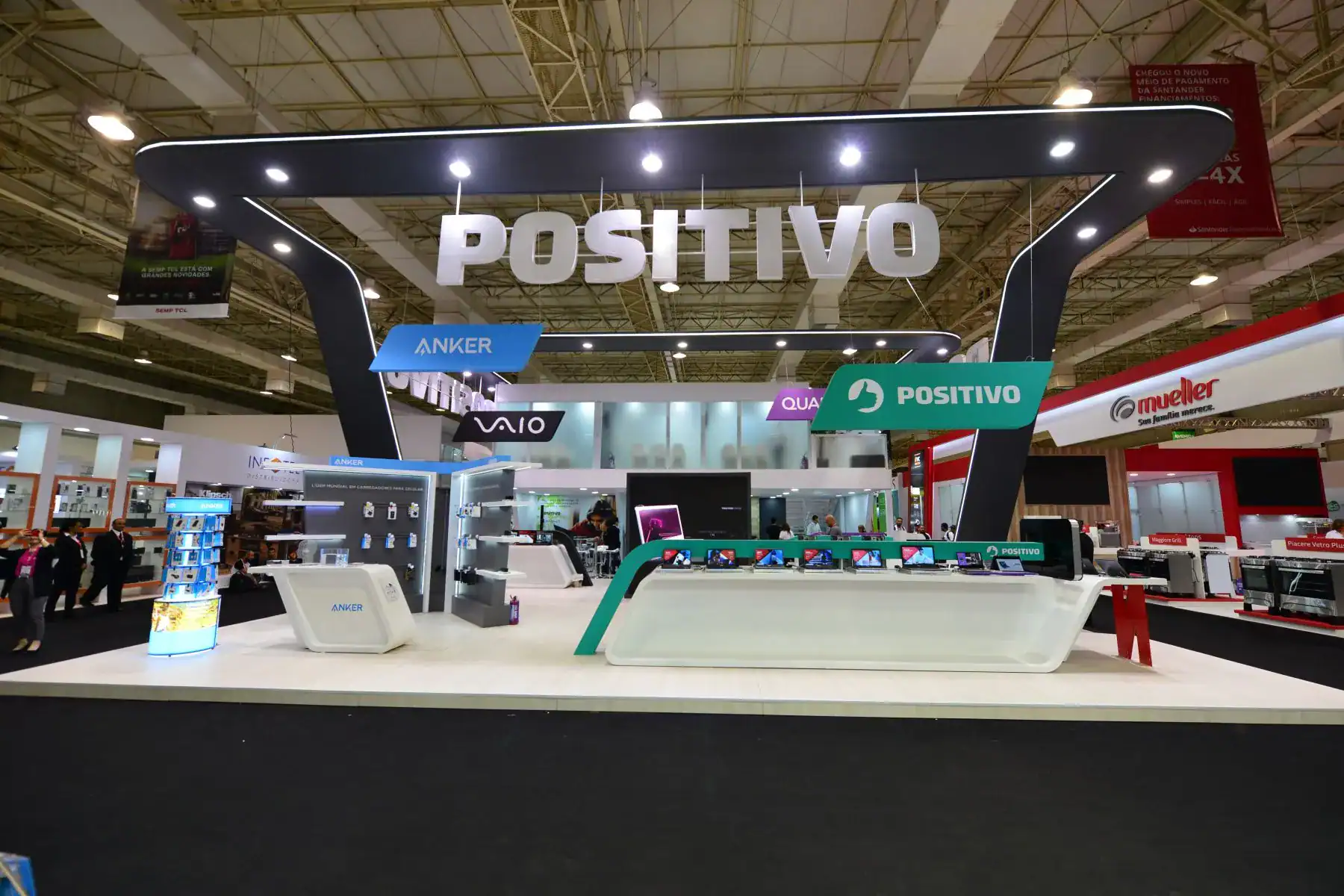
Brazilian PC manufacturer and IT-infrastructure company Positivo Tecnologia (B3: POSI3), one of Latin America’s largest computer manufacturers and a key supplier to Brazil’s public-sector technology market, reported Q1 2026 net loss of R$12.3 million ($2.4 million) — a 2.4 percent narrower loss than the R$12.6 million ($2.5 million) posted in Q1 2025, according to the earnings release published Tuesday May 13.
The operational story was stronger than the bottom line implies. EBITDA reached R$69.7 million ($13.8 million), up 31 percent year-on-year, with the EBITDA margin expanding 200 basis points to 9.4 percent. Net revenue grew 3.6 percent to R$741.4 million ($146.8 million), and gross revenue reached R$881 million ($174.5 million), up 4 percent.
The persistent net loss reflects two specific drags: the 26.5 percent year-on-year increase in net financial expenses to R$56.5 million ($11.2 million), driven by Brazil’s 15 percent Selic policy rate and FX volatility; and a higher working-capital allocation tied to anticipated memory-chip and SSD purchases amid global supply constraints. Operating cash flow reversed sharply to a positive R$91 million ($18 million) from negative R$52 million ($10.3 million) in Q1 2025 — a R$143 million ($28.3 million) swing.
Positivo reaffirmed full-year 2026 gross-revenue guidance of R$4.0-4.2 billion ($792-832 million), maintaining the strategic transformation thesis Itaú BBA initiated coverage on in 2024. Net debt fell 11.4 percent year-on-year to R$673.8 million ($133.4 million), with leverage compressing to 2.1x from 2.5x in Q1 2025.
Key Points
What Positivo Reported in Q1 2026
Positivo Tecnologia, listed on B3 as POSI3, is Brazil’s largest publicly traded computer manufacturer and one of Latin America’s most established technology brands. Founded in 1989 in Curitiba, Paraná, as Positivo Informática, the company is led by founder-CEO Hélio Bruck Rotenberg and operates factories in Ilhéus, Bahia and Manaus, Amazonas — with international presence in Argentina, Kenya, Rwanda, China and Taiwan.
The company develops, manufactures and sells computers, cell phones, tablets, smart home and office devices, servers, IT infrastructure solutions, payment machines and educational technologies. Brands in the portfolio include Positivo, Vaio, Infinix and the Positivo S+ managed-IT-services platform. The 2024 acquisition of Algar Tech MSP added managed-services scale to the ISS segment.
Q1 2026 net loss reached R$12.3 million ($2.4 million), 2.4 percent narrower than the R$12.6 million ($2.5 million) loss reported in Q1 2025. The comparison is structurally meaningful: as the Rio Times reported in May 2025, Q1 2025 had reversed a R$64.3 million ($12.7 million) profit from Q1 2024 — when legacy public-sector projects priced at weaker FX and Brazil’s 10.5 percent Selic at the time crushed margins.
EBITDA totalled R$69.7 million ($13.8 million), up 31 percent year-on-year. The EBITDA margin expanded 200 basis points to 9.4 percent, recovering toward the 11.6 percent margin Positivo had delivered in Q1 2024 before the 2025 downcycle. Management attributed the margin improvement to “greater participation of the IT infrastructure category in the revenue mix” — a business with above-portfolio-average profitability, per the earnings release.
Net revenue reached R$741.4 million ($146.8 million), up 3.6 percent year-on-year. Gross revenue was R$881 million ($174.5 million), up 4 percent. The Infrastructure, Services and Solutions (ISS) segment generated R$459 million ($90.9 million), up 4.6 percent, with servers up 186 percent year-on-year and Positivo S+ managed-IT services up 21 percent. Public-institution sales fell 46 percent — the structural pivot away from low-margin government legacy.
Gross margin compressed 110 basis points to 22.8 percent, reflecting higher participation of projects with lower unit margins but better operating leverage. The net effect at the EBITDA line was positive — EBITDA margin expanded despite gross margin compression — confirming the operating-leverage thesis underlying Positivo’s strategic shift.
The net financial result was a R$56.5 million ($11.2 million) expense, up 26.5 percent from R$44.7 million ($8.8 million) in Q1 2025. Management attributed the increase to the elevated CDI rate (tied to Brazil’s 15 percent Selic) and higher FX volatility. This financial-expense drag is the single largest factor preventing Positivo from converting EBITDA growth into net-income recovery.
Operating cash flow was the surprise of the quarter. Positivo generated R$91 million ($18 million) in cash from operations, reversing the R$52 million ($10.3 million) negative cash flow recorded in Q1 2025 — a R$143 million ($28.3 million) year-on-year swing. The reversal reflects working-capital discipline alongside revenue growth, even with anticipated memory-chip purchases adding inventory tension.
The balance sheet improved meaningfully. Net debt closed at R$673.8 million ($133.4 million), down 11.4 percent year-on-year. Leverage (net debt to EBITDA) compressed to 2.1x from 2.5x in Q1 2025, signalling improving balance-sheet capacity and reduced financial-risk premium.
In April 2026, Positivo announced a R$300 million ($59.4 million) BNDES credit line at below-CDI cost, with three-year disbursement to support the company’s technology-innovation plan. The financing strengthens long-term capex flexibility while reducing the marginal financial-expense burden — a strategically valuable structural-financing event that complements the operational recovery.
Starting Q1 2026, Positivo adopted a new business segmentation based on value proposition, dividing operations into four areas: ISS (Infrastructure, Services and Solutions); Payments Solutions; Smart Devices – Consumer; and Adjacent Businesses. The framework formalises the strategic shift away from pure-hardware reporting toward higher-margin services and B2B-led revenue.
Management maintained 2026 gross-revenue guidance at R$4.0-4.2 billion ($792-832 million). At Q1 run-rate, full-year revenue tracking implies upper-end achievement is realistic — provided the higher-margin ISS mix continues to scale. The Q2 print will be the first test of input-cost pass-through, as fertilizer-equivalent component-cost increases (memory and SSD globally constrained) start affecting the income statement.
Live Company IntelligencePositivo Tecnologia S.A — the full investor dossier
Valuation & profitability
Price & risk
$3.1852-wk high
$5.10
Revenue trend · 6y
Ownership
Dividend
Why Positivo Q1 Matters
Positivo’s Q1 print is the cleanest available proxy for the Brazilian B2B technology spending cycle and a structural test of the multi-year strategic shift from low-margin consumer-hardware retail toward higher-margin IT infrastructure and managed services. The 31 percent EBITDA growth alongside the persistent net loss tells a precise story: operations are recovering, but Brazil’s 15 percent Selic environment continues to compress bottom-line earnings.
The strategic context matters. As the Rio Times reported in July 2024, Positivo’s stock rallied nearly 30 percent that year as the company shifted from budget-PC retail toward corporate and government IT — a strategic pivot that has continued through 2025 and 2026 with the Algar Tech MSP acquisition and the ISS-focused reorganisation.
The Itaú BBA initiation in October 2024 framed the opportunity. As the Rio Times analysed at the time, Itaú BBA identified Positivo’s repositioning toward a R$117 billion ($23.2 billion) addressable market as a structural multi-year thesis, initiating coverage with a Neutral rating and a R$6.70 ($1.33) price target — implying 18 percent upside at initiation. The Q1 2026 result broadly validates the operating thesis underlying that coverage.
The servers +186 percent year-on-year and managed-IT +21 percent data points are the operational pulse. They confirm that Positivo’s repositioning is gaining real commercial traction in segments dominated globally by Dell, HP and Lenovo and locally by integrators with weaker manufacturing capacity. The 186 percent server growth specifically positions Positivo within Brazil’s accelerating cloud-and-AI-infrastructure spending cycle.
The public-sector contraction (-46 percent) is the other side of the strategic pivot. Legacy government contracts had historically dragged margins because of long lead times and FX-mismatched pricing. The deliberate reduction of public-sector exposure releases capital and capacity for higher-return private B2B opportunities — at the cost of short-term revenue. Q1 2026 confirms that the high-margin private business is growing fast enough to more than offset the public-sector contraction.
The Selic environment is the persistent headwind. Brazil’s 15 percent policy rate translates to elevated CDI-linked financial expenses for any Brazilian corporate with net debt — and Positivo’s R$673.8 million ($133.4 million) net debt is substantial relative to the R$1.57 billion ($311 million) implied market cap at Itaú BBA’s price target. Until Copom begins easing toward 12-13 percent, Positivo’s path to net-income breakeven remains constrained by financial-expense gravity.
The component-supply context adds a 2026 wrinkle. Global memory and SSD pricing has been constrained through 2025-2026 as AI-driven datacentre demand consumes wafer capacity. Positivo’s anticipated component purchases this quarter are defensive — locking in supply for Q2-Q4 deliveries — but they also represent a working-capital cost that compresses near-term cash flow. The Q2 print will reveal whether component-cost inflation pressures gross margins beyond the 110 basis-point Q1 compression.
The historical context provides perspective. Positivo posted R$195.8 million ($35.6 million) net profit in 2020 — its largest annual profit in a decade — riding the home-office wave. As the Rio Times reported in 2021, the company’s notebook-and-PC sales surged through the pandemic cycle. The strategic transformation since then has been about not repeating the dependence on a single hardware product cycle.
For foreign investors, Positivo is not directly accessible via a US ADR programme — exposure requires B3 direct access or Brazilian small-cap tech fund vehicles. The investment thesis rests on three pillars: the addressable-market repositioning that Itaú BBA initiated coverage on; the operating-leverage opportunity as ISS scales above corporate fixed costs; and the post-Selic-normalisation financial-expense compression that would convert EBITDA growth to net income.
The BNDES R$300 million ($59.4 million) credit-line announcement in April is more strategically important than the headline number suggests. BNDES funding at below-CDI rates is a structurally cheaper source of long-duration capital — directly addressing the financial-expense burden that is the single largest impediment to net-income recovery. The line’s three-year disbursement provides multi-year financing flexibility for technology-innovation capex.
The new four-segment structure (ISS, Payments, Consumer Devices, Adjacent Businesses) adopted in Q1 2026 is an investor-relations signal as much as an operational change. By formalising the strategic shift in reporting, Positivo is positioning for sell-side coverage expansion and clearer valuation framework around the higher-margin segments. The Q2 print will be the first quarter with the full new segmentation in clean comparability.
EBITDA inflection real. +31% YoY with margin +200 bps to 9.4%. Operating cash flow swung R$143M ($28M) positive. Operational recovery underway.
Strategic mix validated. Servers +186% YoY. Managed IT +21%. ISS segment growing while public-sector legacy intentionally contracting -46%.
Leverage compressing. Net debt -11.4%, leverage 2.1x vs 2.5x. BNDES R$300M ($59M) below-CDI line in April reduces marginal financing cost.
Selic easing optionality. Every 100 bps of Copom easing compresses Positivo financial expense. Net-income breakeven is a Selic-path call as much as an operational one.
Still loss-making. Five consecutive quarterly losses now. Q1 2024 was the last quarterly profit (R$64.3M / $12.7M). Recovery thesis multi-quarter.
Financial expense +26.5%. R$56.5M ($11.2M) drag absorbs all operational gains. 15% Selic + FX volatility are structural, not cyclical.
Gross margin compression. 22.8% vs 23.9% YoY. ISS mix improves operating margin but at lower gross margin — execution dependent on volume.
Component-cost wave coming. Memory/SSD inflation may not have fully hit P&L yet. Q2 will test pass-through capacity in a competitive Brazilian PC market.
Sell-Side View
| Bank | Stance | View on Positivo |
|---|---|---|
| Itaú BBA | Neutral | R$6.70 ($1.33) | Initiated Oct 2024. R$117B ($23.2B) addressable market thesis. Recurring-revenue pivot is the multi-year story. |
| Guidance consensus | Maintained R$4.0-4.2B ($792-832M) | Gross revenue guidance reaffirmed at the print. Q1 run-rate implies upper-end achievability. |
| Bull catalyst | Servers +186% YoY | Brazil AI/cloud infrastructure spending cycle is the structural tailwind underpinning the ISS thesis. |
| Bear focus | Selic + FX + components | Three concurrent macro headwinds keep net income negative despite operational recovery. |
Sell-side coverage on Positivo is concentrated rather than broad — Itaú BBA’s Neutral initiation in October 2024 is the most authoritative single voice, with the R$6.70 ($1.33) price target framing fair value in a multi-quarter recovery scenario. The Q1 print broadly supports the operating thesis; the catalyst for re-rating remains the Selic-easing path that converts EBITDA growth to net income.
Financial Snapshot Q1 2026
| Indicator | Q1 2026 | Chg YoY |
|---|---|---|
| Net Loss | -R$12.3M (-$2.4M) | -2.4% (narrower loss) |
| Net Revenue | R$741.4M ($146.8M) | +3.6% |
| Gross Revenue | R$881M ($174.5M) | +4% |
| EBITDA | R$69.7M ($13.8M) | +31% |
| EBITDA Margin | 9.4% | +200 bps |
| Gross Margin | 22.8% | -110 bps |
| Net Financial Expense | R$56.5M ($11.2M) | +26.5% |
| Operating Cash Flow | R$91M ($18M) | vs -R$52M (-$10.3M) |
Segment Performance and Balance Sheet
| Segment / Metric | Q1 2026 | Chg YoY |
|---|---|---|
| ISS (Infrastructure, Services, Solutions) | R$459M ($90.9M) | +4.6% |
| Servers | +186% YoY | AI/cloud cycle |
| Positivo S+ Managed IT | +21% YoY | Recurring revenue |
| Public-Institution Sales | -46% YoY | Strategic pivot |
| Net Debt | R$673.8M ($133.4M) | -11.4% |
| Leverage (Net Debt / EBITDA) | 2.1x | vs 2.5x Q1 25 |
| BNDES Credit Line (Apr 2026) | R$300M ($59.4M) | Below-CDI cost |
Peer Benchmark — Brazilian Listed Technology
| Company | Profile | Mkt Cap | Strategic Read |
|---|---|---|---|
| Positivo (POSI3) | PC + ISS + payments | ~R$650M ($129M) | Hardware → services pivot |
| TOTVS (TOTS3) | ERP/SaaS dominant | ~R$25B ($4.95B) | Recurring SaaS leader |
| Locaweb (LWSA3) | Cloud + e-commerce | ~R$2.6B ($515M) | SMB cloud services |
| Multilaser (MLAS3) | Consumer electronics | ~R$880M ($174M) | Direct local peer |
What Happens Next for Positivo
Q2 input-cost test: Management explicitly flagged that input-cost inflation will start hitting from Q2. Memory and SSD pricing has been globally constrained — Q2 will reveal whether Positivo can pass through component-cost increases without sacrificing gross margin.
Selic easing trajectory: Every 100 bps of Copom easing compresses Positivo’s R$56.5 million ($11.2 million) financial-expense burden materially. The Q1 print framing implicitly assumes Selic easing toward 12-13 percent through 2026 — net-income breakeven depends on this path.
Server / AI infrastructure scaling: The 186 percent server growth needs validation in subsequent quarters. If sustained, Positivo emerges as a meaningful regional player in Brazil’s cloud-and-AI infrastructure spending cycle — a structurally larger TAM than the consumer-PC market.
BNDES line deployment: The R$300 million ($59.4 million) credit facility supports the technology-innovation roadmap over three years. Deployment pace and project ROI tracking become key disclosure items for the next several quarters.
New segment reporting: The four-pillar structure (ISS, Payments, Smart Devices, Adjacent) takes effect Q1 2026. Q2 will be the first quarter with clean comparability under the new framework — investor visibility into the higher-margin ISS profitability should improve materially.
Frequently Asked Questions
How much did Positivo Tecnologia lose in Q1 2026?
Positivo Tecnologia reported a Q1 2026 net loss of R$12.3 million ($2.4 million), 2.4 percent narrower than the R$12.6 million ($2.5 million) loss in Q1 2025. Net revenue grew 3.6 percent to R$741.4 million ($146.8 million), and gross revenue reached R$881 million ($174.5 million), up 4 percent.
EBITDA rose 31 percent to R$69.7 million ($13.8 million), with the EBITDA margin expanding 200 basis points to 9.4 percent. Operating cash flow swung to a positive R$91 million ($18 million) from negative R$52 million ($10.3 million) in Q1 2025 — a R$143 million ($28.3 million) year-on-year improvement. Net debt fell 11.4 percent to R$673.8 million ($133.4 million); leverage dropped to 2.1x from 2.5x.
Why is Positivo still losing money despite EBITDA growth?
Two specific drags absorb the operational gains. First, net financial expenses rose 26.5 percent year-on-year to R$56.5 million ($11.2 million), driven by Brazil’s 15 percent Selic policy rate (which sets the CDI base for Brazilian corporate debt servicing) and elevated FX volatility. Second, anticipated memory-chip and SSD purchases amid global supply constraints required higher working-capital allocation.
Gross margin also compressed 110 basis points to 22.8 percent, reflecting higher participation of lower-unit-margin projects offset at the EBITDA line by operating leverage. The path to net-income breakeven depends materially on the Selic-easing path through 2026 — every 100 bps of Copom easing compresses Positivo’s financial expense burden meaningfully.
What is the Positivo IT infrastructure strategy?
Positivo has been executing a multi-year pivot from low-margin consumer-PC retail toward higher-margin IT infrastructure, managed services, and corporate B2B sales. The Infrastructure, Services and Solutions (ISS) segment generated R$459 million ($90.9 million) in Q1 2026, up 4.6 percent year-on-year, with servers up 186 percent (riding Brazil’s AI/cloud infrastructure cycle) and Positivo S+ managed IT services up 21 percent.
Public-institution sales fell 46 percent — the deliberate reduction of low-margin legacy government exposure. Itaú BBA initiated coverage in October 2024 with a Neutral rating and R$6.70 ($1.33) price target, framing the strategy as targeting a R$117 billion ($23.2 billion) addressable market. Starting Q1 2026, Positivo adopted a new four-segment business structure: ISS, Payments Solutions, Smart Devices – Consumer, and Adjacent Businesses.
What is the outlook for POSI3 in 2026?
Positivo maintained 2026 gross-revenue guidance of R$4.0-4.2 billion ($792-832 million), broadly tracking the Q1 run-rate. The bull case rests on three pillars: the EBITDA inflection (+31 percent YoY with 200 bps margin expansion); the ISS-segment growth trajectory (servers +186 percent, managed IT +21 percent); and the optionality from Selic easing converting operating gains into net income.
The April 2026 BNDES R$300 million ($59.4 million) credit line at below-CDI cost reduces marginal financing burden and supports the technology-innovation capex roadmap. The bear case focuses on five consecutive quarterly losses, persistent financial-expense drag, gross-margin compression, and potential Q2 component-cost pass-through risk. Positivo does not currently trade through a US ADR programme — foreign-investor access is via B3 direct or Brazilian small-cap tech fund vehicles.
Updated: 2026-05-14T07:30:00-03:00 by Rio Times Editorial Desk
Positivo Tecnologia Q1 2026 | POSI3 earnings | Brazil PC manufacturer | Hélio Bruck Rotenberg | IT infrastructure pivot | Itaú BBA coverage | BNDES credit | The Rio Times
This article was produced by The Rio Times’ automated newsroom system. How we use AI · Report an error · Editorial responsibility: Matthias Camenzind, Editor-in-Chief
LatAm Markets: Live Signals → — real-time movers, turnover leaders and FX across Latin America.