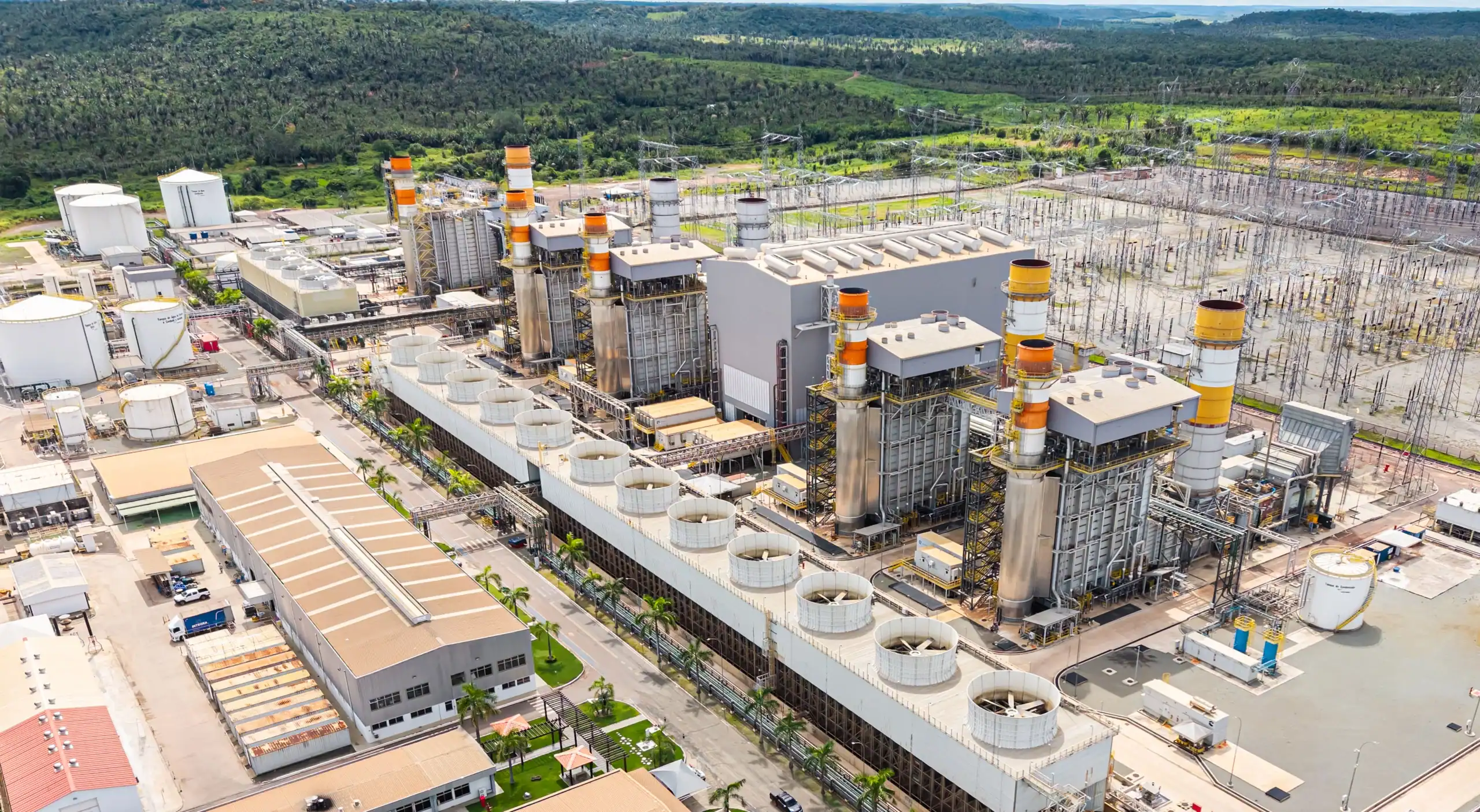
Eneva (B3: ENEV3), Brazil’s largest integrated reservoir-to-wire energy company and the country’s dominant onshore natural-gas-to-power operator, reported Q1 2026 net income of R$522.7 million ($103.5 million) — a 36 percent increase versus Q1 2025’s R$384.4 million ($76.1 million), according to the earnings release published Wednesday May 13 after market close.
Net operating revenue grew 5.9 percent year-on-year to R$4.682 billion ($927 million), driven by higher merit-based thermal dispatch at the Parnaíba Complex and the activation of new fixed-revenue capacity-reserve contracts. Adjusted EBITDA reached R$1.69 billion ($334.7 million), up 10.7 percent year-on-year and a Q1 record, with the EBITDA margin expanding to 36.1 percent.
The standout segment was upstream gas. Eneva’s upstream EBITDA surged 209.2 percent year-on-year to R$1.16 billion ($229.7 million), reflecting higher natural-gas production volumes at the Parnaíba Basin and the resumption of drilling activities. Total gross energy generation reached 3,942 GWh in the quarter — more than three times the Q1 2025 level — as merit-based thermal dispatch supported the integrated gas-and-power model.
The print arrives at a strategically loaded moment. The Iran-Hormuz oil shock that has dominated global energy markets since February 2026 — with Brent peaking at $128 and currently trading near $104 — directly supports Brazilian gas-thermal economics through fixed-revenue capacity contracts and improved merit-dispatch positioning, even as the cost-of-capital environment for capex-heavy growth remains constrained by Brazil’s 15 percent Selic.
Key Points
What Eneva Reported in Q1 2026
Eneva S.A., listed on B3 as ENEV3, is Brazil’s largest integrated reservoir-to-wire energy company — a vertically integrated platform spanning natural gas exploration, gas production, thermal power generation, and energy trading. The company holds concessions covering approximately 60,000 square kilometres across the Parnaíba, Amazonas, Solimões, and Paraná basins, with installed generation capacity of approximately 2.8 GW representing about 11 percent of Brazil’s thermal gas capacity.
Founded in 2001 as MPX Energia, part of Eike Batista’s EBX Group, Eneva was renamed in 2013 after a corporate restructuring. The company has evolved from a near-distressed asset into a high-growth integrated energy platform, with the stock rallying 111 percent in 2025 to become one of the B3’s best-performing utility names of the year.
Q1 2026 net income reached R$522.7 million ($103.5 million), up 36 percent from R$384.4 million ($76.1 million) in Q1 2025. Net operating revenue rose 5.9 percent year-on-year to R$4.682 billion ($927 million), with the Q1 2026 figure marking another acceleration after the company’s transformation through 2025. Q1 2025 had already produced 120.7 percent revenue growth on the back of asset acquisitions.
Adjusted EBITDA reached R$1.69 billion ($334.7 million), up 10.7 percent year-on-year and a new Q1 record. The EBITDA margin came in at 36.1 percent, reflecting operational scaling and the contribution of integrated gas-and-power assets. The result extends the company’s record-setting EBITDA trajectory: 9-month 2025 EBITDA exceeded R$12 billion ($2.38 billion), per data from the Q3 2025 release.
CEO Lino Cançado framed the result in the earnings release: “The quarter was marked by strong operational and commercial performance, with significant EBITDA expansion in thermal and upstream.” Management attributed the operational drivers to three specific items: the start of fixed revenue at UTE Parnaíba VI (the company’s newest thermoelectric plant); higher generation at Jaguatirica II; and the growth of natural-gas operations in the upstream segment.
The upstream segment was the standout. Eneva’s upstream EBITDA reached R$1.16 billion ($229.7 million), up 209.2 percent year-on-year, reflecting higher natural-gas production volumes at the Parnaíba Basin and the resumption of drilling activities that had been paused in Q1 2025. Gas production rebound after the 25 percent year-on-year decline reported in Q1 2025 — when Parnaíba Basin output had dropped to 0.15 billion cubic metres — was the principal contributor.
Total gross energy generation reached 3,942 GWh in Q1 — more than three times the Q1 2025 level of approximately 1,175 GWh. The increase reflects principally merit-based thermal dispatch during the period, where Brazil’s National System Operator (ONS) calls on thermal capacity to balance the grid when hydrological conditions or load growth require it. The merit-dispatch dynamic is inherently weather-dependent but increasingly buffered by Eneva’s growing share of fixed-revenue contracts.
Not all segments performed equally. The third-party fuel thermal generation segment — small plants Eneva operates using fuel supplied by counterparties — recorded a negative EBITDA of R$8.6 million ($1.7 million) after the end of regulated contracts at some plants at the end of 2025. Solar generation also remained in negative territory at -R$5.4 million ($1.1 million), affected by sub-market price spread exposure and time-of-day price mismatches.
Eneva closed Q1 2026 with consolidated net debt of R$18.5 billion ($3.66 billion), up from R$14.4 billion ($2.85 billion) at end-Q1 2025 — a 28 percent increase reflecting the substantial growth-capex programme. The leverage ratio (net debt to EBITDA) closed at 2.77x, up modestly from 2.59x a year earlier and largely in line with the company’s targeted operating range.
Capex totalled R$1.3 billion ($257 million) in Q1, focused on the expansion of strategic projects and the development of new generation assets. Eneva’s growth pipeline includes the Azulão 950 thermoelectric plant in Amazonas, a third liquefaction train at Parnaíba expected to start operations by mid-2027 and expanding capacity by 50 percent, and continued upstream development in the Paraná and Amazonas basins.
The net financial result was an expense of R$431.7 million ($85.5 million), up 70.4 percent year-on-year. The increase reflects elevated interest charges on the higher debt base and the impact of Brazil’s 15 percent Selic policy rate on the company’s floating-rate debt portion.
Reserve certifications across the basin portfolio are an important forward indicator. Per the Q3 2025 release, Paraná Basin reserve certifications were expected in early 2026, with Amazonas Basin certifications targeted for early 2027. These developments expand the resource base supporting Eneva’s long-term integrated-energy strategy.
Live Company IntelligenceEneva S.A — the full investor dossier
Valuation & profitability
Price & risk
$16.5852-wk high
$32.40
Revenue trend · 6y
Ownership
Dividend
Why Eneva Q1 Matters
Eneva’s Q1 print arrives at the intersection of three strategically loaded dynamics: the ongoing Iran-Hormuz oil shock that has reshaped global energy economics since February, the March 2026 capacity-reserve auction (LRCAP) that was the binary catalyst for the recontracting trajectory, and the structural debate over whether Brazil’s integrated gas-to-wire model is the right hedge against renewable intermittency.
As the Rio Times documented in its Iran War 2026 reference guide, Brent crude surged 55 percent in March alone — from $72 to an intraday peak of $128 — the largest monthly gain in recorded history. The shock fundamentally repriced Brazilian energy assets across the value chain. For Petrobras, the oil price tailwind is direct. For Eneva, the read-across is more nuanced but arguably more strategic.
Eneva’s value proposition rests on integrated gas-thermal economics that benefit from oil-disruption in three specific ways. First, global LNG pricing — to which Brazilian gas imports are indirectly indexed — tends to rise with oil during disruption episodes, improving the cost competitiveness of Eneva’s domestic Parnaíba Basin gas production versus imported LNG.
Second, fixed-revenue capacity-reserve contracts continue to pay regardless of dispatch, providing balance-sheet stability through volatility. Third, the political imperative to ensure energy security during external shocks strengthens the regulatory case for thermal capacity.
Management addressed the geopolitical dimension directly. Per the Q3 2025 earnings-call Q&A, Eneva stated that Sergipe Hub LNG receipts should not be affected in the near term by Middle East developments — a strategically important disclosure given that Sergipe Hub gas serves as an optionality asset in the broader gas portfolio.
The February 11 Aneel price-cap shock remains the structural overhang. As the Rio Times reported in February, ENEV3 cratered 9.66 percent on a single session — its worst daily drop in nearly six years — after Aneel approved price caps for the March energy capacity auction far below market expectations.
The regulator set R$128/MWh ($25.3/MWh) for existing thermal plants and R$182/MWh ($36/MWh) for new projects, versus market consensus near R$250/MWh ($49.5/MWh). UBS BB called it “very negative.” The session erased R$4.1 billion ($812 million) of market value before partially recovering.
The Q1 2026 print is therefore the first quarterly result reflecting the post-auction reality, even though full LRCAP impact appears in 2028-2030 contract cycles. The +36 percent profit growth and Q1-record EBITDA suggest the operational fundamentals are intact despite the regulatory pricing setback. The market’s view will hinge on whether merit-dispatch dynamics and upstream gas growth can compensate for less attractive recontracting economics over the longer cycle.
As the Rio Times analysed in March after the Q4 2025 release, full-year 2025 net income reached R$1.16 billion ($222 million) — up 2,655 percent from 2024 — with adjusted EBITDA surging 43.4 percent to R$6.51 billion ($1.29 billion). The Q1 2026 +36 percent print extends that trajectory into 2026, sustaining the multi-year recovery momentum.
The growth investment programme remains intensive. As reported in February 2025, the second liquefaction train at Parnaíba doubled capacity to 600,000 m³/day, and a third train is now scheduled for mid-2027 commissioning — adding another 50 percent to LNG capacity. Long-term LNG contracts with Vale, Suzano, and Copergás anchor the take-or-pay revenue base.
Operating leverage is meaningful at this stage of the cycle. Per the Q3 2025 results, Eneva achieved record quarterly EBITDA of R$1.823 billion ($361 million) in Q3 — the fourth consecutive record quarter — with operating cash flow reaching R$1.965 billion ($389 million), exceeding EBITDA. The Q1 print confirms the operational scaling continues, with upstream gas now contributing the dominant marginal EBITDA growth.
The competitive landscape is differentiated. Eneva’s integrated reservoir-to-wire model is structurally distinct from pure-play thermal generators (which lack upstream gas optionality) and from pure-play upstream gas producers (which lack downstream demand monetisation). The closest comparable globally is GenOn-like vertical integration, but at Brazilian onshore scale with regulatory tailwinds — a position that justifies the EV/EBITDA premium Eneva trades versus pure-thermal peers.
BTG Pactual holds a 25.47 percent equity stake in Eneva, the largest single shareholder. As the Rio Times reported in October 2024, BTG led the R$3.2 billion ($634 million) follow-on share offering that funded the Linhares Energia and other strategic acquisitions. The continued BTG sponsorship aligns the company with one of Brazil’s most influential capital-allocators in the energy and infrastructure sectors.
For foreign investors, Eneva does not currently trade through a major US ADR programme, limiting access to the equity story — but the strategic profile (gas-power integration, oil-shock-insulated, structural Brazilian energy security play) makes ENEV3 a benchmark name for any LatAm utility allocation through B3 direct access or via Brazilian fund vehicles.
Integrated model insulated. Upstream gas, midstream LNG, downstream thermal — Iran shock raises LNG benchmarks and improves Eneva’s domestic-gas cost competitiveness.
Q1 EBITDA record at +10.7%. Operational fundamentals intact despite Aneel price-cap setback. Upstream EBITDA +209% confirms gas-production scaling.
Consensus PT R$24.48 ($4.85). +15.9% upside. 10 Buys, 0 Sells. XP top utility pick, Itaú BBA 2026 top pick.
Pipeline visibility. Parnaíba third liquefaction train mid-2027; Azulão 950 underway; Paraná reserves certification early 2026; Amazonas 2027.
Debt up 28% YoY. Net debt R$14.4B → R$18.5B ($2.85B → $3.66B). Financial expenses +70.4% to R$431.7M ($85.5M). 15% Selic is the structural overhang on capex programmes.
Aneel price-cap residual. R$128/MWh ($25.3/MWh) for existing plants — 40-50% below market expectations. Recontracting economics structurally less attractive.
Hydrology risk. Thermal merit-dispatch is counter-cyclical to rainfall. Above-average 2026 hydrology would compress variable-revenue contribution.
Solar drag, third-party fuel drag. Both segments delivered negative EBITDA in Q1, modest in absolute terms but signal portfolio quality dispersion.
Sell-Side View
| Bank | Rating | PT | View on Eneva |
|---|---|---|
| XP Investimentos | Buy | R$27.10 ($5.37) | Top utility idea. Integrated gas-power model the structural play of the cycle. |
| Itaú BBA | Buy | R$23.80 ($4.71) | Named ENEV3 as top utility pick for 2026. Sees recontracting overhang as priced in. |
| Bradesco BBI | Buy | R$26 ($5.15) | Constructive on integrated upstream-thermal arc, Parnaíba reserves replacement. |
| Safra | Neutral | R$22.50 ($4.46) | More cautious on debt trajectory and capex-cycle execution risk. |
The sell-side consensus is broadly constructive. The R$24.48 ($4.85) average price target implies 15.9 percent upside from the May 13 pre-print close. The Q1 print broadly confirms the operational thesis underpinning the Buy ratings, though Safra’s Neutral cautions on the debt trajectory remain the principal dissenting view.
Financial Snapshot Q1 2026
| Indicator | Q1 2026 | Chg YoY |
|---|---|---|
| Net Income | R$522.7M ($103.5M) | +36% |
| Net Operating Revenue | R$4.68B ($927M) | +5.9% |
| Adjusted EBITDA | R$1.69B ($335M) Q1 record | +10.7% |
| EBITDA Margin | 36.1% | Q1 record |
| Capex | R$1.3B ($257M) | Growth allocation |
| Net Financial Expense | R$431.7M ($85.5M) | +70.4% |
Segment Performance and Balance Sheet
| Segment / Metric | Q1 2026 | Comment |
|---|---|---|
| Upstream EBITDA | R$1.16B ($230M) | +209.2% YoY |
| Third-party Fuel Thermal EBITDA | -R$8.6M (-$1.7M) | Contracts ended 2025 |
| Solar EBITDA | -R$5.4M (-$1.1M) | Sub-market spread, time mismatch |
| Gross Energy Generation | 3,942 GWh | ~3x Q1 2025 |
| Net Debt | R$18.5B ($3.66B) | +28% (vs R$14.4B / $2.85B) |
| Leverage (Net Debt / EBITDA) | 2.77x | vs 2.59x |
Peer Benchmark — Brazilian Energy Utilities
| Company | EBITDA Margin | Mkt Cap | Profile |
|---|---|---|---|
| Eneva (ENEV3) | 36.1% | R$40.8B ($8.1B) | Integrated gas-thermal |
| Axia Energia (ELET3) — ex-Eletrobras | ~42% | ~R$95B ($18.8B) | Hydro/transmission dominant |
| Engie Brasil (EGIE3) | ~50% | ~R$33B ($6.5B) | Diversified renewables |
| Copel (CPLE6) | ~35% | ~R$28B ($5.5B) | Paraná hydro + distribution |
What Happens Next for Eneva
Hormuz path: Iran-Hormuz oil disruption duration is the dominant external variable. Brent currently at ~$104. A sustained resolution would reduce LNG-pricing tailwind for Eneva’s gas economics; continued disruption supports the integrated-energy thesis. Full context in the Iran War 2026 reference guide.
Capex execution: R$1.3B ($257M) Q1 capex run-rate implies ~R$5.2B ($1.03B) full-year deployment. Parnaíba third liquefaction train (mid-2027 commissioning) and Azulão 950 are the principal execution priorities through 2026-2027.
Reserve certifications: Paraná Basin reserve certifications targeted for early 2026; Amazonas Basin early 2027. These resource-base updates are material catalysts for the long-term integrated-energy story.
Leverage discipline: 2.77x leverage versus the company’s targeted operating range. Investors will watch whether capex intensity moderates as growth projects ramp into commercial operation, or whether net debt continues to climb through 2026.
October 2026 election: Brazilian presidential election outcome affects energy regulation, capacity-auction design, and the broader investment framework for thermal generation. Eneva benefits from the current regulatory positioning that prioritises energy security; a change in administration introduces policy continuity risk.
Frequently Asked Questions
How much did Eneva earn in Q1 2026?
Eneva reported Q1 2026 net income of R$522.7 million ($103.5 million), up 36 percent from R$384.4 million ($76.1 million) in Q1 2025. Net operating revenue grew 5.9 percent to R$4.682 billion ($927 million), and adjusted EBITDA reached a Q1 record of R$1.69 billion ($334.7 million), up 10.7 percent year-on-year.
The EBITDA margin came in at 36.1 percent. The upstream segment was the standout, with EBITDA surging 209.2 percent to R$1.16 billion ($229.7 million) on higher Parnaíba Basin gas production and the resumption of drilling activities. Total gross energy generation reached 3,942 GWh — more than three times the Q1 2025 level.
How does the Iran-Hormuz oil shock affect Eneva?
The Iran-Hormuz oil disruption that began in February 2026 — pushing Brent crude from $72 to an intraday peak of $128 in March, the largest monthly oil-price gain in recorded history — benefits Eneva‘s integrated gas-power model through three channels.
First, global LNG pricing tends to rise with oil during disruption, improving Eneva’s domestic-gas cost competitiveness versus imported LNG. Second, fixed-revenue capacity-reserve contracts pay regardless of dispatch, providing balance-sheet stability through volatility. Third, the political imperative for energy security strengthens the regulatory case for thermal capacity. Management has flagged that Sergipe Hub LNG receipts should not be near-term affected by Middle East developments.
Why did Eneva’s debt rise to R$18.5 billion ($3.66B)?
Net debt rose 28 percent year-on-year from R$14.4 billion ($2.85 billion) to R$18.5 billion ($3.66 billion), reflecting Eneva’s substantial growth-capex programme. Q1 2026 capex totalled R$1.3 billion ($257 million), focused on expanding strategic projects including the Parnaíba third liquefaction train (50 percent capacity expansion, mid-2027 commissioning) and the Azulão 950 thermoelectric plant in Amazonas.
The leverage ratio rose to 2.77x from 2.59x a year earlier, broadly within the company’s targeted operating range. Financial expenses jumped 70.4 percent to R$431.7 million ($85.5 million), reflecting the higher debt base and Brazil’s 15 percent Selic policy rate. Safra is the sell-side dissenting voice with a Neutral rating, citing debt trajectory and capex-cycle execution risk.
What is the analyst outlook for ENEV3?
Sell-side coverage is broadly constructive. The consensus 12-month price target is R$24.48 ($4.85), implying 15.9 percent upside from the May 13 pre-print close near R$21.12 ($4.18). Ten analysts have Buy ratings; zero have Sell ratings. XP Investimentos calls ENEV3 its top utility idea with a R$27.10 ($5.37) target.
Itaú BBA named Eneva its top pick for 2026 at R$23.80 ($4.71). Bradesco BBI is also at Buy with R$26 ($5.15). Safra holds Neutral at R$22.50 ($4.46), citing concerns about the debt trajectory. ENEV3 rallied 111 percent in 2025 — one of B3’s best-performing utility names — and the 52-week range spans R$11.48 ($2.27) to R$22.79 ($4.51). The February 11 Aneel price-cap shock that crashed shares 9.66 percent in a single session represents the principal regulatory overhang
Updated: 2026-05-14T07:30:00-03:00 by Rio Times Editorial Desk
Eneva Q1 2026 | ENEV3 earnings | Brazil natural gas | Lino Cançado | Parnaíba Complex | Iran Hormuz oil shock | integrated gas-thermal | The Rio Times
This article was produced by The Rio Times’ automated newsroom system. How we use AI · Report an error · Editorial responsibility: Matthias Camenzind, Editor-in-Chief
LatAm Markets: Live Signals → — real-time movers, turnover leaders and FX across Latin America.