Bolivia 2026 Budget: 9% Deficit, 14% Inflation, State Firm Cuts

Key Facts
— —The Bolivia 2026 budget was presented on April 21 and sent to the Plurinational Legislative Assembly on April 22, marking the first full macro framework of President Rodrigo Paz’s administration after months of operating under the inherited plan of his predecessor Luis Arce.
— —Economy Minister José Gabriel Espinoza said the deficit would have exceeded 15% of GDP under the original draft and has been cut to 9%, with inflation projected at 14%, both well below IMF and World Bank forecasts.
— —Two companion laws are traveling with the budget: a regional-autonomy measure and a public-enterprise liquidation framework giving the government 90 days to evaluate and shut down loss-making state firms, the most structural break with the MAS-era model since Paz took office.
The Bolivia 2026 budget is Paz’s first macro document in Congress, and the numbers are designed to force a direct fight over the accounting of the previous MAS administration.
The Rio Times, the Latin American financial news outlet, reports that the Bolivia 2026 budget was presented in public on Tuesday, April 21, and travels to the Plurinational Legislative Assembly on Wednesday, April 22, as the first full fiscal framework of the Paz administration. The document replaces the original 2026 plan drafted by the outgoing government of Luis Arce, which entered into force automatically on January 1 after the Assembly failed to approve it within the 60-day constitutional window — the third consecutive year Bolivia has begun a fiscal cycle without a ratified budget.
Economy Minister José Gabriel Espinoza framed the new document as a “realistic scenario” after months in which his ministry unwound what he described as overstated revenues, understated expenditures, and “phantom investment” from the inherited accounts. The reformulated Bolivia 2026 budget totals roughly 390 billion bolivianos, or about US$55.7 billion, with a headline fiscal deficit of 9% of GDP and projected inflation of 14%.
How the deficit fell from 15% to 9%
Espinoza said the initial deficit “could have exceeded 15%” of GDP if the inherited accounting had been left untouched. The six-percentage-point reduction comes from two main levers: the elimination of the fuel subsidy in December, which the ministry estimates at roughly 5% of GDP on its own, and a cut in current spending of 4,100 million bolivianos (about US$585 million), equivalent to another percentage point.
The remaining adjustment sits in the technical overhaul of the numbers themselves. Espinoza cited more than 24,000 million bolivianos (US$3.43 billion) in “accounting gaps” and another 4,800 million bolivianos (US$685 million) in projects that, for various reasons, “could not have been executed.” His accusation against the previous administration’s bookkeeping was explicit: “overstated revenues, understated expenditures, and phantom investment,” which the reformulated document corrects to deliver “realism.”
Against that backdrop, the reallocation of spending matters as much as the headline number. The ministry has added more than 1,000 million bolivianos of additional funding for health and education, creating over 3,000 education items and 2,400 health items, while redirecting savings from travel, per diems and publicity budgets at the central government.
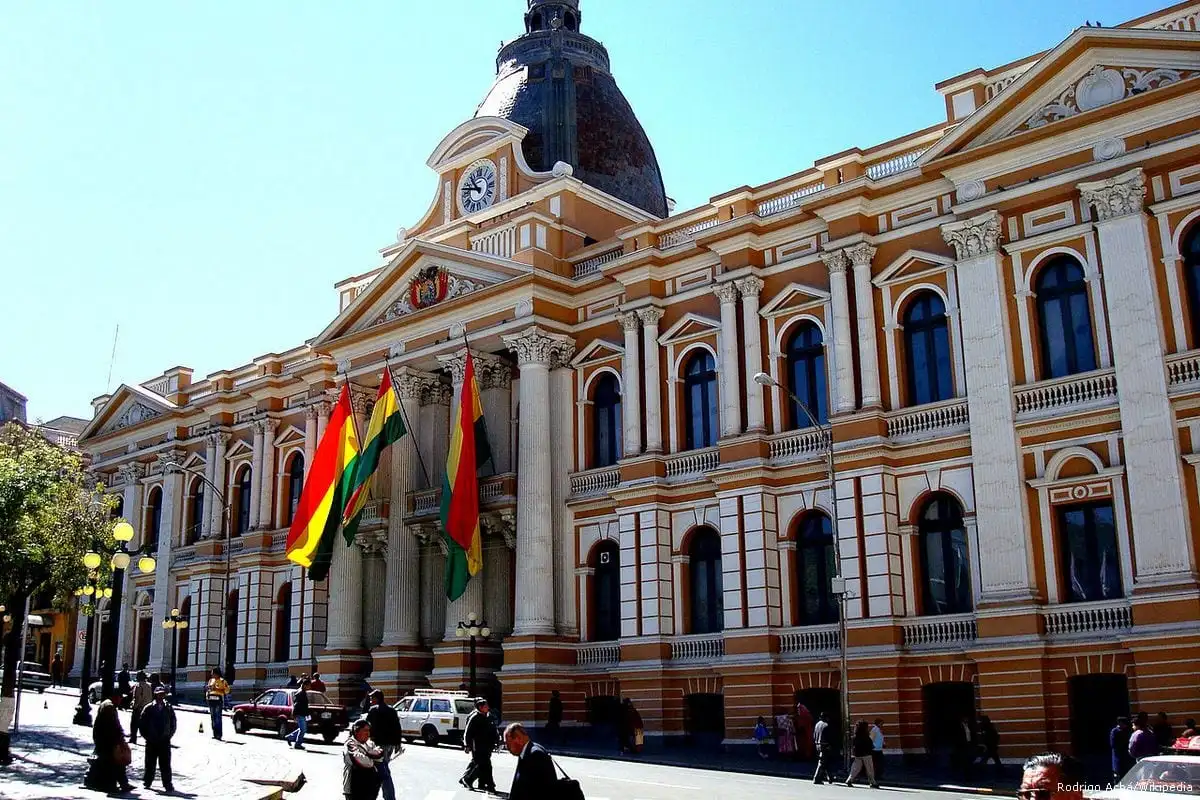
Bolivia 2026 budget vs. IMF and World Bank forecasts
The Bolivia 2026 budget projects growth “slightly below 1%” and inflation of 14%. Both numbers diverge sharply from the views of the two main multilateral lenders. The International Monetary Fund’s April World Economic Outlook expects Bolivia to contract by 3.3% this year and to post inflation of 20.7%, while the World Bank projects a 3.2% contraction, placing Bolivia among the weakest performers in South America and the only country in the subregion projected to post negative growth in 2026.
Bolivia’s external cushion remains thin. International reserves had fallen from a historic peak of US$15.12 billion in 2014 to US$3.148 billion at recent readings, and the country has endured a dollar shortage since early 2023 that has driven parallel exchange rates and fuel-distribution bottlenecks. Even as the IMF flagged Bolivia’s outlook as adverse, the Fund separately credited Paz’s adjustment measures for moving the country away from an “unsustainable” trajectory and signaled it remains open to a future financial-support framework.
That gap between government optimism and multilateral caution is the political test. Paz campaigned on stabilization through spending discipline and private-sector incentives, and the Bolivia 2026 budget now codifies that approach in numbers Congress will either ratify or contest. An earlier phase of this program, executed almost entirely through presidential decree, is analyzed in The Rio Times’s coverage of the fragile calm delivered by decree.
A liquidation law for loss-making state firms
Two companion laws travel with the budget and could prove more consequential than the fiscal figures themselves. The first gives departmental and municipal governments more freedom to execute their own budgets, loosening a centralized framework inherited from the MAS era. The second authorizes the closure and liquidation of loss-making public enterprises following a 90-day evaluation window.
Espinoza was precise about the legal pathway. “Companies that were created by decree will be closed by decree; companies that were created by law will have to be closed by law, so that part involves working with the Assembly,” he told reporters, framing the Congressional negotiation as the operational bottleneck. The sentence effectively maps the fight: decree-level firms can be wound down administratively, but the statutory public companies that absorbed most MAS-era subsidy commitments require legislative consent.
Alongside the budget, the ministry launched “Bolivia en Tiempo Real,” a public-spending transparency platform backed by the Inter-American Development Bank, with records beginning in 2016 because of a digital error that erased 20% of budget data from 2005 to 2016. The launch complements the budget narrative by placing the accounting dispute with the previous administration inside a visible dataset.
What the Assembly vote decides
For international investors watching Andean macro, the Bolivia 2026 budget is the first full data point on whether the Paz reform momentum survives contact with a fragmented Assembly still shaped by MAS factions loyal to Evo Morales and Arce. The country’s recent rating upgrades — S&P’s rare double-notch move to CCC+ in March and Fitch’s upgrade in January — have been built on decree-level adjustment; a ratified budget and a statutory framework to close unprofitable state firms would be the first structural test of whether those gains can be institutionalized.
Espinoza’s underlying message is that his projections describe the “worst possible scenario from which to manage the economy.” That framing is politically useful, because any upside surprise — on dollar liquidity, hydrocarbon revenues, or multilateral disbursements — becomes a win for the new government. The downside is that missing even a weak baseline would damage credibility with the same multilateral lenders Paz is courting for financing.
The legislative calendar is what turns the budget into a live test. Once the Assembly receives the three bills, the deficit cut becomes real only if Congress ratifies the framework and passes the liquidation authority. Bolivia’s macro story in 2026 will be written in that negotiation.
Related coverage: Bolivia Economy 2026: Political Break, Reform Agenda, and What Comes Next • Bolivia Economic Reform Delivers Fragile Calm by Decree • Bolivia’s New President Bets on a 30% Spending Cut
More: Bolivia news in English, every day from The Rio Times.
This article was produced by The Rio Times’ automated newsroom system. How we use AI · Report an error · Editorial responsibility: Matthias Camenzind, Editor-in-Chief