El Niño 2026 — What a Hotter Drier Year Costs Latin America’s Economy

Key Facts
— — NOAA’s April 2026 outlook gives a 61% probability of El Niño emergence in the May-July window rising to 62% for June-August, with a 1-in-3 chance the event classifies as “strong” during October-December 2026.
— — A moderate-to-strong event would cut Andean GDP by 0.6-1.7 percentage points, threaten 50% of LATAM’s hydro-dependent electricity supply, and pressure the Panama Canal’s Gatun Lake — the chokepoint whose 2023-24 drought cost shippers billions in rerouting costs.
— — Impacts split asymmetrically: northern Brazil, the Amazon, Pantanal and Central America face drought; southern Brazil, Uruguay, Paraguay and northeastern Argentina face flooding; Ecuador and Peru face combined coastal flood and inland drought risk.
The El Niño 2026 Latin America risk has moved from hypothetical to imminent. NOAA’s Climate Prediction Center issued an El Niño Watch in March 2026, and the April update raised the probability of emergence to 61% for the May-July window. The Andean subsurface Pacific already contains the heat signature that precedes surface warming, and the low-level trade winds are weakening on schedule.
The Rio Times, the Latin American financial news outlet, reports that the economic consequences will be uneven, front-loaded into the second half of 2026, and transmitted through three primary channels: agriculture, hydroelectric generation, and logistics. The question for investors, governments, and households is not whether El Niño returns but how hard it lands and which economies are positioned to absorb the shock.
The 2015-2016 El Niño — the strongest of the 21st century to date — offers the closest comparable. It produced the worst drought in Central America in four decades, pushed 3.5 million people into humanitarian assistance, and triggered the fires that devastated the Amazon. A 2026 event of similar magnitude would arrive at a Latin American economy that is more industrialized and better monitored but also more hydro-dependent and more exposed to global agricultural trade than a decade ago.
What El Niño 2026 in Latin America Actually Means: NOAA and WMO
The April 2026 CPC/IRI ENSO forecast shows ENSO-neutral conditions favored through the April-June window at approximately 80%, with El Niño probabilities becoming the dominant category starting in May-July at 61-72%. The dynamical model consensus, weighted with statistical-model forecasts, has the event peaking in the October-December 2026 season.
The intensity question is less settled. WMO meteorologist Bárbara Tapia Cortés told Bloomberg Línea that scientific community consensus is to discuss a “growing risk” rather than a certainty. The NOAA CPC assessment gives a roughly 1-in-3 probability that the Niño-3.4 region anomaly exceeds +1.5°C — the “strong” classification threshold — during the peak October-December window.
| Three-month window | ENSO-neutral | El Niño | La Niña |
| Apr-Jun 2026 | 80% | 18% | 2% |
| May-Jul 2026 | 36% | 61% | 3% |
| Jun-Aug 2026 | 35% | 62% | 3% |
| Oct-Dec 2026 (peak) | 22% | 75% | 3% |
Source: NOAA Climate Prediction Center / IRI ENSO probability forecast, March-April 2026.
The Regional Asymmetry
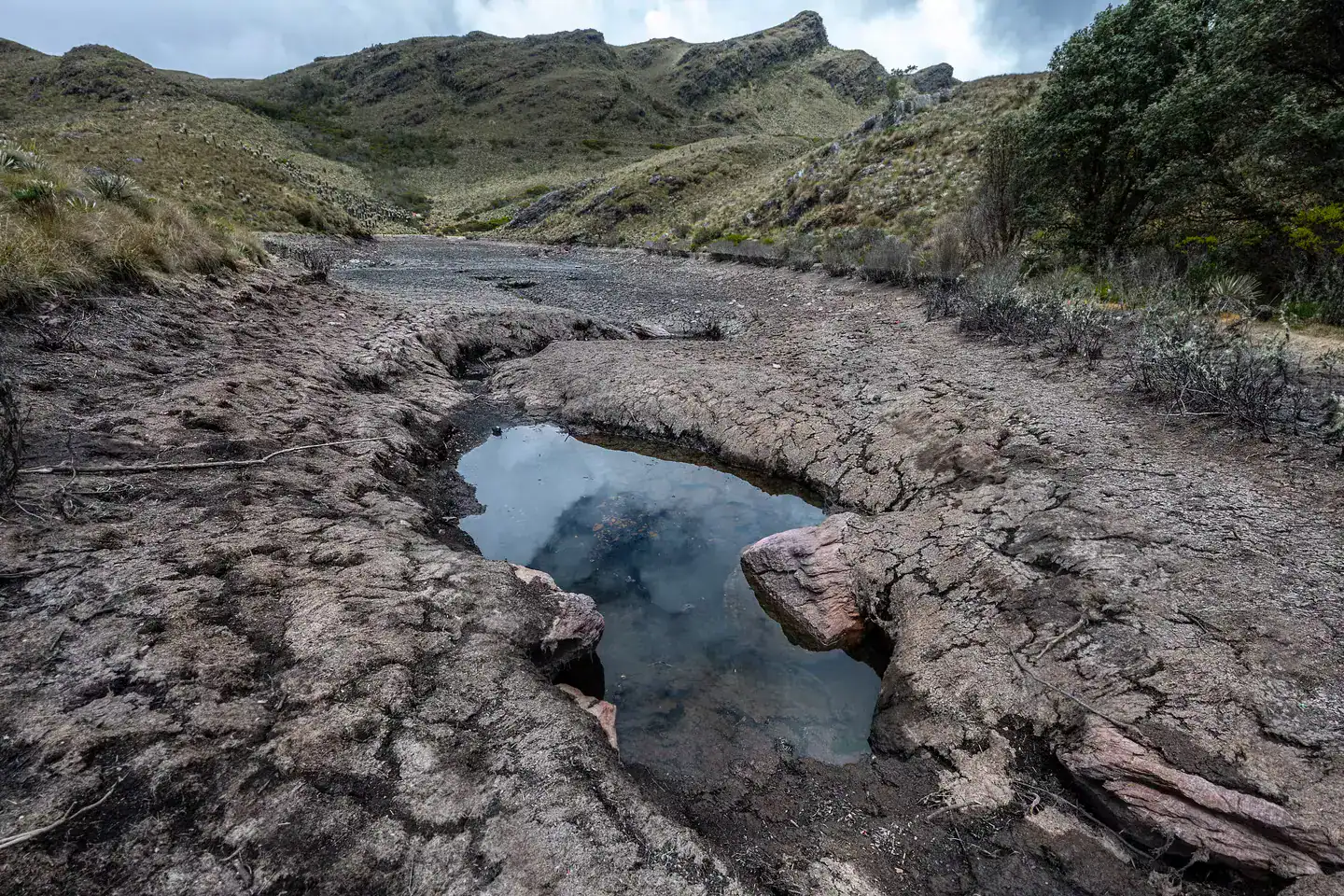
El Niño does not affect Latin America uniformly. The dominant pattern places drought across Central America, the northern Andes, the Brazilian Amazon, and the Pantanal, while pushing excess rainfall into the southern cone: southern Brazil, Uruguay, Paraguay, and northeastern Argentina.
The Pacific coast of Ecuador and Peru faces a combined risk. Coastal areas see intense rainfall, flooding, and landslides; inland highland agriculture faces water stress and temperature shocks. The 2023-24 event produced both phenomena in close temporal sequence, a pattern Ecuadorian and Peruvian disaster-management authorities now treat as the baseline expectation.
| Sub-region | Dominant pattern | Main risk |
| Central American Dry Corridor | Drought | Maize and bean smallholder collapse; food security |
| Northern Andes (Colombia, Venezuela) | Drought | Hydro shortfall; coffee flowering stress |
| Ecuador & Peru (coast) | Flooding | Infrastructure, fisheries, banana/cacao cultivation |
| Brazilian Amazon & Pantanal | Drought + fire | Low river levels, wildfires, biodiversity loss |
| Southeast & Centre-West Brazil | Irregular rainfall | Planting delays; coffee, sugarcane, soy |
| Southern Brazil + Uruguay + Paraguay | Flooding | Soy, rice, logistics; Paraná river levels |
| Northeast Argentina | Above-average rainfall | Soy and corn; Pampas recovery from La Niña |
Source: World Meteorological Organization; historical El Niño 2015-2016 and 2023-2024 impact patterns.
Agriculture: The Soy Pivot
Argentina’s soy and corn belt is the single most important El Niño agricultural variable for global markets. As Rio Times’s Brazil Agribusiness 2026 Guide documents, soy is the dominant commodity cycle across South America; a 25-30% Argentine yield swing between El Niño-friendly and La Niña-damaged seasons is the difference between 48 million tonnes and 25 million tonnes.
The 2022-23 La Niña drought cost Argentina an estimated US$14 billion in soybean, corn, and wheat revenue combined. A 2026 El Niño following two dry years could deliver a record 52-55 million tonne soy harvest for the 2026-27 cycle — but only if rainfall timing aligns with the Southern Hemisphere planting window from October through December.
Brazil’s Centre-West and Southeast soy, corn, and sugarcane regions face irregular rainfall and heat-driven planting delays rather than outright drought or flood. The Cerrado — where most Brazilian agricultural expansion has occurred since 2019 — is particularly vulnerable to the combination of high temperatures and irregular precipitation that El Niño patterns produce in the region.
The coffee dimension is high-stakes. The 2024-25 drought in Minas Gerais and São Paulo cut rainfall 40-60% and drove Brazilian coffee output 8% lower year-over-year in the 2025-26 harvest, bringing global stocks to historic lows. Another El Niño cycle would compound the supply pressure; Colombia, now producing 12.75 million 60-kilogram bags annually according to Federación Nacional de Cafeteros data, faces its own highland drought risk in Andean production zones.
Energy: The 50% Hydro Problem
Approximately 50% of Latin American electricity generation comes from hydroelectric sources, making the region structurally more exposed to El Niño precipitation shifts than any other in the world. Professor Brigitte Castañeda of Universidad de los Andes identifies the most hydro-dependent economies as Paraguay (99.8%), Costa Rica (73.1%), and Colombia (70.8%), followed by Brazil and Panama.
The Colombian context is the most acute. As Rio Times coverage of Colombia’s firm-energy deficit has documented, grid operator XM already projects a -2.3% gap between firm supply and demand in 2026, widening to -6.8% by 2030. An El Niño-driven reduction in hydro generation would push that deficit deeper at exactly the moment Colombia lacks the thermal backup and gas supply to absorb it.
The gas-import fallback is constrained. Colombia’s TGI Ballena LNG regasification project is targeted for January 2027 — after the peak El Niño window. As Rio Times reporting on the Colombia gas imports framework has noted, recent El Tiempo coverage suggests the terminal may slip by a year, leaving the country essentially without LNG import capacity through its most exposed dry season.
Brazil’s framework is significantly more resilient. As Rio Times’s Brazil Renewable Energy 2026 Guide details, wind generation peaks between June and November — precisely during the Brazilian hydro low season — providing natural seasonal balancing.
Wind is projected to reach 16% of Brazil’s electricity mix by 2029, and the 828 MW Dom Inocêncio wind project in Piauí is under construction. That structural hedge limits Brazilian exposure but does not eliminate it.
The Panama Canal Chokepoint
The Panama Canal is the single most consequential logistics node El Niño threatens. The 2023-24 El Niño drought cut Gatun Lake levels to 79.6 feet in August 2023, forced daily transits from 36-38 vessels down to just 18, and compressed global supply chains for the better part of a year.
The recovery has been dramatic. As Rio Times’s Panama Canal 2026 Guide documents, Gatun Lake reached 88.9 feet in February 2026, triggering a preventive water discharge through the Gatún Dam; FY 2025 canal revenues hit a record US$5.7 billion with 13,404 vessel transits, a 19.3% year-over-year increase. Daily averages have climbed back to 33 vessels.
A new El Niño event would threaten that recovery directly. Even a moderate event could compress daily slot allocations, lower draft limits from the current 50 feet, and trigger the emergency auction-pricing framework that drove Last-Minute Transit Reservation fees to US$200,000 for Neopanamax vessels. The LNG segment has not recovered to pre-drought levels and would be first to reroute through Cape of Good Hope if El Niño intensifies.
Inflation and Central Bank Transmission
The monetary-policy dimension is already visible in the April 2026 Brazilian Focus survey. As Rio Times coverage of the Focus inflation revision documents, food and energy pass-through from the Iran war has already pushed 2026 IPCA projections to 4.80% — 30 basis points above the 4.50% target ceiling — for a sixth consecutive week. An El Niño-driven food and electricity shock in the second half of 2026 would compound that pressure at exactly the moment the BCB hopes to resume cutting rates.
Colombia’s framework is even tighter. BanRep reversed its cutting cycle in March 2026, raising the policy rate 100 basis points to 11.25%, citing core inflation at 5.5% and food-price transmission. The Central American Dry Corridor countries — dollarized El Salvador, de facto dollarized Ecuador, and pegged Honduras and Guatemala — face food-price shocks without monetary-policy flexibility to absorb them.
The fiscal dimension is equally constrained. An El Niño disaster-response mobilization compresses fiscal space at economies already stretched by tariff disruption, currency pressure, and capital-account outflows. Colombia has been the most visible case of that compound stress; Argentina’s IMF standby-arrangement framework leaves even less flexibility.
The Food Security Overlay
The human dimension is concentrated in the Central American Dry Corridor. The 2023 El Niño event exposed 1.3 million people in eight Latin American countries to severe drought according to the World Food Programme; the 2015-16 event pushed 3.5 million people into humanitarian assistance across Honduras, Guatemala, El Salvador, and Nicaragua.
The Dry Corridor’s subsistence agriculture — predominantly maize and beans grown by smallholder farmers on rain-fed plots — has no meaningful buffer against rainfall shocks. FAO data classifies 74% of Latin American countries as highly exposed to extreme weather, with 52% considered structurally vulnerable.
Migration pressure is a direct second-order effect. The 2014-2016 Central American drought produced a measurable spike in US-bound migration from the Northern Triangle; a 2026 repetition would land in a very different US policy environment, with the Trump administration’s immigration enforcement framework likely producing a sharper confrontation with transit countries including Mexico.
The Investor Framework
Latin American sovereign and corporate credit is already pricing a rising climate-risk premium, though unevenly. Ecuadorian and Colombian sovereign spreads have widened relative to Mexican and Brazilian peers through Q1 2026; Argentina and Peru are trading primarily off political and election variables that have absorbed attention away from climate risk.
Within equities, utility sector positioning is the most direct El Niño expression. Brazilian generators with diversified portfolios (Engie Brasil, AES Brasil, Auren) enter the cycle with more resilience than Colombian generators (Isagen, EPSA, Celsia) whose hydro concentration amplifies exposure. Mexico’s CFE faces different stress from northern drought and agricultural pump irrigation demand spikes.
Commodity positioning is more nuanced. Argentine soybean-exposed equities (Molinos, Bioceres, Cresud) benefit from a return-to-normal rainfall cycle if El Niño intensity remains moderate; Brazilian coffee traders (Cofco, Volcafe, Tudor Group positions) face asymmetric supply-tightening pressure. As Rio Times’s Colombia Economy 2026 Guide outlines, Colombian coffee is a hedged beneficiary of Brazilian supply pressure but suffers directly from highland drought.
The Policy Response Framework
The UN “Early Warnings for All” (EW4All) initiative defines the multi-risk response framework being adopted across Latin America. The four pillars are risk knowledge, monitoring and forecasting, communication of warnings, and response capacity. WMO’s Tapia Cortés summarized the philosophy: “It is not enough to know that an El Niño event may occur; the decisive thing is to transform that knowledge into anticipatory action.”
Public-sector priorities fall into four categories: updating sectoral risk scenarios; strengthening climate monitoring and seasonal forecasting; elaborating contingency plans for drought, flood, and fire; and activating coordination mechanisms across meteorology, civil protection, agriculture, energy, health, and communications ministries.
Private-sector priorities are more operational: revising planting calendars, diversifying crop varieties, reinforcing drainage systems in flood-exposed zones, securing livestock water and feed supply, stress-testing energy and logistics continuity, and ensuring agricultural insurance coverage. Dante Romano at Universidad Austral in Argentina argues the anticipation window determines outcomes: losses rarely stem from extreme events alone, but from the combination of extremes, preparation gaps, and delayed response.
What to Watch
Three windows define the next six months. First, the May and June NOAA CPC ENSO Diagnostic Discussions. A formal move from Watch to Advisory would confirm El Niño emergence and trigger formal response protocols across exposed ministries.
Second, the Southern Hemisphere planting window from October through December. Rainfall timing in Argentina and southern Brazil will determine whether the event produces the favorable scenario of above-normal soy and corn harvests or the adverse scenario of flooding disruption to planting.
Third, the Central American Dry Corridor “de primera” planting season and the Andean hydro reservoir levels going into August. Both will reveal whether the event is landing at “moderate” or “strong” intensity well before the October-December peak becomes visible in the NOAA-3.4 SST index.
For investors, governments, and households across Latin America, El Niño 2026 is no longer a tail risk. It is the base case.
More: Costa Rica news in English, every day from The Rio Times.
The big picture: Cuba explained — economy, politics, society and daily life in one read.
This article was produced by The Rio Times’ automated newsroom system. How we use AI · Report an error · Editorial responsibility: Matthias Camenzind, Editor-in-Chief