Milei Faces Largest Union March of His Presidency on May Day
Key Facts
— —Argentina CGT march filled Plaza de Mayo on May 1 with the labor confederation, social movements, and opposition parties demanding Milei reverse course on factory closures and wage erosion.
— —The rally opened with a tribute to Pope Francis, who died one year ago, with church representatives and video segments anchoring the religious framing.
— —The Cámara de Apelaciones del Trabajo recently lifted the cautelar that had suspended the core of Milei’s labor reform, putting CGT’s legal strategy under pressure.
The Argentina CGT march on May 1 was the labor movement’s most visible response in months to a Milei government that has just regained the legal upper hand on its core reform.
The Argentina CGT march filled Plaza de Mayo on the afternoon of May 1, with the Confederación General del Trabajo joined by social movements, opposition parties, and church representatives. The rally’s stated theme was “El trabajo es con derechos o es esclavo.” It opened with a homage to Pope Francis, who died a year ago, including a video tribute and a representative from the Argentine Catholic Church.
The Rio Times, the Latin American financial news outlet, reports that the political backdrop is sharper than the CGT had anticipated when calling the rally a month ago. The Cámara de Apelaciones del Trabajo recently overturned the cautelar that had suspended the core of Milei’s labor reform. The labor confederation now finds itself defending workplace protections in front of judges who have just ruled against it.
What the Argentina CGT March Demanded
The CGT document read at Plaza de Mayo demanded a change of direction with “soberanía política y justicia social” — phrasing that doubles as opposition campaign vocabulary. The three cosecretarios general split the address: Jorge Sola, Cristian Jerónimo, and Octavio Argüello shared the stage. Sola and Jerónimo confirmed their attendance at Friday’s PJ summit, integrating the labor confederation with the Peronist political reorganization.
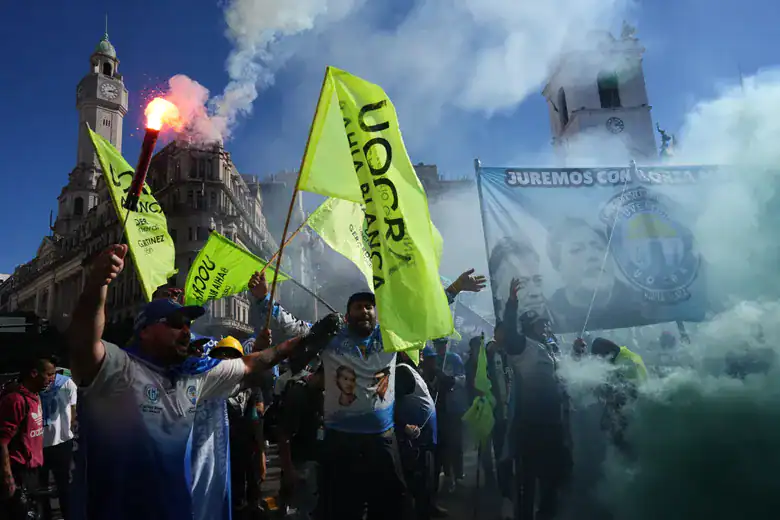
The economic charges were specific. The CGT statement attributed Milei’s policies to “una escalada trágica del flagelo de la desocupación y de la informalidad laboral” and warned of “inflación de bolsillo” running higher than INDEC’s headline IPC, while wage paritarias have been “profundizando la pérdida del poder adquisitivo.” The labor confederation rejected the labor reform as “despoja de derechos colectivos e individuales resguardados por nuestra Constitución.”
The Pope Francis Anchor
The Francis tribute is more than ceremonial. Argentina’s first Latin American pope was a vocal critic of unregulated capitalism and called the Milei austerity package “a serious problem” months before his death. The CGT’s decision to anchor the May 1 rally in Francis’s memory connects labor’s economic critique to Catholic social doctrine — a framing that resonates with parts of the conservative Argentine electorate that voted for Milei in 2023 but have since soured on the cost of the adjustment.
The pre-rally video carried Francis’s recorded statements on labor dignity and economic justice, with an Argentine bishop closing the segment. The structure made it harder for Milei loyalists to dismiss the rally as standard Peronist mobilization. Francis’s institutional weight remains a cross-partisan asset in Argentine political memory.
Why the Argentina CGT March Did Not Announce a General Strike
No general strike was announced from the stage. CGT internal calculations have shifted toward managed mobilization rather than direct action. Past general strikes during the Milei period have produced limited disruption and have given the government talking points about union excess.
The legal strategy is now the primary front. With the cautelar overturned, the CGT will need to relitigate the labor reform’s constitutionality from a defensive position. Several public-sector unions have signaled they will pursue separate constitutional challenges, but the centralized confederation strategy is judicial rather than street-based.
What the Argentina CGT March Means for Markets
For investors tracking Milei‘s reform agenda, the CGT’s reduced confrontational posture is bullish. Each successful general strike historically priced in roughly 50 to 100 basis points of additional country risk. The May 1 rally’s containment within Plaza de Mayo and absence of disruption to the broader economy keeps the country-risk premium near recent lows around 566.
For political markets, the CGT’s PJ alignment is the structural signal. With cosecretarios attending the Friday Peronist summit, the labor confederation is positioning for the October 2027 election rather than for an immediate confrontation with Milei. Argentina’s broader macro stability depends on this pattern holding.
Related Coverage
Latin America Economy 2026 → • Iran War Hormuz Crisis • Oil and Energy Latin America
More: Argentina news in English, every day from The Rio Times.
This article was produced by The Rio Times’ automated newsroom system. How we use AI · Report an error
Read More from The Rio Times