Washington Sends New Diplomat to Venezuela for Post-Maduro Plan
Key Facts
— —John Barrett arrived in Caracas on April 23 as the new Chargé d’Affaires of the United States embassy, replacing Laura Dogu, who had led the mission since it reopened on March 30.
— —Barrett is tasked with implementing Secretary of State Marco Rubio’s three-phase plan: oil-supervised stabilization, economic recovery under Western investment, and a supervised transition to free elections before the end of 2026.
— —The appointment lands as the Inter-American Commission on Human Rights declared on April 23 that 2025 had been a year of “consolidation of a dictatorial regime” in Venezuela under the pre-capture Maduro government.
— —Barrett brings more than two decades of Latin American experience, fluency in Spanish and Portuguese, and comes from Guatemala where he had been Chargé since January 2026.
A career diplomat with posts in Recife, Lima, and Panama has just walked into the most politically sensitive American embassy in South America. His brief is to finish what a military operation in January started.
The Rio Times, the Latin American financial news outlet, reports that the new Venezuela US envoy arrived in Caracas on Thursday April 23 with a mandate almost unprecedented in modern Western Hemisphere diplomacy. John Barrett, who took up his post as Chargé d’Affaires at the US embassy in Caracas, is the man the Trump administration has chosen to push its three-phase post-Maduro plan through its next and most delicate stages.
“It is an honour to represent the United States at this historic moment in our relations with Venezuela,” Barrett said in a video posted by the embassy shortly after his arrival. He signed the message “JB”.
The moment is historic because of how quickly Washington and Caracas have rebuilt a diplomatic relationship that was functionally nonexistent for seven years.
Who the Venezuela US envoy replaces, and why
Barrett’s predecessor, Laura Dogu, formally announced her departure on April 15. She had led the US mission in Caracas since it reopened on March 30, seven years after the last US diplomats left at the start of the Maduro era. Dogu returns to her previous role as foreign policy adviser to the Chairman of the US Joint Chiefs of Staff, General Dan Caine.
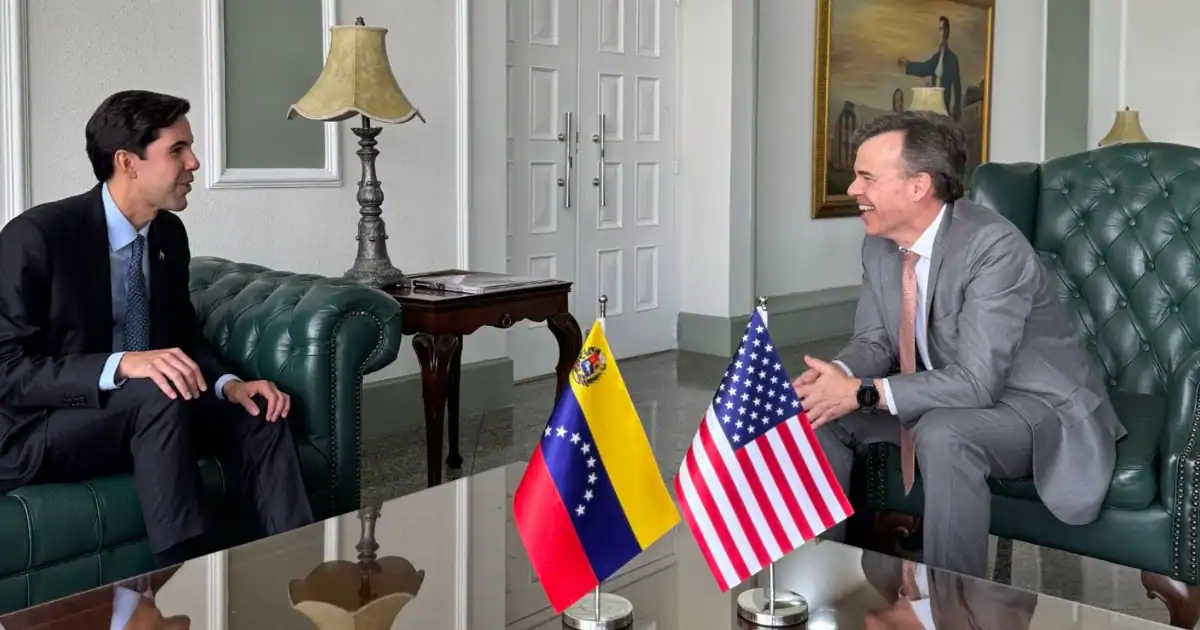
Dogu had framed her departure as a planned handover rather than a retreat. In her farewell statement she thanked President Trump and Secretary of State Marco Rubio for entrusting her with “the task of leading the implementation of their plan in Venezuela” and said the embassy team would continue advancing it “during this new stage of relations.”
That new stage is where Barrett inherits the brief. His background suggests Washington wants someone with deep regional roots rather than a short-term political appointee. Before Caracas, Barrett served as Chargé in Guatemala from January 2026, as Minister Counsellor at the US embassy in Panama from May 2023, as economic affairs counsellor in Peru, and as consul general in the Brazilian city of Recife.
He speaks Spanish and Portuguese. He has overseen humanitarian projects worth more than US$50 million. This is not someone being dropped into an acute crisis with no hemispheric grounding.
The three-phase Trump plan the Venezuela US envoy must now run
The plan Barrett has been sent to implement was outlined by Rubio on January 7, four days after US special forces captured Nicolás Maduro and his wife in a pre-dawn operation at Fuerte Tiuna in Caracas. Maduro was transferred to federal custody in New York to face narcoterrorism charges first announced in 2020.
Phase one is stabilization. Washington retains control over Venezuelan oil exports, allowing the supervised sale of up to 50 million barrels of crude under US oversight. Revenues sit in international accounts earmarked, in the administration’s framing, for the benefit of the Venezuelan people rather than the state.
Phase two is recovery. Western energy companies gain formal access to Venezuela’s oil sector, state oil company PDVSA is reformed to allow larger foreign stakes, and Trump has publicly committed to a US$100 billion investment framework. As the Rio Times documented this month, acting president Delcy Rodríguez has already passed a new Hydrocarbons Law in January and a new Mining Law on April 9 to operationalise this phase.
Phase three is the transition itself: supervised free elections, amnesty for political prisoners, the return of exiled opposition figures, and a formal handover of governance. Rubio’s target date is before the end of 2026. This is the phase Barrett has been sent to manage.
Why the third phase is the hardest one
The first two phases are, mechanically, trade and investment files that can be executed through sanctions and commercial deals. The third is a political contest with two centres of gravity: the Rodríguez government inside Venezuela, and the opposition network around María Corina Machado, the 2025 Nobel Peace Prize laureate who revealed new details of the Trump transition plan in an EFE interview on April 22.
Machado told EFE she maintains “communication” with figures inside the Venezuelan regime about a “peaceful transition process.” The statement was unusual in its precision. It confirmed what Washington analysts have been saying privately for months: the third phase is being negotiated through parallel channels, and Barrett’s embassy is only one of them.
The Inter-American Commission on Human Rights added complication on the same day Barrett arrived. In a statement on April 23, the Commission’s president Edgar Stuardo Ralón Orellana declared that 2025 had been a year of “consolidation of a dictatorial regime” in Venezuela under the pre-capture Maduro government.
The Commission also argued that any democratic transition should be accompanied by monitoring from human rights organisations. That framing pushes back against the Washington argument, as analysed in the Rio Times’ three-month review, that stability should be prioritised before democratisation.
The Delcy Rodríguez paradox the Venezuela US envoy inherits
The working reality Barrett steps into is a government that publicly demands Maduro’s release while privately cooperating with Washington on every major economic file. OFAC lifted sanctions on Venezuela’s Central Bank, three state banks, and Rodríguez herself in the first quarter of 2026.
Chevron expanded its Petroindependencia stake from 35.8% to 49% on April 13. The IMF projects Venezuelan GDP growth of 4% in 2026 and 6% in 2027.
At the same time, the minimum wage remains frozen at 130 bolívares, about US$0.27 at the official rate. Three minimum salaries now fit inside a single US dollar. CNN en Español reported on April 23 that Rodríguez has promised a “responsible” wage increase, but the structural improvement remains invisible to most Venezuelans.
Rodríguez, who called Maduro’s capture “barbaric” in public while accepting her role as acting president from the Supreme Tribunal, is the counterpart Barrett will work with daily. She is not a transitional figure in the classical sense. She has been vice president since 2018, oil minister, foreign minister, and finance chief.
Washington’s bet is that a cooperative Rodríguez is more useful than an elected opposition government that could refuse the investment terms already signed.
What to watch after the Venezuela US envoy’s first month
Three tests will define Barrett’s opening months. The first is whether the 50-million-barrel sale under phase one actually closes at the prices the White House has indicated, and whether the revenues end up where the Trump administration says they will.
The second is whether any release of political prisoners takes place on the path to phase three. The opposition’s baseline demand, backed by Machado and Edmundo González, is that detainees be freed before the formal transition is declared. Washington has so far not pushed hard on this file.
The third is the elections timeline itself. Rubio’s end-2026 target is ambitious. The institutional infrastructure of Venezuelan authoritarianism — a captured judiciary, a compliant security apparatus, a hollowed-out electoral council — remains intact under Rodríguez, and no independent electoral body currently exists that could run a supervised vote.
Barrett has shown, in Panama, Lima, and Recife, that he is comfortable inside Latin American bureaucratic ambiguity. Caracas in 2026 is a harder problem than any of those, because the ambiguity is the policy. Washington is negotiating, in public, with a government that Washington considers the remnant of the regime it just removed from power by military force.
The diplomat who ran US-Guatemala relations for three months is now being asked to turn that contradiction into a supervised democratic transition within nine months. If he succeeds, the Trump plan ends with an election before the 2027 calendar opens. If he does not, the phase-three framework collapses into whatever Rodríguez, Machado, and Trump negotiate directly.
Related coverage: Venezuela 2026 country guide • Delcy Rodríguez’s 100-day economic pivot • Oil flows, democracy doesn’t: Venezuela three months after Maduro
More: Latin America news in English, every day from The Rio Times.
This article was produced by The Rio Times’ automated newsroom system. How we use AI · Report an error · Editorial responsibility: Matthias Camenzind, Editor-in-Chief