Colombia Banana Exports Hit Record US$1.3B; Set to Fall in 2026
Key Facts
— —Colombia’s banana exports reached a record US$1.309 billion in 2025, up 21.6% from 2024, with 133 million 20-kilogram boxes shipped from 52,943 cultivated hectares.
— —The performance made Colombia the world’s fourth-largest banana exporter behind Ecuador, Guatemala and the Philippines, and the third-largest in Latin America — overtaking Costa Rica.
— —The European Union absorbed 65.8% of shipments, followed by the United States with 17.3% and the United Kingdom with 13.6%. Concentration in one bloc is now the sector’s main strategic risk.
— —Heavy rains in early 2026 have already flooded 1,200 hectares in Urabá. Augura projects exports will fall roughly 5% this year as El Niño and peso appreciation compound the pressure.
Colombia quietly became a top-four global banana exporter in 2025, with record revenues of US$1.3 billion. Then the floods arrived.
The Rio Times, the Latin American financial news outlet, reports that Colombia banana exports generated US$1.309 billion in sales in 2025 — a record for the sector and a 21.6% jump from 2024, according to the Asociación de Bananeros de Colombia (Augura). The country shipped 2.5 million tonnes, equivalent to 133 million boxes of 20 kilograms each, at an average yield of 2,516 boxes per hectare.
The performance was enough to move Colombia up one place in the global rankings. According to Augura president Emerson Aguirre, the country is now the world’s fourth-largest banana exporter behind Ecuador, Guatemala and the Philippines, and the third-largest in Latin America and the Caribbean. Costa Rica, which had historically occupied that regional position, was overtaken.
Where the Colombia banana exports come from
Production is concentrated in two zones. Urabá, the banana-producing region of Antioquia, holds 32,465 of the 52,943 cultivated hectares and generated 82 million of the 133 million exported boxes. The Caribbean zone — Magdalena, La Guajira and Cesar departments — holds 20,478 hectares and contributed 51 million boxes.
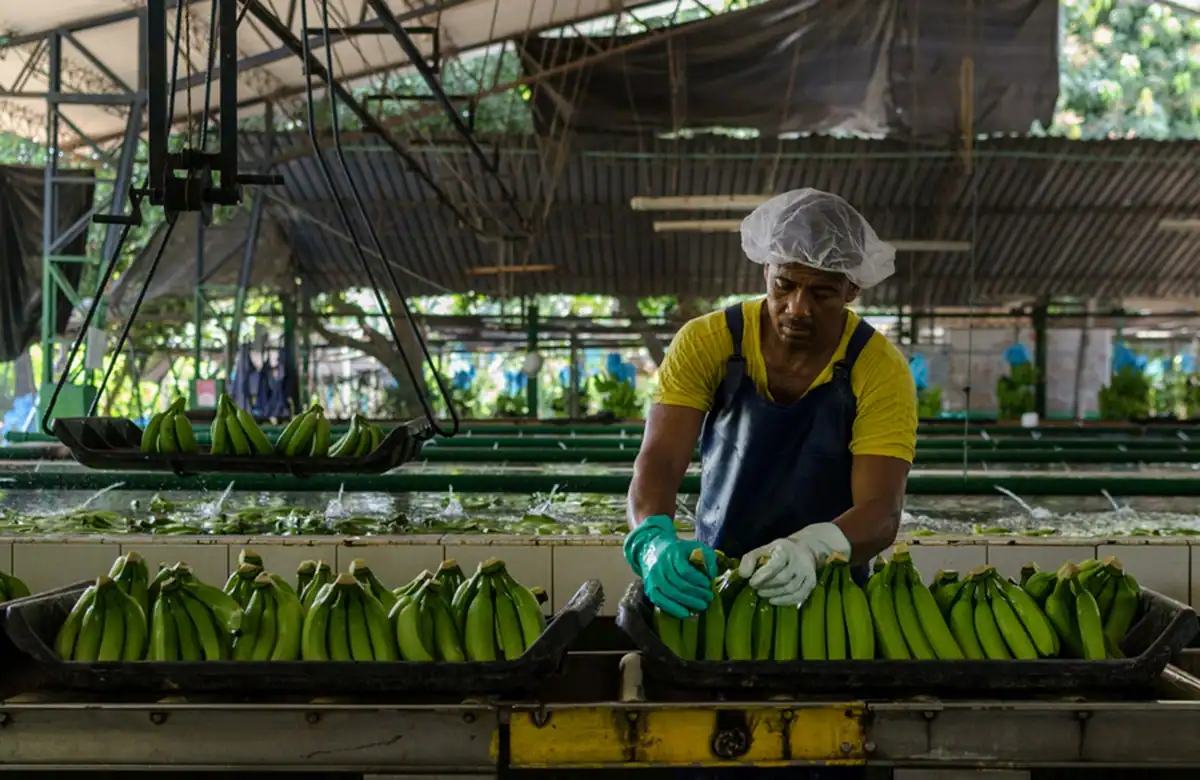
The sector supports more than 53,000 direct jobs — effectively one per hectare — and operates with one of the highest unionisation rates in Colombian agriculture. Augura describes the industry as one of the few in the country with sectoral wage negotiation.
By volume, bananas are Colombia’s largest agricultural export. By value, they rank third. Coffee, Colombia’s export icon, moves around 700,000 tonnes annually — less than a third of banana volume — but commands higher per-unit prices.
Where the boxes go
The market geography is heavily European. In 2025, the European Union absorbed 65.8% of Colombian banana exports.
The United States took 17.3% and the United Kingdom 13.6%. All other markets combined amounted to 2.2%.
That concentration is both a strength and a vulnerability. European buyers operate under some of the strictest sanitary, environmental and commercial standards in the world, and their willingness to pay for Colombian bananas confirms product quality. It also leaves the sector exposed to any regulatory shift in Brussels or to a European demand slowdown.
Augura has flagged diversification as a priority for 2026. The practical path runs toward Middle Eastern, East Asian, and Latin American markets, all of which currently sit inside the 2.2% residual category.
Why 2026 is already going the other way
The 2026 outlook is not a continuation of the 2025 trajectory. Heavy rains in the first months of this year flooded approximately 1,200 hectares of banana cultivation in Urabá. Augura projects the damage will translate into roughly a 5% drop in exports for 2026.
That figure does not yet include El Niño. The Colombian energy sector, as the Rio Times has documented in its firm-energy deficit analysis, is preparing for dry conditions expected within four months. Banana cultivation is water-intensive, and a prolonged dry period would compound the flood damage that has already registered.
The currency picture is the third pressure. Colombian bananas are sold in dollars and produced in pesos. The peso’s appreciation against the dollar over the past year has directly compressed producer margins.
José Francisco Zúñiga Cotes, president of the Magdalena bananeros association Asbama, put the point bluntly: “Colombian bananas are sold in dollars but produced in pesos. Every peso the dollar falls is a direct blow to producer profitability.”
The pricing problem underneath the record
Bananas trade globally at an average of roughly US$10 per box. Colombian producers represented by Augura argue that this price has not kept pace with rising labour and input costs. The country is, in effect, a price-taker in the global banana market — the volume and revenue record comes from producing more boxes, not from capturing higher per-box revenue.
That structural dynamic limits the upside even in strong years. It also means that when adverse conditions arrive — floods, El Niño, a strong peso — the sector has little pricing buffer to absorb them.
Augura has asked the national government for support measures aimed at protecting export competitiveness, rehabilitating flood-damaged areas, and advancing sanitary-and-traceability standards that international buyers increasingly require.
What to watch in Colombia banana exports after 2025
Three variables will define the 2026 trajectory. The first is the extent to which the 1,200 flood-damaged hectares can be replanted and returned to commercial yield within the year.
The second is El Niño severity. A moderate dry season is manageable with existing irrigation and drainage. A severe one compounds the already-projected 5% export decline and could push the contraction closer to 10%.
The third is the peso. The Colombian peso’s trajectory against the dollar matters more to banana-sector profitability than it does to most other export sectors because of the cost-denomination mismatch.
For investors and traders tracking Latin American agricultural commodities, the Colombian banana story is now specific. A country that quietly overtook Costa Rica in 2025 has already lost 2.3% of its productive area to floods before the dry season begins — and its revenue is denominated in a currency it does not control. The record is real, but the cycle turn is arriving faster than the producers wanted.
Related coverage: Colombia economy 2026 guide • Colombia firm-energy deficit and El Niño • Why Latin America is key to global commodities
More: Colombia news in English, every day from The Rio Times.
This article was produced by The Rio Times’ automated newsroom system. How we use AI · Report an error · Editorial responsibility: Matthias Camenzind, Editor-in-Chief