Petro Visits Caracas: Joint Border Security Plan With Delcy Rodríguez
Key Facts
— —President Gustavo Petro became the first head of state to officially visit Venezuela since Maduro’s January 3 capture, meeting interim President Delcy Rodríguez at Miraflores Palace on Friday April 24.
— —Both governments committed to “immediate” mechanisms for intelligence sharing and to elaborate “joint military plans” against criminal groups operating along the 2,219-kilometre shared border, including FARC dissident structures and ELN.
— —The Third Meeting of the Neighbourhood and Integration Commission, led by Foreign Ministers Yván Gil and Rosa Yolanda Villavicencio, advanced cooperation across seven sectors including health, environment, tourism, and air connections.
— —Within 24 hours of the summit, FARC dissidents detonated a cylinder bomb on the Panamericana highway in Cajibío, killing 19 civilians — an immediate and direct test of the security cooperation just announced.
Petro’s Caracas trip was framed as the diplomatic breakthrough of his presidency — the first foreign head of state to recognise Delcy Rodríguez’s interim government in person. Within twenty-four hours, the Cauca cylinder bomb made the trip’s security commitments operational rather than symbolic.
The Rio Times, the Latin American financial news outlet, reports that the Petro Caracas visit on Friday April 24 produced explicit commitments from Colombia and Venezuela to combat criminal groups operating along the 2,219-kilometre shared border. The summit, held at Miraflores Palace, was the first head-of-state visit to Venezuela since former president Nicolás Maduro’s January 3 capture in a US military operation.
“We have undertaken a very serious and concrete approach to combating criminal groups and transnational crime,” Rodríguez told the press at the entrance of Miraflores. She announced the “immediate” establishment of mechanisms for information sharing and intelligence development, alongside the elaboration of formal joint military plans.
Why the Petro Caracas trip happened now
The visit had been delayed once. A summit planned for Cúcuta on the Colombian side of the border had been cancelled at the last minute by Caracas a month earlier, with Venezuelan officials citing force majeure as the press was already waiting at the crossing. Petro responded by signalling during a Spain visit that he would travel to Caracas himself.
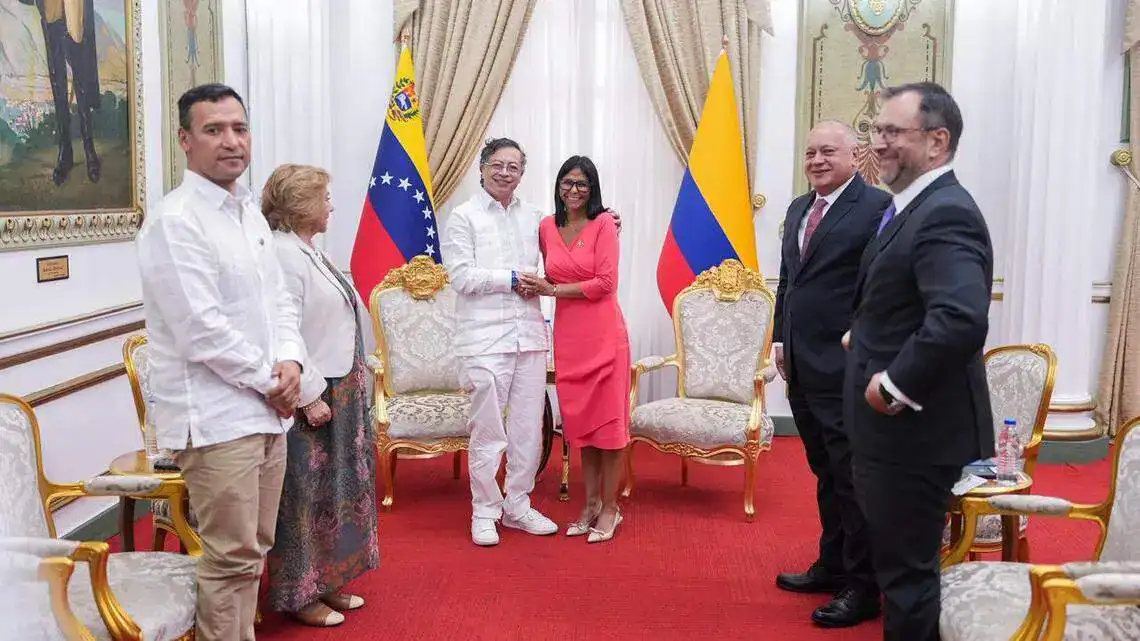
Petro framed it with a public remark that became widely cited: “If Mohammed will not come to me, I will go to the mountain.” The trip materialised on Friday April 24, with technical delegations from both countries beginning preparatory talks in the morning before Miraflores confirmed the meeting publicly.
The Colombian delegation was substantial. Defence Minister Pedro Sánchez attended along with the country’s senior military leadership, including Joint Chiefs commander Hugo Alejandro López. Foreign Minister Rosa Yolanda Villavicencio led the diplomatic track, opposite Venezuelan Foreign Minister Yván Gil.
The security cooperation announced in Caracas
The 2,219-kilometre Colombia-Venezuela frontier is one of the longest in the region and the operational base for multiple armed groups. The principal organisations active in the border zones include the National Liberation Army (ELN), the Estado Mayor Central (EMC) and Segunda Marquetalia descendants of the former FARC, and the Clan del Golfo.
The Catatumbo region, where Norte de Santander department borders Venezuela’s Táchira state, has produced sustained displacement and clashes between armed groups in recent months. Petro’s framing was operational. “If there is no intelligence, the bombs fall in the wrong place,” he said, proposing binational intelligence cooperation as the cornerstone of any joint security approach.
Petro also said both countries would work toward the “liberation of border communities” through coordinated military, police, and social action. The “social action” framing matters — Petro’s government has prioritised territorial development and social-investment approaches alongside security, rather than purely military responses.
The trade and energy track
The summit went beyond security. Rodríguez highlighted bilateral discussions on “import substitution” between the two countries, noting that current bilateral trade stands at approximately US$1.2 billion per year. “It makes no sense for Colombia or Venezuela to look to other regions or hemispheres for what we can produce within our own territories,” she said.
Energy cooperation was the second commercial track. Both governments confirmed advances on energy interconnection — a long-discussed but historically blocked agenda item. Ecopetrol‘s involvement in the bilateral energy conversation reflects the company’s strategic interest in Venezuelan reserves and infrastructure.
The Third Meeting of the Neighbourhood and Integration Commission, led by Foreign Ministers Gil and Villavicencio, formalised cooperation across seven sectors: security, health, environment, tourism, air connections, social affairs, and economic development. Air connections will catalyse “common multi-destination projects” between the two tourism sectors, Rodríguez said.
The Cauca bomb test 24 hours later
On Saturday April 25, less than 24 hours after the Caracas summit concluded, FARC dissidents from the Jaime Martínez column under “Iván Mordisco’s” Estado Mayor Central detonated a cylinder bomb on the Panamericana highway at El Túnel in Cajibío, Cauca. The attack killed 19 civilians and wounded 48.
The timing converted the Caracas commitments from political theatre into an immediate operational challenge. As the Rio Times documented in its analysis of the Cauca attack, the Joint Chiefs reported 26 separate terrorist actions across Cauca and Valle del Cauca in two days.
Joint Chiefs commander Hugo López — present at Miraflores hours earlier — interpreted the attacks as a response to the sustained pressure already being applied. The new Caracas-Bogotá cooperation framework, if it functions, removes the cross-border refuge that historically protected EMC and ELN structures from full Colombian military pressure.
The wider Petro Caracas regional signal
The summit also functions as a regional precedent. Petro’s recognition of Rodríguez as Venezuela’s interim president, by visiting Miraflores in person, is the strongest endorsement any sitting Latin American head of state has given the post-Maduro government.
The same day, Rodríguez also welcomed the Trump administration’s new chargé d’affaires John Barrett at Miraflores. Barrett held a separate private meeting alongside Diosdado Cabello and Foreign Minister Gil, focused on energy and a “long-term cooperation agenda.” The two diplomatic events on the same day reinforce that Caracas is reconstructing its external relations on multiple parallel tracks simultaneously.
Other Latin American governments have not yet formally recognised the Rodríguez interim. Brazil, Mexico, and Chile have remained cautious. Whether the Petro precedent triggers a regional cascade of recognitions is one of the open questions for the next several months.
What to watch after the Petro Caracas summit
Three variables now define the trajectory. The first is whether intelligence-sharing actually starts. Both countries have committed to “immediate” mechanisms, but operational intelligence cooperation requires liaison protocols, secure communications, and political trust that historically has been thin between the two countries.
The second is the Cauca response. The 19 civilian deaths in Cajibío convert the abstract commitment to combat criminal groups into an immediate political and operational test. Tangible binational action against the EMC structures responsible — versus continued Colombian unilateral operations — is the visible signal of whether the framework is real.
The third is regional follow-on. If Brazil, Chile, or Mexico move toward similar bilateral engagement with the Rodríguez government over the next 60 days, Petro’s visit becomes a regional pivot rather than a Colombian one-off. If they hold back, the bilateral remains an isolated diplomatic event in a still-disputed transition.
For investors and observers tracking the Andean security and political picture, the Petro Caracas trip is the most consequential diplomatic event of Petro’s final eighteen months in office. Whether the agreements deliver — or whether the Cauca attack reveals their limits — will define how the Colombia-Venezuela relationship looks when the next Colombian president takes office in August.
Related coverage: Cauca bomb attack • Petro-Delcy trade summit • US envoy Barrett in Caracas
More: Colombia news in English, every day from The Rio Times.
This article was produced by The Rio Times’ automated newsroom system. How we use AI · Report an error
Read More from The Rio Times