Caracas Pivots to Europe After US Sanctions Relief
Key Facts
— — Interim president Delcy Rodríguez publicly asked the United States and Europe to end sanctions on Venezuela, pivoting an economic appeal Washington has partly answered toward a Europe that has not.
— — The US Treasury removed Delcy from the SDN list on April 1 and on April 14 issued new licenses letting Venezuela’s Central Bank and three state lenders transact in dollars, partially reconnecting Caracas to the US-run financial system.
— — EU and UK sanctions on Delcy remain in force, and street protests over a frozen 130-bolívar minimum wage worth roughly US$0.27 add domestic urgency to her foreign appeal.
Venezuela sanctions relief has moved from a Washington-only negotiation to a two-front appeal. Interim president Delcy Rodríguez this week asked the governments of the United States and Europe to end the restrictions still weighing on her country, framing the request not as charity but as the legal certainty foreign investors need to commit capital to Venezuela.
The Rio Times, the Latin American financial news outlet, reports that the appeal lands at a calibrated moment. Washington has already moved significantly since the January 3 US military operation that captured Nicolás Maduro and brought Rodríguez into the interim presidency, while Brussels and London have not.
“I speak to the people of the United States, I speak to the peoples of Europe, I speak to their Governments, to their authorities: enough sanctions against the noble Venezuelan people,” Rodríguez said, adding that Venezuela was not asking for alms but “claiming its rights.”
What Washington Has Already Lifted
On April 1, the US Office of Foreign Assets Control removed Rodríguez from the Specially Designated Nationals list, unfreezing her US-linked assets and allowing her to conduct business with American counterparties. On April 14, Treasury issued fresh licenses that permit transactions with the Central Bank of Venezuela, Banco de Venezuela, Tesoro, and Banco Digital de los Trabajadores — reconnecting the state financial system to the US dollar after years of exclusion.
Those decisions build on a broader normalization that has unfolded since Rodríguez took office on January 5 following Maduro’s capture. The US reopened its Caracas embassy this month, currently approves all Venezuelan oil sales abroad, and channels the proceeds into a US-controlled bank account.
The incremental design is deliberate. Treasury has used licenses rather than a blanket rollback to preserve leverage over a government it wants to keep on a cooperative path while avoiding a rapid political normalization that Congressional critics would reject.
Why Rodríguez Is Now Pressing Europe
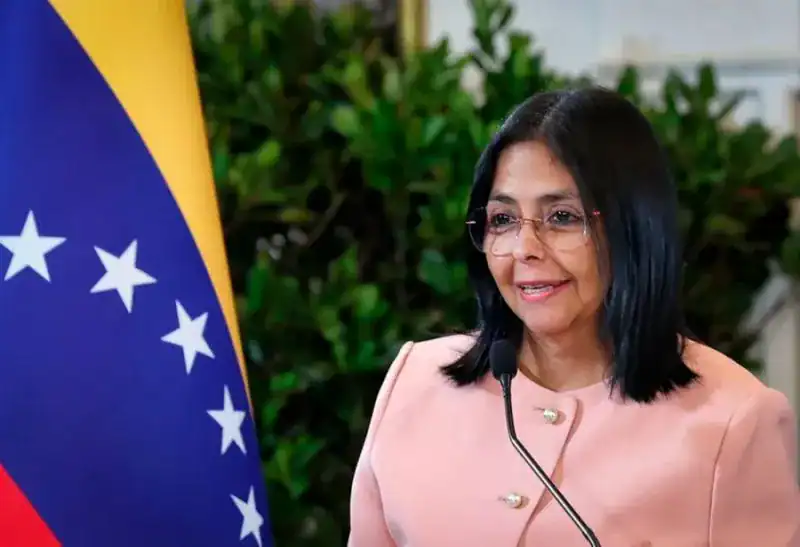
European Union sanctions on Rodríguez personally date back to June 2018 and include an asset freeze and an EU travel ban. The United Kingdom added her to its list in 2020, and both regimes remain in force. The European Commission has not yet answered press inquiries about whether it is reviewing Rodríguez’s designation in light of Maduro’s removal.
For Caracas the asymmetry matters commercially. Spanish oil major Repsol, French group Maurel & Prom, and Italian energy interests all need European regulatory cover before returning in scale, even if US licenses are in place. European banks hesitate to settle transactions when an individual at the top of a counterparty government is still EU-listed.
Rodríguez framed the appeal accordingly, arguing Venezuela needs to be “free of sanctions” to offer investors “institutional legal certainty” and “sustained investment over time.” That language is aimed at European capitals and at the corporate legal departments that shape their business decisions.
The Domestic Pressure Behind the Sanctions Relief Appeal
Street pressure in Caracas is the other half of the story. Public-sector workers demonstrated last week demanding higher wages and pensions. The minimum wage has been frozen at 130 bolívares since March 2022 — about US$0.27 at the official rate — because raising it would have required either money printing or access to dollar revenues the sanctions regime blocked.
Rodríguez has raised the monthly public-sector bonification from US$160 to US$190 and promised an undisclosed May 1 salary increase. The April 14 banking licenses give her the technical basis to fund such a move without reigniting hyperinflation, but only if state lenders actually receive dollar inflows at scale from oil revenues and the Treasury-approved accounts.
The commercial side is moving fast. Chevron struck a new production-expansion deal with Caracas this month and is targeting 300,000 barrels per day from its Petroindependencia venture, up from roughly 260,000. Venezuelan oil output reached 1.095 million barrels per day in March, according to Al Jazeera citing OPEC-adjacent figures.
The Interim Presidency’s Strategic Bet
Rodríguez’s calculation is visible in the structure of her appeal. She cannot afford to criticize Washington, which holds her in power; she can and does publicly pressure Europe, whose sanctions constrain economic recovery but not her political survival. Cooperating with the US while demanding more from Brussels squares both circles.
That playbook also fits the pattern of her first 100 days in office. Rodríguez rewrote the Hydrocarbons Law on January 29 and the Mining Law on April 9, hosted US Energy Secretary Chris Wright and Interior Secretary Doug Burgum in Caracas, and secured the OFAC delisting of the Central Bank and three state banks — all while demanding Maduro’s release in every public speech.
The cabinet rebuild tells the same story. As earlier Rio Times coverage of the Rodríguez reshuffle documented, she has replaced 14 of 32 ministers since January, consolidating personal control while keeping the Chavista political frame intact.
What Markets Will Watch Next on Venezuela Sanctions Relief
Three moves will signal whether the sanctions relief sequence continues or stalls: the EU’s response to Rodríguez’s appeal, where any review of her personal designation would be read as political recognition of the post-Maduro arrangement. The second is the size and financing of the May 1 wage increase. The third is whether Treasury extends the April 14 licenses to PDVSA-linked financial arms or stops at the state banks.
The Rio Times Latin America oil and energy guide tracks the broader commercial reopening. The investment thesis for Venezuela turns on whether the country can sustain the legal and financial architecture the US has begun to rebuild, and whether Europe will agree to walk the same path.
For now, the Venezuela sanctions relief trajectory is real but partial. Rodríguez has a dollar tap that did not exist in January and a European problem that did. Closing that second gap is the project her Tuesday appeal was designed to launch.
More: Latin America news in English, every day from The Rio Times.
This article was produced by The Rio Times’ automated newsroom system. How we use AI · Report an error · Editorial responsibility: Matthias Camenzind, Editor-in-Chief