Peru Election Crisis Deepens as Street Protests Follow López Aliaga’s Fraud Claims
Peru’s presidential runoff has since taken place. Keiko Fujimori won the vote of 7 June 2026 with 50.135 percent against Roberto Sánchez’s 49.865 percent, a margin of 49,641 votes, and was sworn in on 28 July 2026. The article below describes the situation as it stood at the time of publication. Read the result →
Key Facts
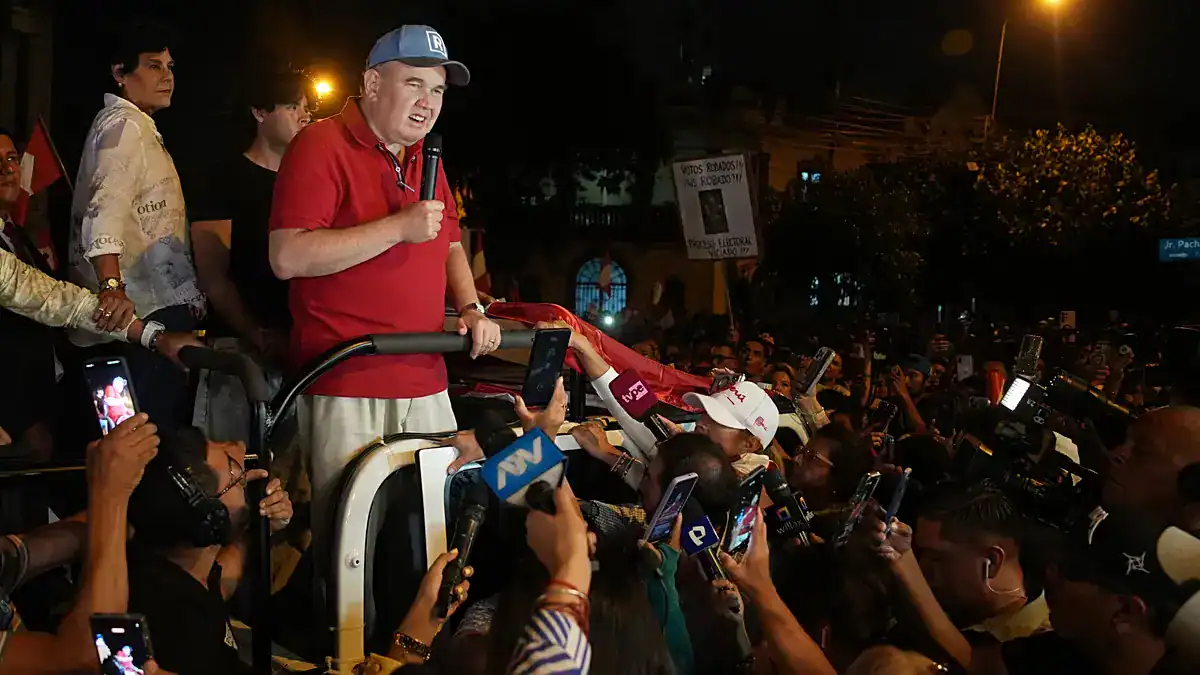
— — Approximately 3,000 supporters of conservative candidate Rafael López Aliaga protested in Lima on Saturday against the April 12 presidential election results, which show him losing the second-place slot — and the June 7 runoff — to left-wing candidate Roberto Sánchez by roughly 13,000 votes at 93% counted
— — López Aliaga has called on followers to commit “insurgency,” demanded the JNE annul the election, offered 20,000 soles (US$5,800) to electoral workers who provide fraud evidence, and called the ONPE chief a criminal — all without presenting any proof of systematic fraud
— — Peru’s prosecutor general has said he has “not identified any question of fraud or cause for nullity,” and JNE president Roberto Burneo acknowledged logistical irregularities in election organization but not manipulation of votes — final results may not come until mid-May as 5,766 challenged ballots are resolved
— Deep Dive
— For the complete picture, see our guide: Peru Elections 2026.
The Rio Times, the Latin American financial news outlet, reports that the Peru election protests that erupted Saturday represent the latest escalation in a post-election crisis that has already crashed the Lima stock exchange 4.16% and sent the sol to its worst day in six weeks. Three thousand López Aliaga supporters gathered outside the electoral tribunal demanding the annulment of an election that, by all official measures, was conducted without systematic fraud.
The numbers tell the story clearly: with 93.3% of ballots counted, Keiko Fujimori leads at 17.06%, Roberto Sánchez holds second at 12.00%, and López Aliaga sits third at 11.92% — a gap of roughly 13,000 votes that is expected to widen as remaining ballots arrive from southern highland regions where Sánchez dominates.
The Peru Election Protests Playbook Echoes Across the Americas
López Aliaga — the billionaire hotel and railway magnate who styled himself as Peru’s answer to Trump and Milei — has deployed a post-election strategy that will look familiar to anyone who has watched contested elections in the United States, Brazil, or Bolivia in recent years. He has called the ONPE chief “a criminal,” told supporters to prepare for “insurgency,” compared the count to Venezuelan-style fraud, and offered cash bounties to electoral workers who provide evidence of manipulation.
The bounty offer — 20,000 soles (US$5,800) posted to his social media accounts before being deleted — was especially notable. It amounted to an open solicitation for fabricated evidence from the very officials responsible for counting the vote. Sánchez responded by threatening to call his own mobilization if “political actors insist with the fraud narrative despite having no proof.”
What the Institutions Are Saying
Peru’s prosecutor general Tomás Gálvez said publicly that he has “not identified any question of fraud or any cause for nullity.” JNE president Roberto Burneo acknowledged “serious irregularities” in the election’s organization — particularly delays in opening polling stations and problems with the ballot distribution contract with supplier Galaga — but distinguished between logistical failures and vote manipulation. The JNE has 5,766 challenged ballots under review by 60 special electoral juries, with final results possibly not arriving until mid-May.
The police have been ordered to increase security at airports, borders, and checkpoints to prevent a potential flight by the ONPE chief Piero Corvetto — an extraordinary measure that underscores the institutional tension even as the fraud narrative lacks evidence. López Aliaga’s own earlier statement that he would “not recognize any result even if he is the one who advances to the runoff” reveals the strategy: delegitimize the process regardless of outcome.
What This Means for the June 7 Runoff
If the count holds — and every official indicator says it will — Peru faces a Fujimori-vs-Sánchez runoff that pits institutional conservatism against the left-wing successor to Pedro Castillo’s movement. For copper markets, mining investors, and the region’s geopolitical alignment, the shift from a guaranteed right-right runoff to a right-left contest introduces uncertainty that has already repriced Peruvian risk assets.
López Aliaga’s street strategy is unlikely to change the arithmetic but may succeed in poisoning the legitimacy of whoever wins. In a country that has seen six presidents in five years and a congressional impeachment machine that destroyed every administration since 2016, institutional trust was already fragile. Saturday’s 3,000-person protest is small by Latin American standards — but in a country this unstable, even small fires can spread.
More: Latin America news in English, every day from The Rio Times.
This article was produced by The Rio Times’ automated newsroom system. How we use AI · Report an error · Editorial responsibility: Matthias Camenzind, Editor-in-Chief
In depth