Argentina, Chile Join US AI-Minerals Bloc Aimed at China
Trade
Key Facts
A United States alliance built to wrestle the artificial-intelligence supply chain away from China has just opened a Pax Silica Latin America front, and the region’s lithium is the prize.
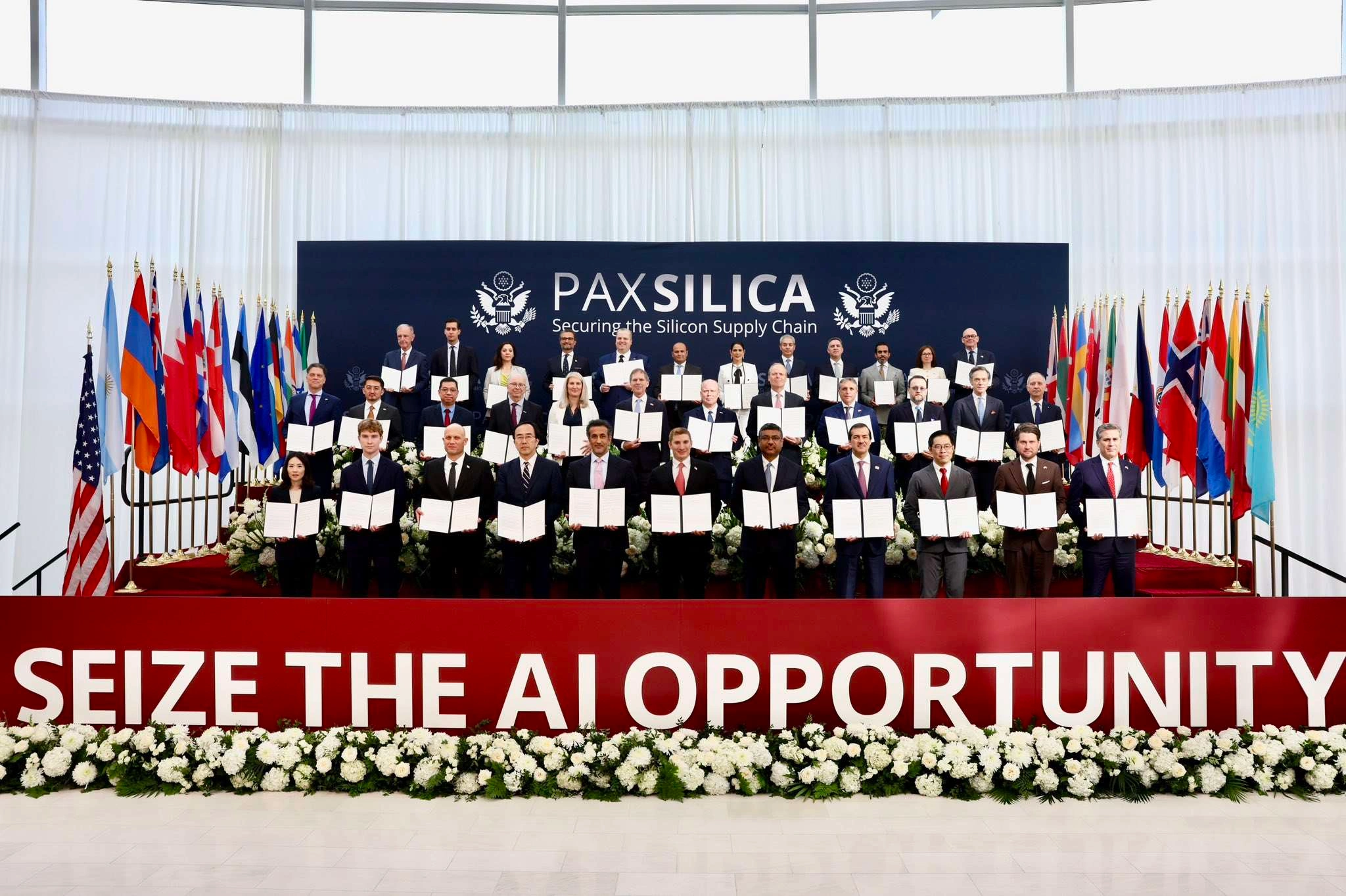
For the first time, economies from the Western Hemisphere have signed on to Pax Silica, the United States-led pact for securing the materials and machinery behind artificial intelligence. At a summit in Washington this week, Argentina, Chile, Costa Rica, Panama and Kazakhstan were named as new members.
The deputy secretary of state, Christopher Landau, said it marked the first time the hemisphere had joined the initiative. His pitch was blunt: no single nation holds every link in these supply chains, and pooling them is how free-market economies outrun a command economy.
To a reader in London or Munich, the names matter less than the pattern. Washington is assembling a club of countries it trusts to build the physical underpinnings of the AI economy, and it has decided South America’s mineral belt belongs inside the tent.
What Pax Silica Latin America actually signs up for
The Pax Silica Latin America accession is best understood as the second act of a deliberate plan. The bloc launched in December 2025 with a technology-heavy founding group, including Japan, South Korea, Singapore, the United Kingdom, Israel and the United Arab Emirates.
This year’s expansion has been pointedly different. The new entrants are resource and processing nations rather than chip makers, a shift that pulls in the raw inputs rather than the finished hardware.
That is the strategic logic in one line. The architects of the pact have concluded that the real chokepoint in the AI supply chain sits at the mineral layer, not the chip layer, and Latin America is where a large share of those minerals lie.
The State Department, in its official declaration, frames the effort as a new economic-security consensus among trusted partners, spanning everything from energy and critical minerals to high-end manufacturing and the AI models themselves. It is, in the department’s own phrase, an attempt to build the AI ecosystem of tomorrow among aligned states.
The unspoken word in all of it is China. Officials are open that the goal is to reduce dependence on supply chains dominated by Beijing, which currently refines an estimated sixty to seventy percent of the world’s lithium into battery-grade chemicals no matter where the rock comes out of the ground.
Why Argentina is the centre of gravity
Among the new members, Argentina is the one to watch, and not only because it sits on part of the so-called lithium triangle it shares with Chile and Bolivia. The interesting part is how the country is being positioned.
The framework casts Argentina not as a supplier of raw brine but as a midstream processor, expected to turn out the refined lithium hydroxide and carbonate that battery cells actually use. That distinction is where the money is, because battery-grade chemical commands a steep premium over unprocessed brine and keeps more of the value inside the producing country.
Foreign minister Pablo Quirno tied the accession directly to domestic policy, casting Argentina as a reliable supplier of the critical minerals the AI build-out needs. He linked it explicitly to the incentive regime now moving through Congress.
That regime is the “Super RIGI,” the law offering thirty years of tax, customs and currency stability to brand-new billion-dollar projects in industries such as AI, data centres, semiconductors and lithium. It cleared the lower house on June 24, two days before the Pax Silica announcement, and the timing was not a coincidence.
Read together, the two moves form a single offer to global capital. Pax Silica supplies the geopolitical demand signal and a measure of Washington’s blessing, while the Super RIGI supplies the domestic guarantees a thirty-year refinery investment would demand.
Why a foreign reader should care
For an investor weighing the region, this is the clearest sign yet that Latin America’s minerals are being folded into the central economic contest of the decade. The continent is no longer a bystander to the AI-and-chips story; it is being cast as the resource floor beneath it.
The honest reading also requires the caveats, and they are substantial. The Pax Silica Declaration is non-binding, closer to a shared statement of intent than an enforceable treaty, and a roughly two-hundred-and-fifty-million-dollar fund is a rounding error against the tens of billions a serious refining build-out would cost.
There is a harder constraint too: moving from digging to refining needs power, water and skilled labour that Argentina’s lithium provinces are still assembling, and the country’s long record of currency turmoil is exactly the risk the Super RIGI is trying to insure away. Whether thirty years of promised stability is believed is the whole question.
Still, the direction of travel is unmistakable, and it rewards watching rather than dismissing. If even a fraction of the processing capacity the framework imagines is actually built, the map of where the world’s battery chemicals come from would start to shift south and west, away from the single country that dominates it today.
Frequently Asked Questions
What does Pax Silica Latin America membership mean for Argentina and Chile?
It places both countries inside a United States-led club designed to secure the AI supply chain, with access to a shared investment fund and a political signal that Washington views them as trusted minerals partners. For Argentina specifically, the framing positions it as a midstream processor of battery-grade lithium rather than a raw exporter, which is where the higher margins sit.
What is Pax Silica and who leads it?
Pax Silica is a United States-led initiative launched in December 2025 and coordinated by the State Department to secure supply chains for semiconductors, critical minerals and artificial intelligence. It has grown from eight founding members to around twenty-four, and its central purpose is to reduce Western dependence on China, which dominates the refining of rare earths and lithium.
How does the Super RIGI connect to the deal?
The Super RIGI is an Argentine law offering thirty years of tax, customs and currency stability to new billion-dollar projects in fields such as AI, lithium and semiconductors, and it cleared the lower house on June 24. It functions as the domestic mechanism that could turn Pax Silica membership into actual refineries, by giving long-horizon investors the legal guarantees a processing plant requires.
Connected Coverage
› Argentina’s Lower House Backs Milei’s Super RIGI Investment Plan
› Kenya Nears a Critical Minerals Deal With the US on Its Own Terms
Read More from The Rio Times