Mexico Stock Market Holds Above 70,000 Despite Hot US Inflation Data
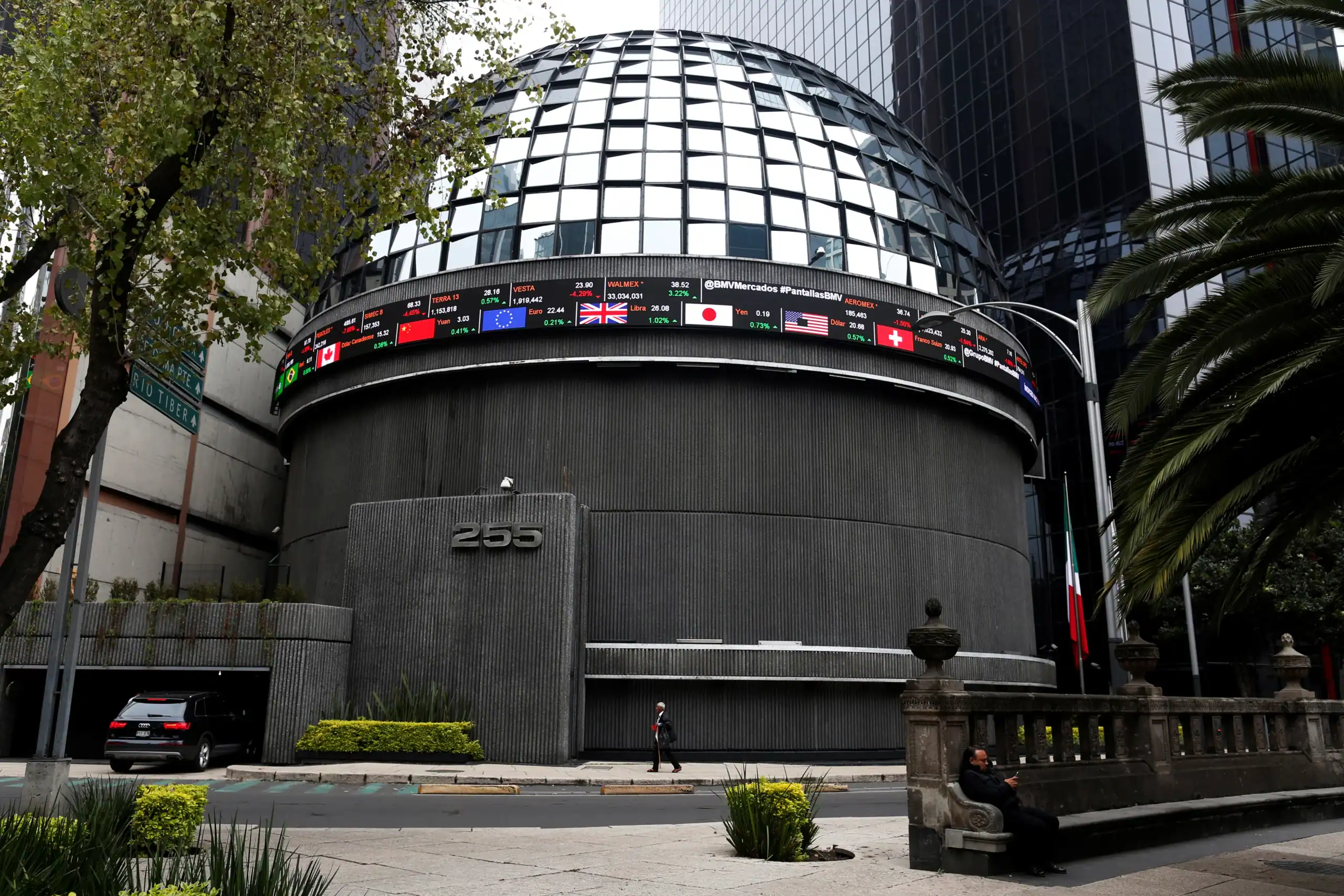
The S&P/BMV IPC fell 0.30% to 70,036.66 on Tuesday May 12, 2026 — a third consecutive close above the 70,000 psychological level despite a hot US April CPI print at 3.8% year-on-year. The Mexican peso held near MXN 17.30 per dollar while Brazil’s Ibovespa fell 0.86% and Colombia’s COLCAP dropped to a new 2026 low. Banxico’s May 7 cut to 6.50% remains the structural anchor. Next: US PPI Wednesday at 08:30 ET.
The Big Three
The S&P/BMV IPC closed at 70,036.66 on Tuesday — down 0.30% (−209.64 points) but the third consecutive session above 70,000 despite the broadest LatAm risk-off of 2026. Intraday range 69,577.54–70,313.83. The session opened at 70,228, briefly tested below 70K at the low, then recovered to close inside the consolidation range. Crucially, the IPC held its bid even as US April CPI printed 3.8% year-on-year (highest since May 2023), Brazil’s Ibovespa fell 0.86% to 180,342, and Colombia’s COLCAP dropped 0.97% to a new 2026 low at 2,088, per BMV data and TradingView at the May 13 06:48 UTC snapshot.
The technical setup remains constructive despite Tuesday’s pullback. The MACD histogram at +183.92 has cooled from Monday’s +111 peak in absolute terms but the line at +341.11 versus signal at +157.19 is still expanding bullish. RSI fast at 57.11 versus slow at 50.81 — both above the neutral 50 line with no overbought signal. The 20-day SMA at 68,982 is now firm support, the 50-day at 68,789 sits just below, and the 200-day SMA at 67,835 is 3.2% under price. The cycle high from Monday at 70,717 is the immediate resistance, with the February 12 ATH at 72,111 still 2.96% above.
The LatAm divergence is now extreme. Tuesday delivered the cleanest separation of 2026: Mexico’s IPC holds 70K, Brazil’s Ibovespa breaks below 180K intraday, Colombia’s COLCAP makes a third consecutive new low at 2,088, and Argentina’s Merval approaches its capitulation low ahead of Thursday’s INDEC CPI. The Banxico cut to 6.50% on May 7 is doing what the BCB, BanRep and BCRA cuts have not — providing fundamental risk-on cover. The World Cup kickoff is 30 days away (June 11), the USMCA review (July 1) consensus expects the agreement intact, and nearshoring FDI was $40.9 billion in 2025. The structural case is now being validated by price.
03 Key Movers
Winners
Domestic-economy names continued to lead the IPC’s outperformance. América Móvil (AMX) — the index’s second-largest component — bid through the session on continued institutional rotation into Mexican telecoms. Walmart de México (WALMEX) held the prior session’s gains as Banxico’s lower rate path supports consumer credit. Grupo México (GMEXICO), the index’s heaviest weight at ~91 billion pesos market cap, was supported by stable copper prices. The airport operators — ASUR and GAP — continued the World Cup-demand-cycle trade with the June 11 kickoff now just 30 days away. Industrial Peñoles (PE&OLES) extended its annual gain — now +130% YoY — on continued gold and silver strength.
Losers
Profit-taking from Monday’s cycle high was the dominant theme rather than broad selling. Banks (Banorte, Inbursa) were modestly lower on the curve-steepening effect of hot US CPI, but the moves were contained relative to peers in Brazil (Bradesco −2.69%) and Colombia (Davivienda −2.94% on the week). Cuervo, the index’s worst-performing component over 12 months (−33.64% YoY), continued its drift lower on weak Q1 spirits-volume numbers. The breadth was constructive: no IPC component fell more than 2% on the session.
Key Facts
— Tuesday was the cleanest test of Mexico’s LatAm-leader thesis since the April correction bottom. The hot US April CPI print at 3.8% year-on-year — the highest since May 2023 — should have, in theory, hit every emerging market equity through the global rates and dollar channels. It did hit Brazil and Colombia. It did not hit Mexico to the same degree. The reason is Banxico’s May 7 rate cut to 6.50%, which preceded the data shock by five days and effectively pre-loaded the easing impulse. While the BCB is now data-dependent on its June 17–18 cut, the BanRep is paralyzed by election risk, and the BCRA is fighting for survival ahead of Thursday’s INDEC CPI, the IPC is trading on a settled policy reaction function.
— The micro evidence is consistent. The IPC has now closed above 70,000 in three consecutive sessions for the first time since the February all-time-high period. The MACD histogram has cooled from Monday’s +111 to Tuesday’s +184 on the line but remains expanding above signal — the technical pattern that historically produces breakouts to fresh highs rather than reversals. Volume has supported the move: the May 7 Banxico-cut session showed a third consecutive bullish expansion in MACD, and three more sessions have built on that base.
— The structural overlay is what makes the Mexico trade different from the rest of LatAm right now. Nearshoring foreign direct investment hit $40.9 billion in 2025. The Sheinbaum-Trump USMCA bilateral channels have produced no shocks — the consensus heading into the July 1 mid-term review is that the agreement remains intact with limited cosmetic changes. The World Cup kickoff in 30 days is a tangible inflow catalyst (FIFA-affiliated tourism, hospitality, retail) that the airport operators and consumer names are pricing. The peso at MXN 17.30 is roughly two pesos stronger than its 2026 low in March. Nothing in this matrix is broken yet — and Tuesday’s session was the market saying so.
Live Market IntelligenceMexico — Live Market Board
Rio Times · Live Market Intelligence
Mexico — Live Market Board
+1.63%
209,066.90
+1.38%
66,048.57
+1.63%
11,043.36
+0.17%
2,828,027
-0.16%
2,531.15
+0.00%
60,956.11
-0.51%
| Instrument | Last | Change | YoY | Prev. | High | Low | Volume |
|---|---|---|---|---|---|---|---|
| IPC MEX | 66,048.57 | +1.63% | +12.17% | 64,986.91 | 66,121 | 65,405 | 108,886,187 |
| USD/MXN | 17.06 | -0.24% | -8.58% | 17.10 | 17.08 | 17.01 | — |
| WALMEX | 48.07 | -0.62% | -14.38% | 48.37 | 48.65 | 48.02 | 10,781,446 |
| GMEXICO | 223.28 | +0.35% | +73.59% | 222.50 | 226.18 | 222.17 | 1,325,556 |
| FEMSA | 201.19 | -0.24% | +25.67% | 201.67 | 206.71 | 199.56 | 750,706 |
| CEMEX | 19.32 | +0.89% | +19.10% | 19.15 | 19.35 | 19.04 | 14,327,054 |
| GFNORTE | 193.98 | +1.18% | +14.36% | 191.71 | 195.79 | 191.83 | 1,579,115 |
| BIMBO | 60.98 | -0.96% | +11.89% | 61.57 | 61.46 | 60.29 | 1,048,115 |
| TELEVISA | 9.71 | +0.21% | +12.78% | 9.69 | 9.75 | 9.60 | 577,851 |
| AMX | 19.80 | -0.95% | +12.53% | 19.99 | 20.05 | 19.70 | 58,058,525 |
| GAP | 366.23 | +0.43% | -21.21% | 364.68 | 370.85 | 362.82 | 226,946 |
| ASUR | 275.04 | +1.25% | -15.28% | 271.64 | 275.08 | 271.31 | 15,451 |
| OMA | 233.50 | +0.62% | -6.48% | 232.06 | 235.00 | 230.62 | 555,693 |
| KOF | 188.04 | +0.86% | +18.94% | 186.44 | 188.56 | 185.52 | 425,273 |
| GRUMA | 252.90 | +0.11% | -21.85% | 252.61 | 254.74 | 250.36 | 90,048 |
| KIMBER | 39.74 | +0.43% | +8.85% | 39.57 | 40.09 | 39.33 | 490,551 |
| AMX ADR | 23.38 | -0.23% | +22.25% | 23.43 | 23.49 | 23.06 | 1,347,445 |
05 Technical Analysis
The IPC daily chart shows the index closing at 70,036.66 just 36 points above the 70,000 psychological level — but the intraday low at 69,577 briefly pierced below it before the close recovered. Tuesday’s candle is a small doji-like bearish bar with the open at 70,228, close at 70,036, low at 69,577 — the longest lower wick of the past five sessions, indicating dip-buyers active below 70K. The 20-day SMA at 68,982 and 50-day SMA at 68,789 are stacked just below as the first support tier, with the cloud edge at 68,343 reinforcing.
Momentum: The MACD histogram at +183.92 remains positive but has compressed from Monday’s +111 peak — the third bullish bar after the May 7 cross. The MACD line at +341.11 is well above signal at +157.19, an expanding bullish stack. RSI fast at 57.11 with slow at 50.81 is in healthy uptrend territory with no overbought signal (the 70 RSI threshold would only be reached above the February ATH).
The cycle high from Monday May 11 at 70,717 is the immediate resistance to clear; above it, the upper Bollinger Band at 70,882 and then the open road to the February 12 ATH at 72,111 (2.96% above Tuesday’s close). The 200-day SMA at 67,835 is deep support 3.2% below — the structural line a bear case would need to break.
06 Forward Look
07 Questions & Answers
Key Facts
— The Mexico stock market enters Wednesday with the IPC consolidating above 70,000 for the third consecutive session — the most resilient performance of any major Latin American equity index through Tuesday’s hot US CPI shock. The technical structure remains intact (MACD bullish, RSI 57, all moving averages stacked below price), the fundamental anchor (Banxico at 6.50%) was delivered before the macro test, and the catalyst calendar (World Cup, USMCA review, Q1 earnings tail) remains supportive. The path of least resistance is toward the 70,717 cycle high and then the 72,111 February all-time high — provided 70,000 holds on every retest.
— For Monday’s setup that produced the cycle high see Mexico Stocks at 70,246 — New Cycle High, MACD +111. For the regional comparison see Colombia COLCAP Falls to 2,088 on Vote Risk and Tuesday’s Ibovespa coverage.
Disclaimer: This analysis is for informational purposes only and does not constitute investment advice. Emerging-market equity markets carry political and currency risk. Always consult a licensed financial advisor. Published by The Rio Times.
More: Latin America news in English, every day from The Rio Times.
This article was produced by The Rio Times’ automated newsroom system. How we use AI · Report an error · Editorial responsibility: Matthias Camenzind, Editor-in-Chief
LatAm Markets: Live Signals → — real-time movers, turnover leaders and FX across Latin America.