World’s Largest Trade Zone Activates Friday: Mercosur-EU
Key Facts
— — Brazilian President Luiz Inácio Lula da Silva signed the promulgation decree Tuesday April 28, formalizing the entry into force of the Mercosur-EU trade deal on Friday May 1 — ending 26 years of negotiations between the two blocs and creating the largest South-South-North free-trade zone in modern history. Coverage: 31 countries (27 EU + 4 Mercosur), 720 million inhabitants, US$22 trillion combined GDP. Brazilian Senate ratification completed in March 2026. EU Commission applies the deal provisionally despite a pending Court of Justice review requested by the European Parliament.
— — Tariff schedule: Mercosur (Brazil, Argentina, Uruguay, Paraguay) eliminates tariffs on 91 percent of EU goods over 15 years; EU eliminates tariffs on 95 percent of Mercosur exports over 12 years. The asymmetric phase-in reflects Mercosur’s structurally higher tariff baseline. EU agricultural protection through tariff-rate quotas on beef, poultry, ethanol, and rice remains. Industrial manufacturing tariffs disappear faster than commodity-export schedules.
— — Implementation: Lula, Argentine President Javier Milei, Uruguayan President Yamandú Orsi, and Paraguayan President Santiago Peña hold a videoconference Friday May 1 with European Commission President Ursula von der Leyen and European Council President António Costa to mark the entry into force. Same day, Lula sent the Mercosur-Singapore agreement and the Mercosur-EFTA (Switzerland, Norway, Iceland, Liechtenstein) agreement to Brazilian Congress for ratification — adding access to 290 million additional consumers and US$4.39 trillion in combined GDP.
The Mercosur-EU trade deal enters force Friday May 1 — 26 years after negotiations began — creating a free-trade zone covering 720 million people and US$22 trillion in combined GDP, the largest such activation in modern global history.
Latin America’s most consequential trade-policy moment in a generation just locked in. The Rio Times, the Latin American financial news outlet, reports that the Mercosur-EU trade deal enters force Friday May 1 after Brazilian President Luiz Inácio Lula da Silva signed the promulgation decree Tuesday April 28 — ending 26 years of negotiations and creating a free-trade zone of 31 countries, 720 million inhabitants, and US$22 trillion in combined GDP, with the European Commission applying the agreement provisionally despite a pending European Court of Justice review.
“The response that the European Union and Brazil are giving the world is that there is nothing better than to believe in the practice of democracy, in multilateralism, and in cordial relations between nations,” Lula said at the Palácio do Planalto signing ceremony. “This is the example we set with this agreement.” The framing is deliberate — Lula is positioning the agreement as a structural counterweight to Trump-era unilateral tariff escalation.
The Mercosur-EU Trade Deal Mechanics
The asymmetric tariff schedule reflects Mercosur’s structurally higher tariff baseline. Mercosur eliminates tariffs on 91 percent of European goods over 15 years; the EU eliminates tariffs on 95 percent of Mercosur exports over 12 years. The differential supports Mercosur’s nascent industrial-protection framework while allowing EU manufacturers gradual access to the South American consumer base.
European agricultural protection remains intact through tariff-rate quotas on sensitive products: Brazilian beef (limited annual quotas), poultry, ethanol, and rice all retain quota structures rather than full liberalization. This was the central concession that allowed French and Polish governments to drop their veto threats during 2024-2025 final negotiations.
Industrial manufacturing tariffs disappear faster than commodity-export schedules. European automotive, machinery, pharmaceutical, and chemical exporters get the deepest immediate access, while Mercosur consumer-goods imports rebalance toward European brand penetration over the 12-year transition. Brazilian and Argentine domestic auto industries face the most consequential adjustment cycle.
The 26-Year Negotiation Backdrop
Negotiations began in 1999 and went through multiple cycles of breakdown and revival. The 2019 framework agreement under Macri, Bolsonaro, Macron, and Merkel collapsed amid concerns over Amazon deforestation, French agricultural opposition, and the Bolsonaro government’s environmental policy reversal.
The Lula-Milei-von der Leyen 2024-2025 reactivation cycle resolved the structural barriers. Lula’s commitment to ending Amazon deforestation by 2030 (with 42 percent reduction now demonstrated for 2025) gave EU governments the political cover, while Milei’s pro-business pivot in Argentina removed the historical Mercosur-protectionism objection. Von der Leyen’s commitment to provisional application before parliamentary ratification removed the procedural delay.
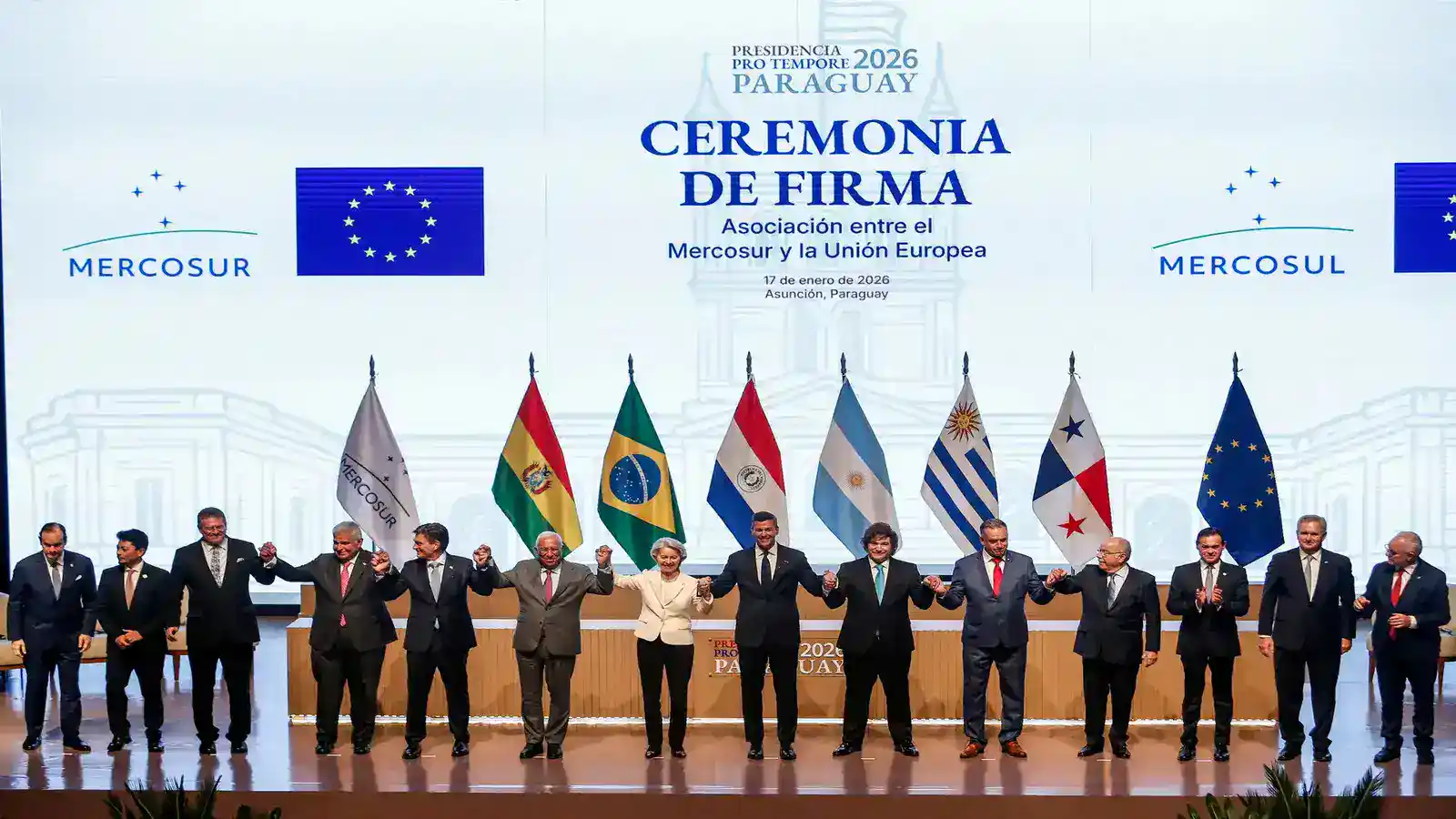
Final terms were signed in late January 2026 in Asunción, Paraguay, with Brazilian Congress ratification completing in March. Argentine, Uruguayan, and Paraguayan parliamentary processes also concluded. The European Parliament requested a Court of Justice legal review, but von der Leyen’s provisional-application authority allows enforcement to begin Friday May 1 regardless.
What Friday May 1 Looks Like
The four Mercosur presidents — Lula, Milei, Orsi, and Peña — will hold a videoconference with von der Leyen and European Council President António Costa to mark the activation. The bilateral framework provides for review meetings every 18 months and a comprehensive renegotiation cycle every 5 years. Implementation reporting will be published quarterly through both the Mercosur Secretariat in Montevideo and the European Commission’s DG Trade.
The same day, Lula will send the Mercosur-Singapore agreement (originally announced 2023) and the Mercosur-EFTA agreement (Switzerland, Norway, Iceland, Liechtenstein, finalized June 2025) to Brazilian Congress for ratification. The Singapore agreement opens Asian commodity-export channels. The EFTA agreement adds 290 million consumers and US$4.39 trillion in combined GDP.
For Mercosur, the cumulative effect is roughly 1 billion-consumer market access through 2027 — Europe + Asian Tigers + Northern Europe alpine markets. The diversification reduces Mercosur dependence on US-China bilateral demand and creates structural negotiating leverage that did not exist in the unilateral-tariff Trump era.
What This Means for Investors
For Brazilian agricultural and beef export majors (JBS, BRF, Marfrig, Minerva), the EU agreement is structurally positive but quota-bound. The tariff-rate quota framework limits volumes immediately, but premium pricing for high-quality beef cuts opens. Brazilian commodity giants gain incremental EU market share without disrupting domestic margins.
For European industrial manufacturers (Volkswagen, Siemens, Sanofi, BASF), Mercosur access compounds the recent Brazilian and Argentine RIGI investment frameworks. Volkswagen’s Argentine operations, Siemens’s Brazilian energy contracts, and Sanofi’s expanded Latin pharmaceutical operations all benefit from accelerated tariff elimination and harmonized regulatory frameworks.
For sovereign-credit investors, the Mercosur-EU agreement is structurally positive at the margin. Increased trade volume supports current-account balances, structural reforms required by EU partners discipline domestic policy frameworks, and the implicit anti-Trump diversification narrative provides a political-risk hedge. The R$4.9795 BRL closing level Monday already reflected some of this optimism — Friday’s formal activation should add modest BRL support over the 60-day post-launch window.
More: Brazil news in English, every day from The Rio Times.
This article was produced by The Rio Times’ automated newsroom system. How we use AI · Report an error · Editorial responsibility: Matthias Camenzind, Editor-in-Chief