Iran War Sends Mexican Jet Fuel Up 80% as Volaris and Viva Bleed Cash
Key Facts
—The price move. Pemex jet-fuel pricing rose from 11.66 pesos ($0.62) per litre in February 2026, just before the Iran war began, to 23.70 pesos ($1.26) per litre in March, an increase of 103%. Year-on-year the move is 82%. The international benchmark moved from $2.41 to $4.14 per gallon between February and early May (S&P Global Platts).
—The damage. Volaris reported a Q1 net loss of $71 million; Viva Aerobus a Q1 net loss of $74 million. Combined, the two carriers lost $1.6 million daily during the quarter. Aeroméxico’s net profit fell 50% to $11 million.
—The exposure. Jet fuel accounts for 26-32% of operating costs at Mexican carriers and can reach 40% under stress conditions. Aeroméxico plans gradual fare pass-through: 50% this quarter, 70% next, 100% by Q4 2026.
—The capacity cuts. Volaris reduced May domestic capacity by 9% and trimmed full-year capacity growth from 7% to 4%. Viva Aerobus has 26 grounded A320neo aircraft due to Pratt & Whitney GTF engine reliability issues. Magnicharters ceased operations.
—The World Cup timing. Mexico hosts the 2026 FIFA World Cup with kickoff weeks away. Nearly 6 million international visitors are expected. Mexicana de Aviación is being asked to fill connectivity gaps to Guadalajara and Monterrey.
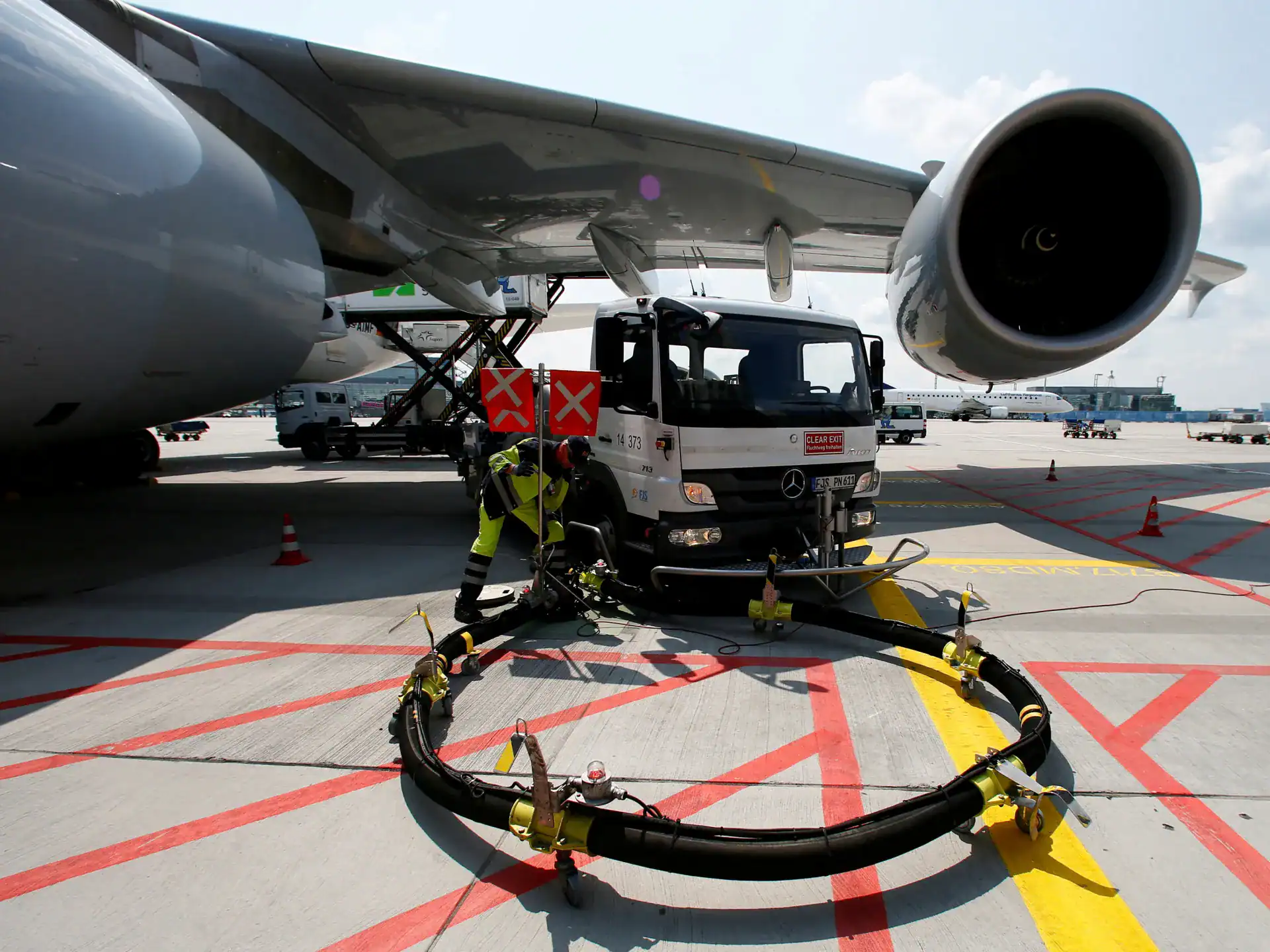
The Iran war started on February 28. The Strait of Hormuz closed. Jet fuel doubled in eight weeks. Mexico, with 100% imported turbine fuel and a deregulated airline sector built around razor-thin low-cost margins, is now operating under a commodity shock the industry’s hedging machinery was not built to absorb. The World Cup arrives in weeks.
The price line and what broke it
The Mexican turbosina (jet fuel) price has moved on a near-vertical line since the joint US-Israel operation against Iran began on February 28, 2026. The Rio Times, the Latin American financial news outlet, reports that Pemex tracked the rise from 11.66 pesos per litre in early February to 23.70 pesos per litre by end-March, an increase of 103%. International benchmark pricing through S&P Global Platts shows kerosene jet fuel moving from $2.41 to $4.14 per gallon between February 27 and May 4, a rise of 74%. On April 2 the international quote touched $5.19 per gallon, more than double the pre-war level. The IATA global average for the week ending April 24 was $179.46 per barrel, up 99.3% year-on-year.
The transmission mechanism is direct. Brent crude rose from $72.96 to $108.71 per barrel (+49%); Mexican Mezcla blend rose from $66.63 to $111.51 (+67%). Refineries that produce most of the kerosene fraction supplying Mexico are in the Gulf region or take Gulf input. The Strait of Hormuz handles about 20% of global oil and an even higher share of jet-fuel-grade kerosene.
What it cost the three Mexican carriers
| Carrier | Q1 2026 reading |
|---|---|
| Volaris (Enrique Beltranena) | Net loss $71M; capacity growth 7% → 4%; -9% May domestic |
| Viva Aerobus (Juan Carlos Zuazua) | Net loss $74M; 26 A320neo grounded; 7.7% fuel hedge cover |
| Aeroméxico (Andrés Conesa) | Net profit $11M (-50% YoY); 70% international revenue mix |
| Magnicharters | Operations ceased |
| Jet fuel share of operating cost | 26-32% baseline, up to 40% stress |
| Aeroméxico price-target cut (analyst) | 32 → 25 pesos (-22%) |
| Volaris price-target cut (analyst) | 12 → 10 pesos (-17%) |
The three response strategies
The three carriers have responded differently to the same shock. Aeroméxico is pursuing graduated fare pass-through: 50% in Q2, 70% in Q3, and 100% by Q4 2026, focused on international routes where 70% of revenue is generated. Volaris is concentrating capacity on transborder routes where demand has held and cutting domestic capacity by 9% in May; the carrier reduced its full-year capacity growth target from 7% to 4%. Viva Aerobus, the most exposed because only 7.7% of its 2026 fuel needs are covered by hedging instruments, faces the additional grounding of 26 A320neo aircraft from the Pratt & Whitney engine issue, with 15 net new aircraft added partially compensating.
What investors and analysts watch
- July ceasefire scenarios. IATA Director General Willie Walsh warns Europe may see jet-fuel cancellations by end-May. Strait of Hormuz reopening would not deliver immediate price relief.
- World Cup connectivity. Mexicana de Aviación is being asked to expand Aeropuerto Felipe Ángeles frequencies. The Sectur, Pemex, SAT, ASA negotiation table is running in permanent session.
- Volaris/Viva merger execution. The recently approved fusion creating the Grupo Mexicano de Aerolíneas controls 74% of the Mexican market. Execution amid fuel crisis is the test.
- Cirium global capacity revision. 19 of the 20 largest world carriers cut May schedules; global capacity growth forecast cut from 4-6% to 3%.
More: Latin America news in English, every day from The Rio Times.
Connected Coverage
The methanol supply-chain shock to Brazil sits in our methanol shock analysis. The UBS read on Brazil’s positioning is in our UBS Bassan analysis. The morning markets briefing sits in our morning market signal. The Cuba fuel blockade is in our Cuba playbook analysis.
Reported by The Rio Times — Latin American financial news. Filed May 18, 2026.
This article was produced by The Rio Times’ automated newsroom system. How we use AI · Report an error
Read More from The Rio Times