Colombia: the difficult task of selling houses with a dark bloody past
RIO DE JANEIRO, BRAZIL – A three-bedroom, two-bathroom apartment with swimming pool for rent on Colombia’s Caribbean coast.
A four-bedroom, four-bath home with hardwood floors near the Panamanian border surrounded by jungle.
A large Art Deco mansion in the heart of Colombia’s second largest city, Medellin.
The houses for sale were once owned by former right-wing paramilitaries and left-wing guerrillas of the Revolutionary Armed Forces of Colombia (FARC) who fought each other during Colombia’s decades-long armed conflict.

1,600 properties
In February, Colombia launched an online real estate agency called Bienes FRV, in an attempt to sell more than 1,600 houses, apartments, farms and plots of land that were confiscated by the government or handed over by armed groups that have demobilized in recent years.
The proceeds from the properties, estimated at some $140.3 million, will be used to pay reparations to more than seven million victims of the armed conflict.
But while the cash and gold handed over as part of the peace process are easy to convert into funds for victims, some of the houses and apartments have been “impossible” to sell or rent, explains Miguel Avendaño, who heads Colombia’s Victims’ Unit reparations fund.
“The fund needed something like a real estate service,” Avendaño said. “We can’t be left behind because there were very few sales and rentals. (Having this service) means more resources for the victims,” he assures.
Since it began publishing ads in 2018, the Victims Unit only managed to sell 12 properties that were previously owned by combatants.
Avendaño explains that the real estate agency is an attempt to add transparency to sales and change the idea of the properties’ bloody past to favor reparations as the country struggles to heal.
The Montecasino mansion
Many of the properties are located in rural areas where the conflict continues five years after the FARC guerrillas signed a peace agreement with the government.
Others are in safer areas, but remain overshadowed by their violent history, such as the Montecasino mansion in Medellín.
The marble-clad mansion sits in the heart of the dense, mountainous city. It rents for US$4,700 per month. It has 12 bedrooms, 13 bathrooms, a spiral staircase, a lounge bar, a wine cellar, multiple pools and fountains, extensive gardens and a shell-shaped gold-painted bathtub.
The previous owners of the mansion were the founders of the now demobilized right-wing paramilitary group Autodefensas Unidas de Colombia.
The land on which it was built was once a place of bloodshed and tragedy.
It was a meeting point where paramilitary leaders planned some of the worst atrocities of Colombia’s long conflict, including bombings and massacres, where people were tortured and some of the country’s most feared hitmen were trained.
“It’s a mansion unlike any other, occupying three hectares in Medellín’s best neighborhood, but it was impossible to sell,” Avendaño says of the property’s dark past.
It took civil engineer Sergio Ortiz to appreciate the property’s potential.
The 52-year-old, who says his own family is a victim of the armed conflict, hopes to lease the property and transform the land into a park open to the public.
If his bid for the property is accepted, Ortiz’s family wants to turn the mansion into a physical therapy center and an adjacent building into a music center.
He says his plan is to employ other victims of the conflict and “move on” by leaving the past behind.
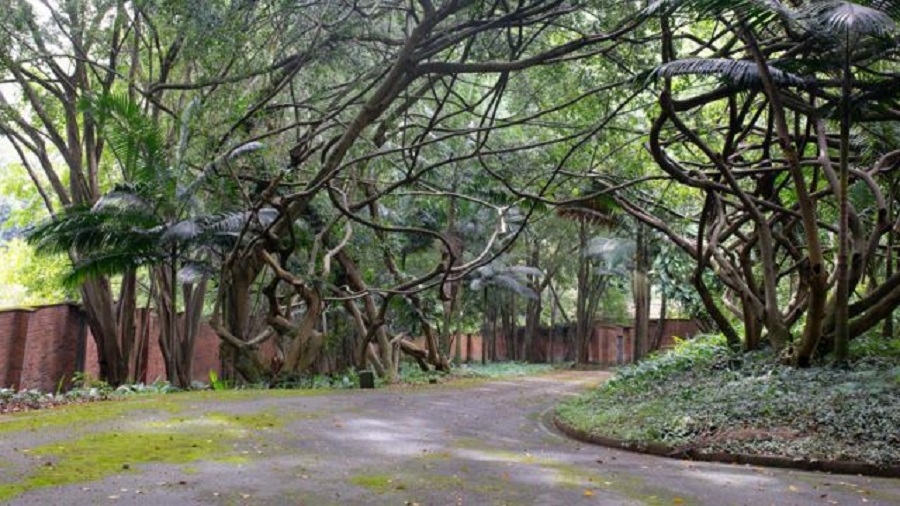
“What we want to offer citizens is a space for sports and recreation,” Ortiz describes as he walks through the mansion’s overgrown gardens and luxurious, if dilapidated, hallways.
“This is our way of helping our country, generating a space of peace and tranquility,” he relates.
Risky
While properties in larger cities may be relatively safe, buying land in areas where dissident armed groups continue to operate and there is little state presence can be risky, says Elizabeth Dickinson, Crisis Group senior analyst in Colombia.
“Everybody knows who they belonged to and, of course, there are some feelings in those areas of who they still really belong to,” Dickinson explains.
There were cases where tenants were forced out of their new homes and others where potential buyers were threatened and pulled out.
But Avendaño hopes that as time goes on and more properties that once belonged to guerrillas or paramilitaries become normal homes, this will become less of a problem.
Within two months of the real estate agency’s launch, 10 properties have already been sold.
Ortiz is also feeling hopeful as he looks out over the grounds from the Montecasino mansion.
“This is where we envision the garden,” he details, pointing to a strip of trees and dense undergrowth.
“We want flowers, flowers and more flowers because they mean life,” he says.
Source: BBC
More: Colombia news in English, every day from The Rio Times.
This article was produced by The Rio Times’ automated newsroom system. How we use AI · Report an error · Editorial responsibility: Matthias Camenzind, Editor-in-Chief