Germany and Brazil Double Biggest Brazilian Navy Program
Key Facts
— —The Brazilian Navy formally commissions its first Tamandaré-class frigate, the F200, in Rio de Janeiro on April 24 — the first vessel of the program delivered since contracts were signed in 2020.
— —President Lula signed a Letter of Intent in Hannover on April 20 for a second batch of four additional frigates, with German Chancellor Friedrich Merz, doubling the programme from four ships to eight.
— —The ships are designed on the German MEKO A-100 platform and built in Itajaí, Santa Catarina, by a consortium of ThyssenKrupp Marine Systems, Embraer Defesa & Segurança, and Atech.
— —The expansion is bundled into the broader EU-Mercosur framework that enters provisional force on May 1, and into a joint Brazilian-German critical-minerals cooperation track.
A naval programme that Brazil began under Jair Bolsonaro, and that Lula has now doubled in the middle of EU-Mercosur week in Hannover, just produced its first commissioned warship. The political geometry around it is bigger than the ships themselves.
The Rio Times, the Latin American financial news outlet, reports that on April 24 the first Brazil Navy Tamandaré frigate, the F200, is being formally commissioned into the fleet in a ceremony in Rio de Janeiro. The “Mostra de Armamento” marks the final step that moves the ship from construction and sea trials to active service, and it caps a six-year journey from contract to blue-water warship.
Four days earlier, on April 20, President Lula stood in Hannover, Germany, and told reporters that Brazil will buy four more ships of the same class. The confirmation came after a meeting with German Chancellor Friedrich Merz during the EU-Mercosur celebrations that precede the provisional entry into force of that agreement on May 1.
“A binational consortium is building four Tamandaré-class frigates, for delivery by 2028. Here in Hannover, we advanced the talks for the acquisition of four more units,” Lula said.
What the Brazil Navy Tamandaré frigate programme actually is
The Tamandaré-class is a Brazilian adaptation of the MEKO A-100 design by German shipbuilder ThyssenKrupp Marine Systems. Each ship is 107 metres long, 16 metres at the beam, displaces about 3,500 tonnes, and carries roughly 130 crew.
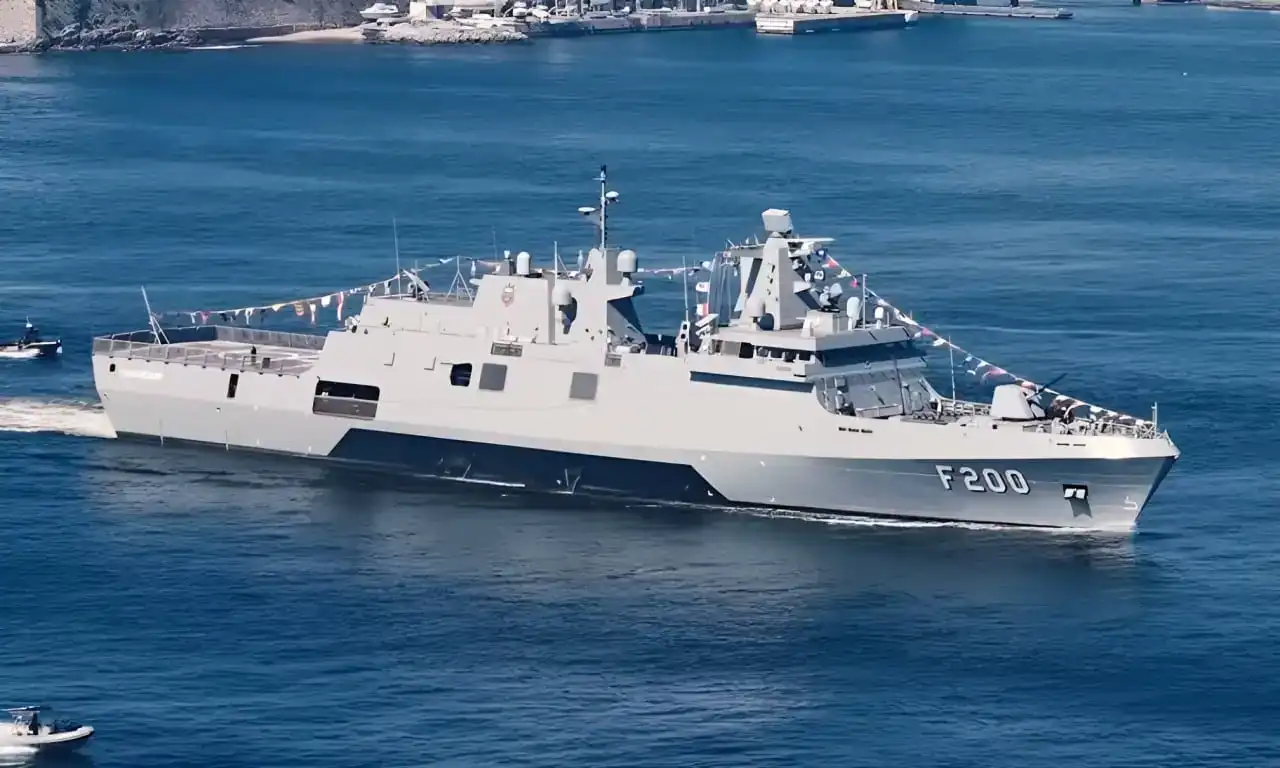
Armament includes a 76mm naval gun, a 30mm close-in weapon system, two 12.7mm remotely operated machine guns, anti-ship and surface-to-air missiles, torpedoes, and a flight deck able to operate a medium helicopter or unmanned aerial vehicle.
Construction runs at the TKMS Estaleiro Brasil Sul in Itajaí, Santa Catarina, a yard that ThyssenKrupp Marine Systems acquired in 2020 specifically to execute this programme. The ships are built by the Águas Azuis consortium, in which TKMS works alongside the Brazilian partners Embraer Defesa & Segurança and Atech, which is part of the Embraer group.
The original R$9.1 billion contract was signed in March 2020, during the Bolsonaro government. The first ship is the F200 Tamandaré. The remaining three already under construction in Itajaí are the F201 Jerônimo de Albuquerque, the F202 Cunha Moreira, and the F203 Mariz e Barros.
Why the Hannover letter matters more than another frigate order
A Letter of Intent is not a signed contract. The Brazilian defence press has been quick to underline that point. What the April 20 Hannover document does is move the second batch of four frigates from a naval preference to a formally acknowledged Brazilian-German state commitment.
For TKMS and the Itajaí yard, that matters because a confirmed second batch is what keeps industrial capacity and technical transfer alive beyond 2028. The local-content share of the programme was set at 30% for the first ship and 40% for the follow-on units, and the numbers only rise if the yard stays busy.
For Brazil, the letter converts the Tamandaré programme from a one-off defence procurement into a generational naval-industrial strategy. Lula framed the expansion explicitly in those terms, tying the frigate announcement to shipyard jobs in Santa Catarina.
For Berlin, the signal is that the MEKO A-100 export that was first sold to a right-wing Brazilian government has survived a change of power in Brasília, a left-wing successor who personally signed the extension, and a change of government in Germany itself. Friedrich Merz, who took office earlier this year as chancellor of a centre-right coalition, chose defence industrial cooperation with Brazil as one of the early public flagships of his foreign-policy agenda.
The EU-Mercosur and critical-minerals backdrop
The Hannover meeting that produced the Letter of Intent was, formally, about celebrating the entry into provisional force of the EU-Mercosur agreement on May 1. That agreement covers roughly 5,000 products at zero tariff and reshapes the trade relationship between the European Union and South America in ways that the Brazilian industrial sector has been preparing for since the political agreement of December 2024.
The joint Brazilian-German declaration that accompanied the Hannover meeting goes beyond ships and tariffs. Both sides committed to intensifying talks for a double-taxation agreement, to a Joint Declaration of Intentions on ocean research, to cooperation on the CO2Image space mission, and — most importantly for investors watching Latin America’s minerals story — to “future cooperation on critical minerals.”
That critical-minerals language matters because, as the Rio Times reported this week, Brussels is already reviewing four Brazilian critical-minerals projects. Germany being the anchor partner in both the naval programme and the minerals conversation is not a coincidence. It reflects a deliberate choice in Berlin to treat Brazil as the EU’s principal industrial partner in the Southern Hemisphere.
What a doubled Brazil Navy Tamandaré frigate fleet means operationally
More than 90% of Brazilian foreign trade moves by sea, and the Brazilian Navy has been open for more than a decade about the mismatch between that dependence and an ageing fleet. Fleet Admiral Marcos Sampaio Olsen, now commander of Naval Operations, was explicit about it at the Tamandaré’s August 2024 launch: modernisation is not optional.
Eight Tamandaré-class ships, once fully delivered, become the operational backbone of Brazilian escort and patrol capability across the so-called “Blue Amazon” — the 5.7 million square kilometres of Atlantic waters under Brazilian jurisdiction that include the country’s offshore oil reserves.
The same waters are the shipping corridor for Brazilian agricultural exports, for the rare-earths output of the Pela Ema mine in Goiás now being acquired by US Rare Earth, and for the offshore oil that funds the federal budget. Frigates do not extract minerals or pump oil, but they provide the maritime picture that determines whether any of those flows are secure.
For Brazil’s Latin American neighbours watching from Buenos Aires, Caracas, and Bogotá, the delivery of a German-built Brazilian frigate also recalibrates the regional naval balance. No other South American navy currently operates a comparable modern escort class at similar scale.
What to watch after the Brazil Navy Tamandaré frigate commissioning
Three tests will define whether the Hannover Letter of Intent becomes real steel at Itajaí. The first is budget allocation in the 2027 federal budget. A formal contract for four additional ships requires a multi-year budget commitment that the Brazilian Congress has not yet approved.
The second is the outcome of Brazil’s October 2026 presidential election. The Tamandaré programme has now survived one transition of power, but a contract signed in Lula’s final year would still need execution by his successor. The programme has bipartisan defence support today; that could be tested if the election turns on fiscal austerity.
The third is what happens to local content. The first ship’s 30% Brazilian content was politically acceptable as a starting point. The follow-on batch of four, if contracted, is expected to push local content toward 50% or higher.
That is the industrial prize the Itajaí yard is playing for. It is also what turns the Tamandaré from a purchase into a Brazilian capability.
The F200 was delivered to the Rio de Janeiro arsenal on April 16 after a 765-kilometre journey from Itajaí. It sat through a week of preparation. On Thursday it is a warship in the Brazilian Navy, and the government that took delivery of it is the same one that, four days ago in Hannover, committed to build four more.
Related coverage: Tamandaré launch 2024 • EU reviews four Brazil critical mineral projects • Brazil’s extended-range missile programme
This article was produced by The Rio Times’ automated newsroom system. How we use AI · Report an error · Editorial responsibility: Matthias Camenzind, Editor-in-Chief