Brazil Defense Up 13%, Guyana 16%: SIPRI’s LATAM Picture
Key Facts
— — The Stockholm International Peace Research Institute (SIPRI) reported Monday April 27 that global military spending reached US$2.887 trillion in 2025, a 2.9 percent real-terms increase from 2024 and the 11th consecutive annual rise. Global military spending now stands at 2.5 percent of world GDP — its highest share since 2009. Per-capita global military spending reached US$352 in 2025.
— — Europe drove the surge with a 14 percent rise to US$864 billion — the sharpest annual increase in Central and Western European spending since the end of the Cold War. The 29 European NATO members spent a combined US$559 billion, with 22 of them now meeting the 2 percent of GDP target. Germany became Europe’s largest military spender at US$114 billion (+24% YoY). Asia and Oceania rose 8.1 percent to US$681 billion — the largest annual rise since 2009.
— — South America’s total reached US$56.3 billion (+3.4%). Brazil — the regional leader — rose 13 percent to US$23.9 billion driven by naval modernization. Guyana surged 16 percent to US$248 million amid the Essequibo dispute with Venezuela. The United States declined 7.5 percent to US$954 billion as Ukraine military aid was suspended, but Trump’s proposed 2027 budget of US$1.5 trillion would set a new record. Russia, China and the US together spent US$1.48 trillion — 51 percent of the global total.
Global military spending has now risen for 11 consecutive years to a record US$2.89 trillion — and Latin America’s defense budgets are joining the wave, led by Brazil’s 13 percent jump and Guyana’s Essequibo-driven 16 percent surge.
The world is rearming on a scale not seen in decades. The Rio Times, the Latin American financial news outlet, reports that the global military spending total reached a record US$2.887 trillion in 2025 according to the Stockholm International Peace Research Institute (SIPRI) report published Monday April 27 — an 11th consecutive year of growth driven by European rearmament, Asian programs responding to US strategic uncertainty, and Latin American budget increases led by Brazil’s naval modernization and Guyana’s response to Venezuelan territorial pressure.
“Global military spending rose again in 2025 as states responded to another year of wars, uncertainty and geopolitical upheaval with large-scale armament drives,” said Xiao Liang, researcher with SIPRI’s Military Expenditure and Arms Production Programme. “Given the range of current crises, as well as many states’ long-term military spending targets, this growth will probably continue through 2026 and beyond.”
The Global Military Spending Numbers
The headline reading: world military expenditure rose 2.9 percent in real terms in 2025, the lowest annual rate since 2021 but still the 11th straight year of growth. Total global spending has risen 41 percent over the past decade (2016-25). The military burden — the share of global GDP allocated to defense — climbed from 2.4 percent in 2024 to 2.5 percent in 2025, the highest level since 2009.
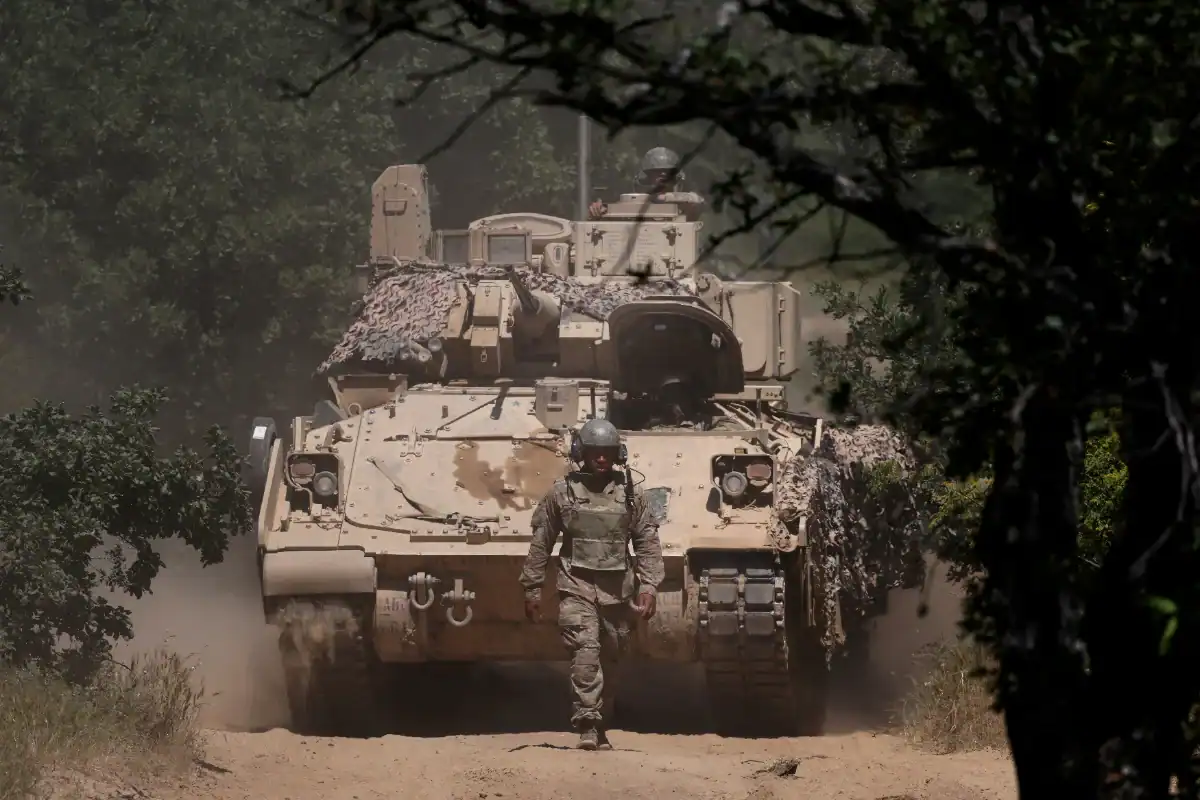
The geographic distribution shifted. Europe drove the increase with a 14 percent surge to US$864 billion.
Asia and Oceania rose 8.1 percent to US$681 billion. Africa rose 8.5 percent to US$58.2 billion.
Middle East spending was broadly stable at US$218 billion. South America rose 3.4 percent to US$56.3 billion.
The top three military spenders — the United States, China, and Russia — together accounted for US$1.48 trillion or 51 percent of global spending. Excluding the United States, world military expenditure grew 9.2 percent in 2025 — illustrating that the US decline reflected a one-off Ukraine aid suspension rather than a structural trend.
Why Europe Drove the Surge
European spending grew faster in 2025 than any year since 1953. The 29 European NATO members spent a combined US$559 billion, with 22 nations meeting the 2 percent of GDP target — up from 16 a year earlier. Germany became Europe’s largest military spender at US$114 billion (+24% from 2024) following Berlin’s historic March 2025 debt-brake reform that opened fiscal space for rearmament.
Other European movers included Spain (+50% to US$40.2 billion), France (+1.5% to US$68 billion), and the United Kingdom (-2% to US$89 billion). Russia’s spending grew 5.9 percent to US$190 billion, equivalent to 7.5 percent of GDP.
Ukraine increased spending 20 percent to US$84.1 billion — equal to 40 percent of GDP, the highest military burden in the world. Ukraine became the world’s seventh-largest military spender despite a substantially smaller economy than larger budgets above it.
“In 2025 military spending by European NATO members rose faster than at any time since 1953, reflecting the ongoing pursuit of European self-reliance alongside increasing pressure from the United States to strengthen burden sharing within the alliance,” said Jade Guiberteau Ricard, researcher with SIPRI’s Military Expenditure and Arms Production Programme.
Asia’s US$681 Billion Reality
Asia and Oceania saw the largest annual rise in defense spending since 2009, climbing 8.1 percent to US$681 billion. The driver was strategic anxiety: long-standing regional tensions plus growing uncertainty over US security commitments under the Trump administration. Taiwan increased military spending 14 percent to US$18.2 billion (2.1% of GDP) — its largest annual rise since at least 1988.
India became the world’s fifth-largest military spender at US$92.1 billion (+8.9%). Japan’s procurement focused on long-range strike and counterstrike capabilities including cruise missiles and ISR systems — a structural pivot from Japan’s traditional pacifist posture. The Philippines and Australia also recorded substantial increases.
“US allies in Asia and Oceania such as Australia, Japan and the Philippines are spending more on their militaries, not only due to long-standing regional tensions but also due to growing uncertainty over US support,” said Diego Lopes da Silva, senior researcher at SIPRI. The structural read: Asian allies are hedging against a less reliable Washington while preparing for sustained Chinese pressure.
Latin America’s Defense Picture
Latin America has historically been one of the world’s lowest-spending regions on defense, but 2025 marked notable movement. South America’s total reached US$56.3 billion (+3.4% YoY, +5.7% over the decade). Brazil — the regional leader — rose 13 percent to US$23.9 billion, driven primarily by increased investment in naval technological development plus higher military personnel costs.
The Brazilian rise has structural significance. Members of Brazil’s Congress submitted a constitutional amendment in 2023 aiming to mandate annual military expenditure of at least 2 percent of GDP — up from approximately 1.1 percent currently.
While that amendment has not progressed, the 13 percent real-terms increase in 2025 represents the largest single-year jump in over a decade. Brazil’s naval modernization includes the FX-2 Gripen fighter program, Amazonas-class corvettes, and the Riachuelo-class submarine project.
Guyana’s military spending rose 16 percent to US$248 million in 2025 — fueled by escalating tensions with Venezuela over the Essequibo region. The disputed territory contains substantial offshore oil reserves under Guyanese operation by ExxonMobil, Hess and CNOOC.
The Maduro government previously claimed Essequibo formally; Delcy Rodríguez’s transition government has not yet clarified its position. SIPRI noted Venezuela has not publicly reported military spending figures, making the bilateral comparison incomplete.
Mexico, Colombia, and the Cartel-War Spending
Mexico continues a structural shift. Spending reached US$11.8 billion in 2023 (latest detailed SIPRI figure), with the Guardia Nacional — the militarized internal security force created in 2019 — rising from 0.7 percent of total military expenditure in 2019 to 11 percent in 2023. The pattern reflects Mexico’s increasingly militarized response to cartel violence rather than external threats.
Colombia’s defense spending continues to absorb a large share of government expenditure as a result of internal armed conflict. The current crisis in Cauca — 21 dead in the El Túnel bombing last weekend, US travel advisory issued Monday — will likely accelerate further spending in 2026 budget proposals. Defense Minister Pedro Sánchez Suárez has already deployed 13 armored cavalry platoons and 12 infantry platoons to Cauca.
“The use of the military to suppress gang violence has been a growing trend in the region for years as governments are either unable to address the problem using conventional means or prefer immediate — often more violent — responses,” Lopes da Silva noted in SIPRI’s analytical commentary. The Mexico CJNG capture announced Monday — Audias Flores Silva, alias El Jardinero, taken down by Mexican Navy Special Forces — illustrates the operational scale of this trend.
The US Decline That Isn’t
US military spending fell 7.5 percent to US$954 billion in 2025 — the first decline in years and the headline contradiction in an otherwise rising-spending world. SIPRI attributed the drop almost entirely to the suspension of new Ukraine military aid: in the previous three years, Washington had approved US$127 billion in such packages.
The decline is structurally short-lived. US Congress has already approved over US$1 trillion for fiscal 2026 — a substantial increase from 2025. President Trump’s fiscal 2027 proposal of US$1.5 trillion would mark the largest defense budget in US history, with funds going toward the Golden Dome missile system, AI capabilities, and a new class of battleships.
Despite the 2025 decline, US strategic priorities remained stable. Washington continued investing in nuclear and conventional capabilities aimed at maintaining dominance in the Western Hemisphere and deterring China in the Indo-Pacific — both core objectives of the new National Security Strategy. The structural framework is one of US strategic continuity at higher spending levels with one-off Ukraine accounting noise.
What This Means for Investors and Markets
Defense equity performance in 2025 reflected the spending wave. Hanwha Aerospace surged 193 percent in 2025 (after 154% in 2024). Hyundai Rotem rose 278 percent.
Germany’s Rheinmetall climbed 154 percent and ThyssenKrupp gained 215 percent. Mitsubishi Heavy Industries rose 72.7 percent and IHI Corp spiked 107.1 percent.
BAE Systems rose 49.2 percent. The pattern: defense equities are pricing in multi-year sustained spending growth, not just war-driven peaks.
For Latin American investors, the structural read is mixed. Brazil’s 13 percent rise creates opportunity for Embraer (whose Q1 backlog hit US$32 billion) and select naval-defense suppliers.
Guyana’s surge benefits regional defense logistics providers. Mexico’s continued Guardia Nacional growth supports specific equipment categories.
Colombia’s structural conflict-driven spending supports rotorcraft and surveillance equipment.
The geopolitical read is sharper. Eleven consecutive years of rising global military spending, with no sign of inflection, indicates a structural rearmament cycle that pre-dates Trump’s specific decisions and will outlast them.
The 2.5 percent of GDP global military burden — highest since 2009 — places defense spending firmly back in the macroeconomic conversation. For Latin American economies that have historically invested defense budgets at one-third or less of European levels, the question is whether 2025 marks the start of regional convergence with the global spending wave or remains an outlier moment.
This article was produced by The Rio Times’ automated newsroom system. How we use AI · Report an error · Editorial responsibility: Matthias Camenzind, Editor-in-Chief