Argentina Signs Five-Year US Pact to Patrol the South Atlantic
Argentina · Defense
Key Facts
—The deal. the Argentina US patrol pact is a five-year maritime-security partnership, the Protecting Global Commons Program, to monitor the South Atlantic, signed on May 18.
—The signatories. a letter of intent was signed by Argentina’s navy chief, Admiral Juan Carlos Romay, and Rear Admiral Carlos Sardiello of the US Southern Command’s Fourth Fleet.
—The hardware. the program starts with a specialized surveillance camera and centers on two new Textron-built patrol aircraft, the first arriving in December 2026 and the second by mid-2027.
—The targets. the stated aims are illegal fishing, including by the Chinese fleet, drug trafficking and other transnational maritime threats.
—The bigger picture. the pact follows joint naval drills, President Javier Milei’s visit to the carrier USS Nimitz and a critical-minerals accord, marking a systematic tilt toward Washington.
—The pushback. the opposition calls it a surrender of sovereignty, while the government and the US embassy frame it as “stronger together, safer together.”
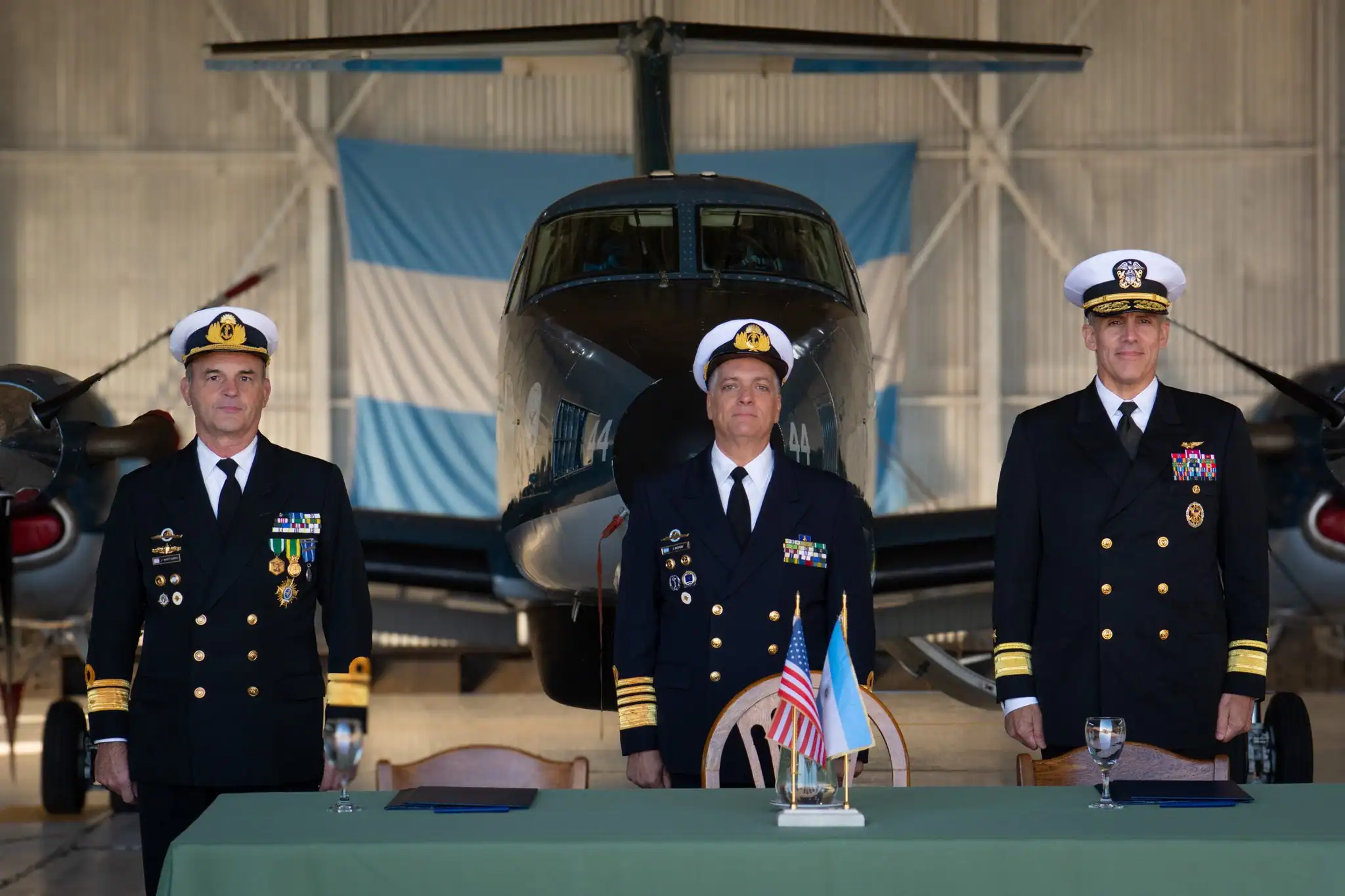
A new patrol deal in the South Atlantic is, on its own, a modest piece of defence cooperation. Its real significance is as the latest marker in Argentina’s steady, deliberate realignment with Washington under Javier Milei.
What does the Argentina US patrol pact cover?
The Rio Times, the Latin American financial news outlet, reports that the Argentina US patrol pact is a five-year maritime-security partnership, named the Protecting Global Commons Program, to monitor activity in the South Atlantic. The letter of intent was signed on May 18 by Argentina’s navy chief, Admiral Juan Carlos Romay, and Rear Admiral Carlos Sardiello of the US Southern Command’s Fourth Fleet.
Washington framed the deal as a step to “boost maritime security in the South Atlantic,” to be expanded over five years with advanced equipment, elite training and operational support to intercept and neutralise maritime threats. The opposition, by contrast, denounced it as a fresh handover of sovereignty.
What hardware is involved?
The program begins with the delivery of a specialized surveillance camera mounted on an Argentine navy patrol aircraft. Its centerpiece is the provision of two factory-new Textron-built patrol planes configured for intelligence, surveillance and reconnaissance.
According to the official schedule, the first modified patrol aircraft is due to arrive in December 2026, with the second joining naval aviation by mid-2027. The deal is financed by the US side and aims to rebuild Argentina’s ocean-surveillance and reconnaissance capacity.
Why does it matter beyond defence?
The stated targets are illegal fishing, especially by the large Chinese fleet that works the edge of Argentine waters, along with drug trafficking and other transnational threats. That framing places the agreement squarely within the US push to counter Chinese influence across the South Atlantic.
The pact arrives alongside joint naval exercises, Milei’s high-profile visit to the carrier USS Nimitz, a critical-minerals cooperation accord and a trade deal sought with the Trump administration. Taken together, they form a pattern rather than a one-off, a systematic realignment of Argentine foreign policy toward Washington.
What do the two sides say?
The government and the US embassy in Buenos Aires presented the agreement in upbeat terms, with the slogan “stronger together, safer together,” casting it as a way to protect shared global commons and strengthen regional security. Officials describe concrete capabilities that bolster South Atlantic security.
Critics and much of the opposition see it differently, arguing that the deal cedes sovereignty and binds Argentina more tightly to Washington’s strategic agenda. For these voices, the recurring pattern of military and economic alignment under Milei is the real story, not the patrol planes themselves.
What should investors and analysts watch next?
- Aircraft delivery: whether the first patrol plane arrives on schedule in December 2026.
- The trade track: how the patrol pact dovetails with the broader US-Argentina trade deal.
- Mercosur strain: whether deeper US alignment widens the rift with Brazil inside the bloc.
- China’s response: how Beijing reacts to surveillance aimed partly at its fishing fleet.
- Domestic politics: whether the sovereignty debate gains traction ahead of Argentina’s elections.
More: Argentina news in English, every day from The Rio Times.
Frequently Asked Questions
What is the Argentina US patrol pact?
It is a five-year maritime-security partnership, the Protecting Global Commons Program, signed on May 18 between Argentina’s navy and the US Southern Command to monitor the South Atlantic.
What equipment does it provide?
It starts with a specialized surveillance camera and centers on two new Textron-built patrol aircraft, the first due in December 2026 and the second by mid-2027, financed by the United States.
What are its stated targets?
The pact aims at illegal fishing, including by the Chinese fleet, drug trafficking and other transnational maritime threats in the South Atlantic.
Why is it controversial?
The opposition argues it cedes sovereignty and deepens Argentina’s dependence on Washington, while the government and the US embassy present it as mutually beneficial security cooperation.
How does it fit Milei’s foreign policy?
It is one of several steps, alongside joint drills, a carrier visit, a critical-minerals accord and a trade deal, that mark a systematic realignment of Argentina toward the United States.
Connected Coverage
The pact extends a realignment we mapped in how the Trump-Milei trade pact locks Argentina into Washington’s orbit. It echoes the foreign-policy break seen when Milei expelled Iran’s chargé d’affaires, and the regional tension traced in how a US-Argentina trade deal strains Mercosur.
Reported by Sofia Gabriela Martinez for The Rio Times — Latin American financial news. Filed May 20, 2026 — 17:30 BRT.
This article was produced by The Rio Times’ automated newsroom system. How we use AI · Report an error
In depth
Read More from The Rio Times