How Argentina Became Israel’s Strongest Ally as Latin America Turned Away
Key Facts
— — Latin America has split sharply over Israel since October 7, 2023: Bolivia severed relations, Colombia broke ties, Chile and Honduras recalled ambassadors, and Brazil’s Lula was declared persona non grata after comparing Gaza to genocide
— — Argentina under Milei has moved in the opposite direction: three state visits to Israel, an IRGC terrorist designation, Iran’s diplomat expelled, UN voting reversed, the Genesis Prize accepted, and a US$1 million “Isaac Accords” initiative launched to build pro-Israel coalitions across the continent
— — Milei travels to Israel this weekend (April 19–22) to receive the Presidential Medal of Honor and potentially inaugurate an Argentine embassy in Jerusalem — which would make Argentina the seventh country to relocate its diplomatic mission to the disputed city
— Deep Dive
— For the complete picture, read our in-depth guide: Argentina Economy 2026: Growth, Reforms and Investor Guide
The Rio Times, the Latin American financial news outlet, reports that the Argentina Israel alliance under President Javier Milei has become the most dramatic foreign policy realignment in the region since the left-wing wave of the early 2000s — and it is moving in the opposite direction of almost every major neighbor. While most of Latin America has distanced itself from Israel over the Gaza war, Milei has made the relationship a defining pillar of his presidency.
His third visit to Israel, scheduled for April 19–22, will be the exclamation point. Israeli President Isaac Herzog will confer the Presidential Medal of Honor — the country’s highest civilian decoration — and Milei will become the first foreign leader to light the Independence Day torch on Mount Herzl. The embassy relocation to Jerusalem, while not yet formally confirmed by Argentina’s foreign ministry for this specific trip, is widely expected to be inaugurated during the visit.
The Continental Split
The Hamas attack on October 7, 2023, and the subsequent Israeli military campaign in Gaza triggered a cascade of diplomatic ruptures across Latin America. Bolivia severed relations entirely, Colombia’s President Petro broke ties and compared Israeli operations to genocide, and Chile under Boric recalled its ambassador and downgraded its mission — while Honduras pulled its ambassador despite having previously moved its own embassy to Jerusalem.
Brazil’s Lula delivered the sharpest verbal attack, comparing the Gaza operation to the Holocaust at a BRICS summit — a remark that led Israel to declare him persona non grata and recall its ambassador from Brasília. The diplomatic freeze between Latin America’s two largest economies and Israel was effectively complete by mid-2024.
Against this backdrop, Argentina moved in the opposite direction — systematically and with increasing speed.
Milei’s Pro-Israel Escalation Ladder
The sequence has been deliberate. In February 2024, barely two months after his inauguration, Milei made Israel his first state visit — arriving while the Gaza war was at its most intense. He prayed at the Western Wall, toured the devastated kibbutz of Nir Oz, and declared Argentina’s “unconditional solidarity.” No other Latin American leader visited Israel during that period.
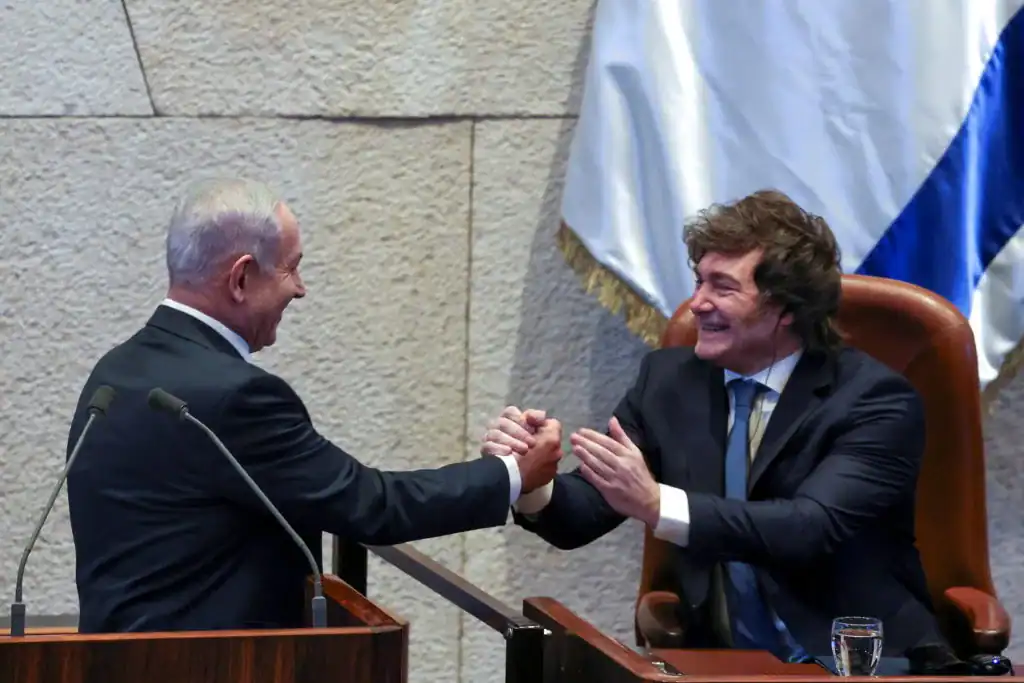
In June 2025, he returned for a second visit and announced from the Knesset floor that Argentina would move its embassy to Jerusalem in 2026. He received the Genesis Prize — informally known as the “Jewish Nobel” — and used the US$1 million award to launch the Isaac Accords, a diplomatic initiative modeled on the Abraham Accords aimed at building pro-Israel coalitions with Uruguay, Panama, and Costa Rica.
In early April 2026, during the Iran war, Milei designated the IRGC a terrorist organization and expelled Iran’s top diplomat from Buenos Aires within 48 hours, while also reversing years of Argentine UN votes and designating Hamas and Hezbollah as terrorist organizations. Israel’s foreign minister, Gideon Sa’ar, responded by declaring 2026 “the year of Latin America” for Israeli diplomacy.
Why Milei, and Why Now
Three factors explain the depth of the alignment. First, personal conviction: Milei has studied Torah, expressed interest in converting to Judaism, and describes himself as a “fervent Zionist.” His spiritual connection to Jewish tradition predates his political career and appears genuine rather than purely instrumental.
Second, the AMIA factor. Argentina is the site of Latin America’s worst terrorist attacks — the 1992 Israeli embassy bombing that killed 29 and the 1994 AMIA Jewish community center attack that killed 85, both attributed to Iranian-backed Hezbollah. The cases remain unresolved three decades later, and Milei has weaponized the memory to justify anti-Iran measures that previous governments avoided.
Third, strategic calculation. The Israel relationship is inseparable from the Trump relationship, and the Trump relationship is inseparable from the IMF. Milei needs US support for Argentina’s debt restructuring, and aligning with Washington and Jerusalem on the Iran war positions Buenos Aires as a reliable ally at exactly the moment when Argentina is asking for financial favors.
The Risk Calculus
The alignment carries costs. Iran has historically used proxy networks and energy disruptions to retaliate against perceived enemies, and the IRGC designation and diplomatic expulsion have eliminated any buffer between Buenos Aires and Tehran. Argentina is simultaneously trying to attract foreign investment, stabilize its currency, and rebuild international credibility after Milei’s first two years of radical economic reform.
The broader regional dynamic may shift: Israel’s foreign ministry has flagged election cycles in Brazil (October 2026) and Colombia (May 2026) as potential turning points, with right-leaning successors potentially reopening ties, and Chile under Kast has already signaled a warmer posture. Whether Milei’s solo act becomes a regional trend or remains an Argentine exception will depend on those ballots — and on whether the wars produce outcomes that change the political calculus for Latin American voters.
More: Argentina news in English, every day from The Rio Times.
This article was produced by The Rio Times’ automated newsroom system. How we use AI · Report an error
Read More from The Rio Times