Chevron and Shell Expand Venezuela Oil Operations
Key Facts
— — Chevron is signing a deal to return a gas field to Venezuela and enter a Faja del Orinoco heavy-crude area; Shell will receive the Loran offshore gas field
— — The deals are part of a US $100 billion energy reconstruction plan launched after Maduro’s capture and January’s petroleum law reform
— — Separately, former Defense Minister Vladimir Padrino López — with a $15 million US bounty for narcotrafficking — was named agriculture minister by Delcy Rodríguez
The Venezuela Chevron oil deal is expanding significantly as the US energy giant prepares to sign an agreement returning an offshore gas field to the Venezuelan state while simultaneously entering a heavy-crude area in the Faja del Orinoco, according to Reuters sources. Shell is set to receive the Loran gas field for its own operations in a parallel arrangement.
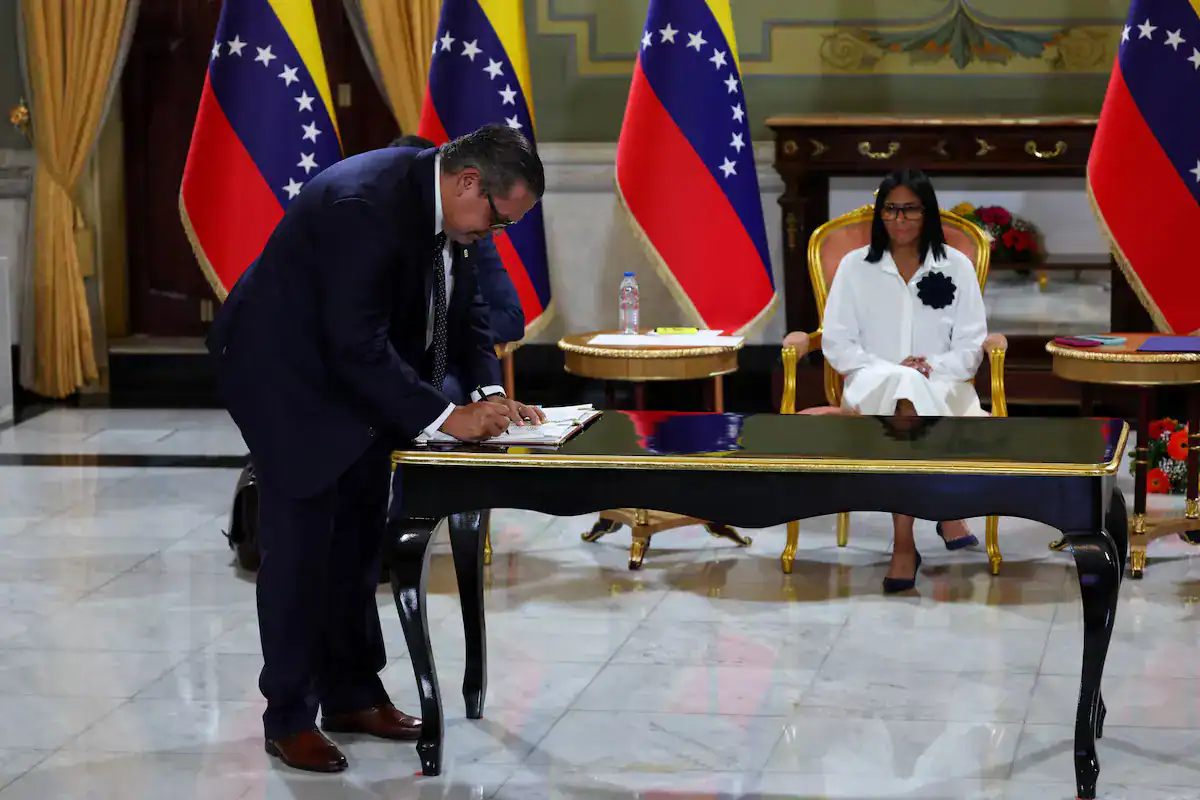
The Rio Times, the Latin American financial news outlet, reports that both deals will be signed with the Petroleum Ministry and PDVSA in the presence of acting President Delcy Rodríguez. They form part of the $100 billion energy reconstruction plan launched after Washington flexibilized sanctions following Nicolás Maduro’s capture and the sweeping petroleum law reform approved in January.
What the Venezuela Chevron Oil Deal Means
Chevron, which has operated in Venezuela under specific US Treasury licenses since 2022, currently accounts for approximately 15% of Venezuela’s crude refining in the United States. The new agreements would deepen its footprint in the country’s most strategic energy zones.
The US Embassy in Caracas confirmed “advances in energy cooperation” on Monday. The phased approach includes stabilizing the sector, recovering production, and reactivating foreign investment — all operating under Treasury Department licenses that remain subject to political conditions in Washington.
Padrino López: From Defense to Agriculture
In a separate but equally significant cabinet reshuffle, Rodríguez named General Vladimir Padrino López as Minister of Agriculture. Padrino ran the Defense Ministry for over a decade — from October 2014 to March 2026 — making him one of the longest-serving pillars of the Maduro era.
Washington maintains a $15 million bounty on Padrino for narcotrafficking charges. His appointment to lead agricultural production — in a country that imports the vast majority of its food — drew skepticism from analysts who noted his expertise lies in “logistics of command and control” rather than crop yields. Rodríguez said Padrino “assumes the commitment to boost agricultural production and contribute to the new diversified economic model.”
The Bigger Picture for Investors
The juxtaposition captures Venezuela‘s current reality. Western oil majors are re-entering the country under US-backed reconstruction frameworks while the Rodríguez government recycles Maduro-era military figures into civilian roles. The Padrino appointment signals that the armed forces retain their institutional grip even as the new prosecutor general and cabinet project a reformist veneer.
For energy markets already strained by the Hormuz blockade, any increase in Venezuelan production capacity represents a marginal supply relief. Venezuela has stopped sending oil to China and now channels exports exclusively through Chevron’s licensed operations — a dependency that gives Washington significant leverage over the country’s energy transition.
More: Latin America news in English, every day from The Rio Times.
This article was produced by The Rio Times’ automated newsroom system. How we use AI · Report an error · Editorial responsibility: Matthias Camenzind, Editor-in-Chief