Trump’s $1.5 Trillion Defense Push Puts Power Above The Postwar Rulebook
Key Points
- Trump calls for U.S. defense spending to rise from $901 billion to $1.5 trillion in 2027.
- That implies about $599 billion in extra annual outlays, versus roughly $195 billion in tariff receipts through September 30.
- The proposal spotlights a harder era: leverage and industrial capacity over institutions and paper rules—a shift our reporting has tracked since Trump’s 2025 National Security Strategy upgraded the Western Hemisphere to top priority and recast alliances as transactional. For Latin America, that doctrine has already translated into direct pressure: our archive shows how Washington has increasingly treated the region not as a diplomatic partner but as a strategic buffer against China, demanding alignment on security and trade while offering little in the way of development partnership. The $1.5 trillion figure also signals where the administration intends to direct its industrial energy; as our reporting detailed in January, the Pentagon’s AI-first warfighting blueprint and a new barrier-busting CTO structure are designed to turn that spending into a technology edge that will reshape security dynamics across the hemisphere.
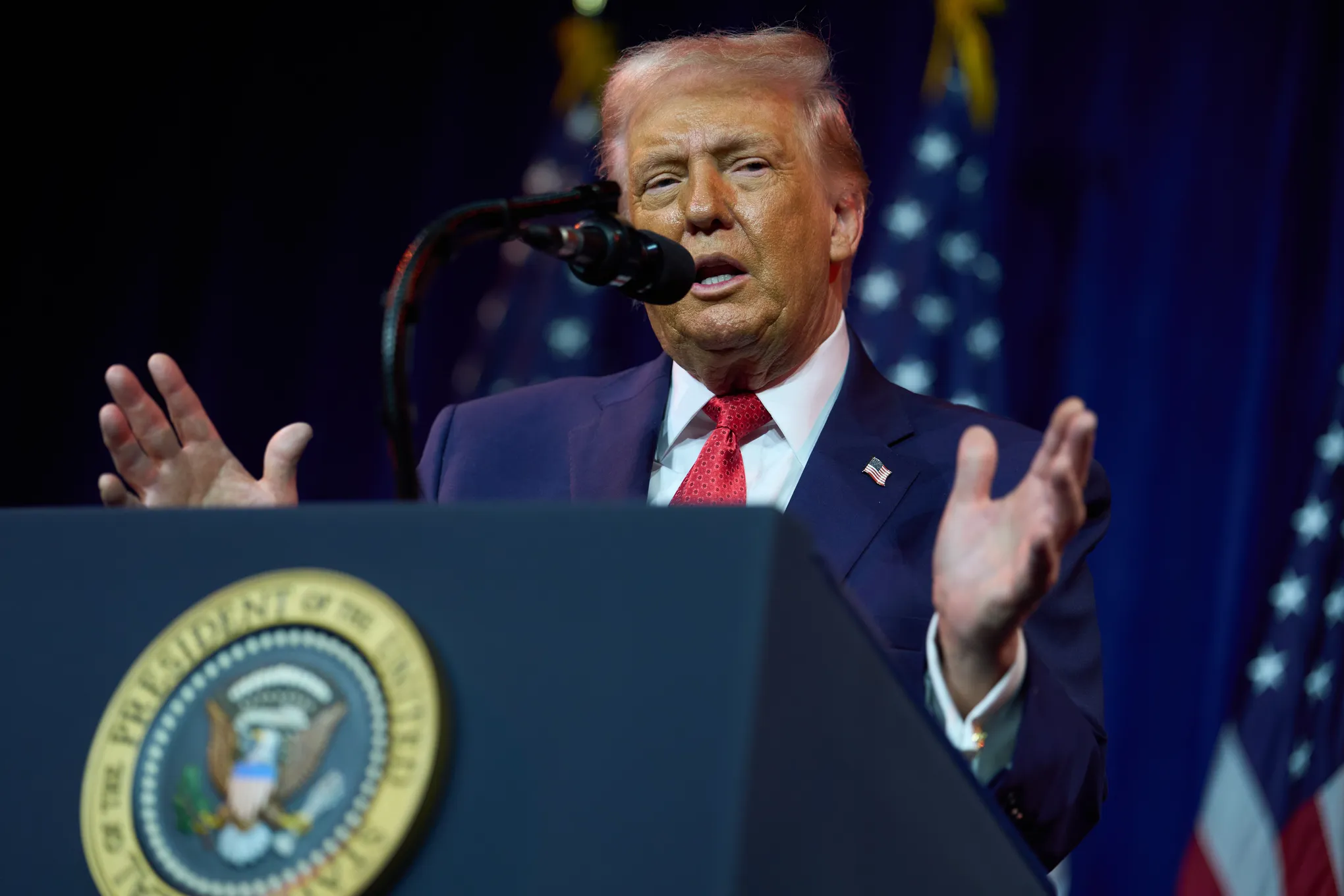
Donald Trump is urging lawmakers to lift annual U.S. defense spending to $1.5 trillion by 2027, reversing an earlier Elon Musk-linked push to trim parts of the Pentagon.
He says tariff revenue can finance the buildup while also reducing debt. Congress would have to approve any increase. The fiscal tension is immediate.
With national security spending authorized at about $901 billion for the current fiscal year, the target adds roughly $599 billion in annual outlays using a $901 billion base. Tariffs have generated about $195 billion in revenue this year through September 30.
That leaves a gap that would likely require borrowing or cuts elsewhere. Supporters argue deterrence is cheaper than drift; critics say the bill crowds out domestic priorities.
Measured against other powers, $1.5 trillion is in a class of its own. Recent comparable estimates put China near $314 billion and Russia near $149 billion.
Germany and India are roughly $88–86 billion, the UK $82 billion, Saudi Arabia $80 billion, France $65 billion, Japan $55 billion, and Türkiye $25 billion. A $1.5 trillion U.S. level would widen a lead that already exceeds the next nine countries combined.
Some published 2026-era plans underline the gap: Germany has outlined more than €108 billion (about $126 billion) in defence resources; Russia’s draft 2026 national defence line has been reported around 13 trillion roubles (about $157 billion); Japan’s FY2026 defence budget is over ¥9 trillion (about $58 billion).
Yet the headline is not only money. Since World War II, U.S. leadership leaned on treaties, institutions, and predictable norms.
Trumpism signals a pivot: rules are negotiable, bargaining is constant, and power—tariffs, output, and force projection—sets the terms. Even tougher pressure on contractors for faster delivery fits that logic: results over process.
Related coverage: Brazil’s Morning Call | America’s Productivity Surge Is Cooling Wage Inflation Witho This is part of The Rio Times’ daily coverage of global affairs and Latin American financial news.
This article was produced by The Rio Times’ automated newsroom system. How we use AI · Report an error · Editorial responsibility: Matthias Camenzind, Editor-in-Chief
Read More from The Rio Times