Colombia’s Total Peace Is Over: Petro Cuts Calarcá, Gulf Clan Out
Key Facts
— — President Gustavo Petro ordered High Commissioner for Peace Otty Patiño on Tuesday, April 21, to evaluate suspending the negotiation with alias Calarcá’s FARC-dissident faction after documented violations of ceasefire commitments — specifically attacks on soldiers and continued Amazonian deforestation for cattle ranching. Calarcá’s Estado Mayor de Bloques was the last FARC-dissident structure still at the table.
— — Hours earlier the same day, Ricardo Giraldo, lawyer for the Clan del Golfo (Ejército Gaitanista de Colombia), told reporters in Bogotá that the Doha dialogue will not produce a peace agreement under Petro’s government. With four months left in Petro’s mandate — which ends August 7, 2026 — the Gulf Clan rejection and the Calarcá rupture effectively close the two remaining active Paz Total tracks.
— — Paz Total’s collapse lands 40 days before Colombia’s May 31 first-round presidential vote, where security is the dominant campaign issue. Armed groups now control 170 municipalities flagged at electoral risk, a 30% jump from 2022. The next president will inherit stronger cartels, weaker ceasefires, and a discredited negotiation framework.
The Petro Calarcá peace talks termination is the moment Paz Total stops being a strategy and becomes a campaign issue — a four-year negotiation framework that is now collapsing under the weight of its own concessions, exactly as the country enters its most violent electoral cycle in a generation.
Colombian President Gustavo Petro ordered his High Commissioner for Peace on Tuesday afternoon to evaluate suspending the negotiation with the last active FARC-dissident faction, effectively closing the most visible remaining Paz Total track. The Rio Times, the Latin American financial news outlet, reports that the Petro Calarcá peace talks suspension came hours after the Gulf Clan’s legal representative publicly ruled out any peace agreement under the current government — making Tuesday, April 21, the day Colombia’s four-year peace strategy ran out of runway.
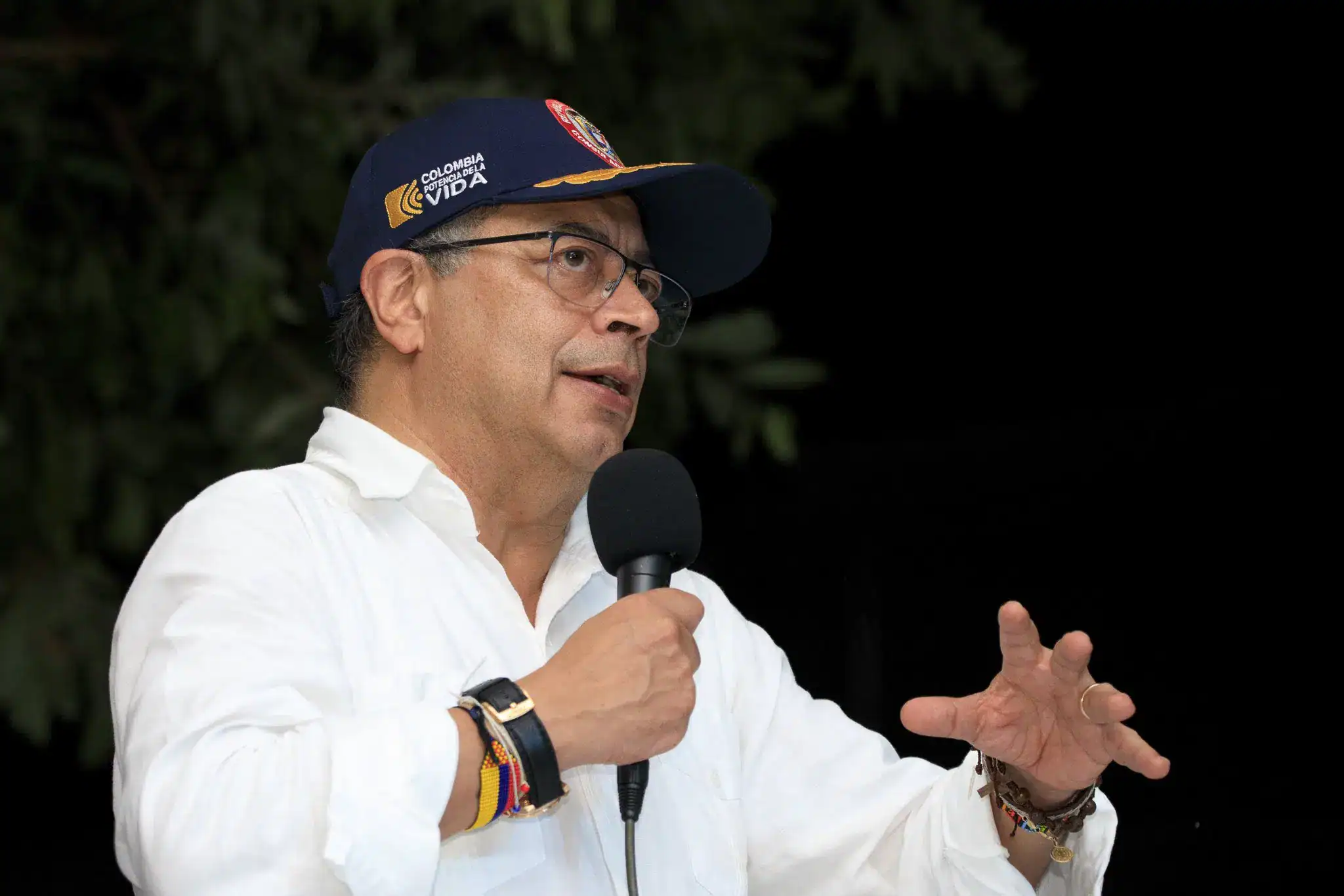
Speaking in a televised Cabinet meeting at Casa de Nariño, Petro told ministers he had instructed High Commissioner Otty Patiño to halt the process with alias Calarcá’s Estado Mayor de Bloques if the group continues breaching the ceasefire. Petro cited documented violations on two specific commitments: stopping Amazonian deforestation for cattle ranching and ending armed attacks on civilians and security forces.
“If Mr. Calarcá breached the pacts not to burn the forest and dedicated himself to killing soldiers, then there is no peace,” Petro said. “I would like peace, but peace has to be built on serious foundations, not on lies.”
Who Calarcá Is and Why the Petro Calarcá Peace Talks Mattered
Alexander Díaz Mendoza, known as “Calarcá Córdoba,” leads a splinter of the Estado Mayor Central (EMC) — the largest organized successor of the dissolved FARC. The EMC fractured in April 2024 when commander Iván Mordisco walked away from peace talks and intensified attacks, while Calarcá’s minority faction, rebranded as the Estado Mayor de Bloques, chose to stay at the table.
That decision made Calarcá the last significant FARC-dissident structure Petro could plausibly claim was negotiating in good faith. Suspending the dialogue removes that claim and leaves the Colombian government with no active peace track against any FARC-derived group — Mordisco was declared a terrorist organization in 2025, Segunda Marquetalia never entered talks, and Calarcá’s ceasefire is now over.
The Fiscalía, Colombia’s attorney general’s office, announced separately on Tuesday that Calarcá will be summoned for formal charges on crimes against humanity — a legal move that functionally closes the door on the dialogue Petro had just suspended.
The Gulf Clan Rejection on the Same Day
Hours before Petro’s Cabinet announcement, Ricardo Giraldo — legal representative of the Ejército Gaitanista de Colombia (EGC), better known as the Clan del Golfo — told reporters that the Doha negotiation will not culminate in a peace agreement under the current administration. The statement effectively confirms what Colombian security analysts have been saying since February: the EGC process is running out the clock rather than closing toward a deal.
The EGC track had appeared the most procedurally advanced of Petro’s remaining dialogues. Two negotiating cycles in Doha, Qatar produced agreements on Temporary Location Zones (ZUTs) in Chocó and Córdoba and a verification mechanism that delivered its first bimestral report this week. But the February 2026 rupture — triggered by Petro’s Washington offer to Trump to deliver EGC leader “Chiquito Malo” — exposed the fragility of the Doha process.
The dialogue was reactivated on February 17 in Bogotá with mediator countries Qatar, Spain, Norway, and Switzerland back at the table. Giraldo’s Tuesday statement signals that reactivation delivered procedural motion without political closure.
ELN, Segunda Marquetalia, Mordisco: The Other Tracks
The ELN peace process collapsed in January 2026 after guerrilla attacks in Catatumbo killed more than 100 people and displaced approximately 55,000 civilians in Norte de Santander. That breakdown triggered Petro’s state of emergency declaration and the deployment of thousands of troops to the Venezuelan border region. Talks have not resumed.
Mordisco’s EMC faction was formally designated a terrorist organization by Petro in 2025, with a 5-billion-peso bounty on his head. Segunda Marquetalia, the Iván Márquez-led FARC splinter based in Venezuela, never entered dialogues at all. The only quasi-positive exception is the Comuneros del Sur, an ELN splinter that formally relinquished weapons in April 2025 — the first and still only demobilization under Paz Total.
Put together, Petro’s final legacy on peace looks closer to his predecessors’ records than to the transformational break he promised in 2022.
Election Timing: 40 Days to First Round
Colombia’s first-round presidential vote is May 31, 2026. Security has become the dominant campaign issue — the independent Misión de Observación Electoral counts 170 municipalities at electoral risk, a 30% jump from 2022, with 81 classified as extreme. Departments including Arauca, Cauca, and Norte de Santander are effectively off-limits to candidates without armed-group permission.
The polling race is splitting between Iván Cepeda, architect of Petro’s negotiation approach and the Pacto Histórico candidate, and hard-line right-wing candidates Abelardo de la Espriella and Paloma Valencia. De la Espriella has already received explicit death threats from the ELN, which declared him a military target on February 10. The peace-versus-security frame that defined the 2022 race has now inverted — security is the pro-establishment position, and dialogue is the insurgent one.
Whoever wins in May and takes office August 7 will inherit an armed-group landscape more fragmented than in 2022, with the Clan del Golfo operating in 392 municipalities — a 55% expansion during Petro’s term — and cocaine production at record levels.
Economic and Market Implications
The collapse of Paz Total has direct economic consequences. The peso is trading around COP 3,660 per dollar, with medium-term forecasts clustering at COP 4,000–4,200 by year-end and pessimistic scenarios from Capital Economics extending to COP 4,600. Violence in Chocó, Cauca, Nariño, and Arauca continues to disrupt mining and oil operations, and sovereign spreads have widened through Q1 as Colombia’s fiscal and security risk premium has compounded.
Institutional investors have been watching the peace framework as a leading indicator for the election outcome. A collapsed Paz Total favors right-wing candidates who promise restored state authority; their victory would likely produce a short-term currency rally and a medium-term fiscal tightening. A Cepeda victory preserving Petro’s approach would extend the current uncertainty, with armed groups now operating under a negotiation framework the state has lost the credibility to enforce.
For commodity markets, Colombia’s security deterioration is already pricing into gas import dependence, firm-energy deficits ahead of El Niño, and FDI that fell to its lowest Q1 level since 2021.
What to Watch
Three inflection points define the next six weeks. First, whether Petro formally gazettes the Calarcá suspension or allows the High Commissioner room for a last-minute recalibration. Second, whether the Clan del Golfo walks away from Doha outright or continues the procedural motion through the May 31 election.
Third, whether the Fiscalía actually executes the crimes-against-humanity summons against Calarcá in a way that would permanently foreclose future dialogue. The televised Cabinet framing on Tuesday suggests the decision is made but the legal instrument has not yet been signed.
The broader question for international readers is whether Petro will spend his final four months governing from inside the Paz Total frame or pivot to a more conventional security posture. Tuesday’s announcement points to the latter.
Paz Total was never going to end on a signing ceremony. It is ending instead as it was born — through a televised Petro speech, with the policy’s architects still in their jobs, and with the violence on the ground completely unchanged.
Related Coverage: Colombia Peace Process 2026 Guide • Why Colombia’s 2026 Elections Could Turn Deadly • Colombia Economy 2026 Guide
More: Colombia news in English, every day from The Rio Times.
This article was produced by The Rio Times’ automated newsroom system. How we use AI · Report an error · Editorial responsibility: Matthias Camenzind, Editor-in-Chief