Peru Election 2026: Sánchez Surges Toward Runoff
Peru’s presidential runoff has since taken place. Keiko Fujimori won the vote of 7 June 2026 with 50.135 percent against Roberto Sánchez’s 49.865 percent, a margin of 49,641 votes, and was sworn in on 28 July 2026. The article below describes the situation as it stood at the time of publication. Read the result →
Key Facts
— — With approximately 89% of actas counted, Keiko Fujimori leads at 16.8%, Rafael López Aliaga holds second at roughly 12%, but Roberto Sánchez of Juntos por el Perú has surged to 11.7% and overtaken Jorge Nieto for third place.
— — Sánchez gained more than 2 points as rural and southern actas were processed, while López Aliaga lost 2 points from his early count—narrowing the gap to under 1 point and raising the possibility that the June 7 runoff becomes Keiko vs. a left-wing candidate rather than a right-vs-right contest.
— — The Galaga logistics scandal—a private contractor’s failure to deliver ballots to hundreds of voting stations—forced an extraordinary second day of voting on April 13, and Congress has summoned the heads of ONPE and JNE to testify.
Exit polls predicted a comfortable right-wing runoff. The actual count is telling a different story, and the remaining 11% of actas come from the regions where Sánchez is strongest.
The Peru election 2026 results are shifting as the count deepens into rural and southern regions. The Rio Times, the Latin American financial news outlet, reports that with approximately 89% of actas processed by ONPE as of early Wednesday, the fight for second place—and therefore the shape of the June 7 runoff—has become a genuine three-way race between Rafael López Aliaga, Roberto Sánchez, and Jorge Nieto, with Sánchez on the strongest upward trajectory.
The Peru Election 2026 Results at 89% Counted
Keiko Fujimori of Fuerza Popular holds a commanding first-place lead at 16.8% that has barely moved since the first returns, while the battle for second has shifted dramatically. López Aliaga (Renovación Popular) started at nearly 14% in early urban-heavy returns but has slid to approximately 12%, while Sánchez (Juntos por el Perú) climbed from 8.5% to 11.7%, overtaking Nieto in the process.
Nieto (Partido del Buen Gobierno) has faded from early third to fourth at 11.2%, while Ricardo Belmont (Partido Cívico Obras) sits fifth at roughly 10%—making this the most fragmented first round in modern Peruvian history with five candidates between 10% and 17%. The gap between López Aliaga and Sánchez has narrowed to under 1 percentage point, and CNN en Español reported that the remaining uncounted actas come disproportionately from the southern highlands and rural areas where Sánchez is strongest.
Why Second Place Changes Everything
A Keiko–López Aliaga runoff would pit two right-wing candidates against each other in a competitive but ideologically narrow contest. A Keiko–Sánchez runoff would recreate the left-versus-right dynamic of Peru’s 2021 election—when Pedro Castillo narrowly defeated Keiko with Sánchez serving as one of his ministers—and reactivate the polarization that defined Peruvian politics for the past five years.
Markets are already reacting: the sol rose to S/3.415 per dollar on Tuesday on post-election uncertainty before recovering slightly. Keiko’s own running mate Luis Galarreta told media that Fuerza Popular would prefer to face López Aliaga—an implicit acknowledgment that Sánchez in the runoff would be the harder fight.
The Galaga Scandal and the Extra Voting Day
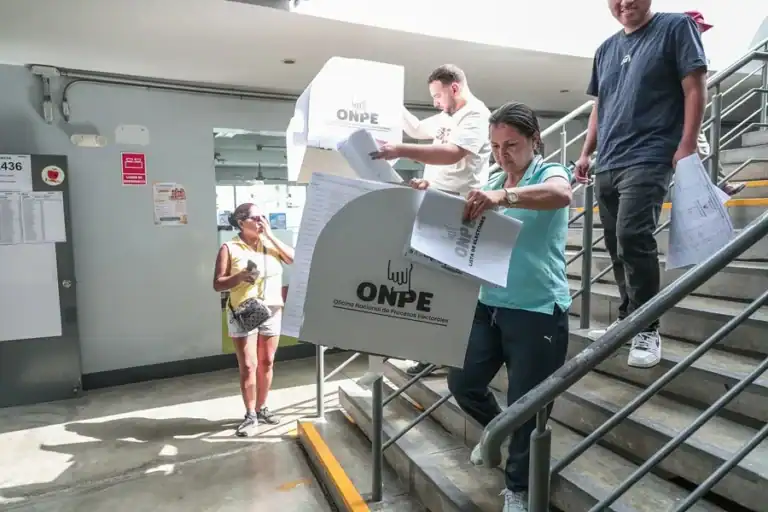
The election itself was marred by a logistics failure when Servicios Generales Galaga, the private contractor responsible for ballot distribution, failed to deliver materials to hundreds of voting stations on April 12, leaving thousands of citizens unable to vote. The JNE ordered an extraordinary second voting day on Monday April 13 at 13 centers in Lima and two in the United States, while Congress summoned the heads of both ONPE and JNE to testify. The opposition group Transparencia warned against any congressional interference in the count.
A Historic Congress Takes Shape
Beyond the presidency, Peru elected its first bicameral Congress in 34 years: 130 diputados and 60 senators. The composition remains unknown as the count proceeds, but the fragmentation visible in the presidential race—with no party above 17%—suggests a deeply divided legislature that will complicate governance for whoever wins in June. The broader investor landscape for Latin America depends partly on whether Peru’s next government can provide the institutional stability that its 2.8% IMF growth projection assumes.
Related Coverage: IMF WEO: Latin America Grows 2.3% as War Reshapes Winners and Losers • Investing in Brazil 2026 Guide
More: Latin America news in English, every day from The Rio Times.
This article was produced by The Rio Times’ automated newsroom system. How we use AI · Report an error · Editorial responsibility: Matthias Camenzind, Editor-in-Chief
In depth