Mexico April Inflation Supports Another Banxico Rate Cut in June

Key Facts
— —Mexico’s headline inflation eased to 4.53% year-on-year in the first half of April 2026 — below the 4.55% reading for the second half of March — according to INEGI data published April 23, the 141st consecutive fortnight the CPI has remained above the Banco de México 3% target.
— —Tomato prices jumped 24.37% in the two-week window and fruit and vegetables advanced 23.03% year-on-year, while premium gasoline rose 2.97% despite the government’s highest fuel subsidy since September 2023 — the supply-side drivers visibly reshaping the CPI composition.
— —Core inflation came in at 4.27% year-on-year with a 0.18% fortnightly change, supporting the case for another Banxico 25 bp rate cut at the June meeting — a Citi survey this week projected the policy rate would close 2026 at 6.5%.
The Mexico inflation April print is the softest fortnightly read this year on a core basis, but the headline rate remains well above Banxico’s tolerance band — leaving the rate-cut path dependent on how agricultural prices and fuel subsidies feed into the May and June reads.
The Rio Times, the Latin American financial news outlet, reports that Mexico’s consumer price index rose 0.11% in the first half of April 2026 compared with the previous fortnight, taking the annual Mexico inflation April rate to 4.53%, according to INEGI data released on April 23. The reading is marginally below the 4.55% registered in the second half of March and notably below the 4.63% reading of the first half of March. The CPI sat at 3.96% year-on-year in the same period of 2025.
The index remains above Banco de México‘s 3% target for the 141st consecutive fortnight, with the central bank’s tolerance band running from 2% to 4%. Core inflation — the measure that excludes volatile items — rose 0.18% fortnightly and 4.27% year-on-year, with goods at 4.10% and services at 4.44%. The non-core or volatile segment showed a broader dispersion, with fresh produce the single largest driver on the upside.
What drove the Mexico inflation April reading
Tomato prices rose 24.37% in the two-week window and contributed 0.205 percentage points to the fortnightly INPC change — the single largest generic-product incidence in the release. Chile serrano rose 21.94%, other fresh chiles rose 16.87%, with potatoes, onions and other tubers also contributing — at the category level, fruits and vegetables advanced 23.03% year-on-year while total agricultural products ran at 8.68%. On the downside, electricity prices fell 14% as seasonal “temporada cálida” tariffs came into effect in 18 Mexican cities, offsetting part of the vegetable pressure.
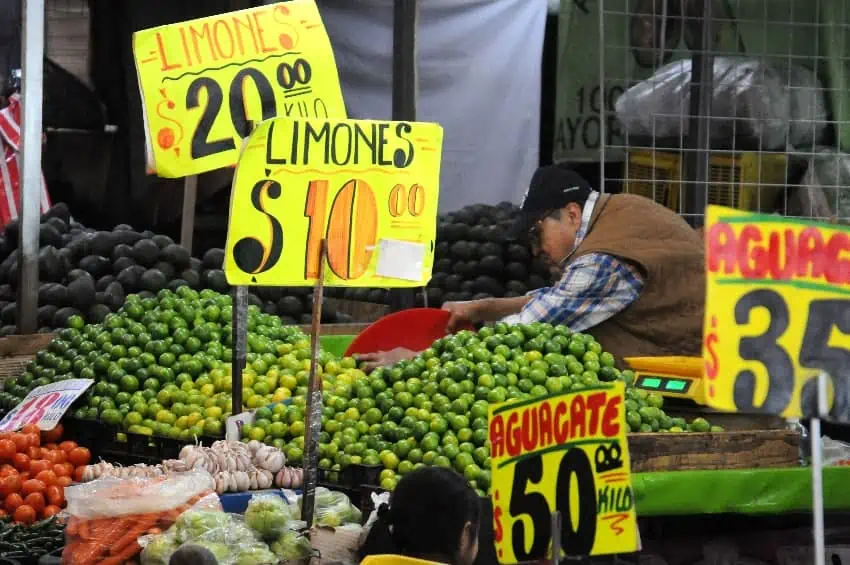
Premium gasoline rose 2.97% and added 0.015 percentage points despite the Hacienda Ministry applying its largest fuel subsidy in over two years during the first fortnight of April. Green tomato, air transport, chicken and eggs all fell, partially cushioning the headline. Lunch-counter establishments (loncherías, fondas, torterías, taquerías) moderated price adjustments to 0.28% in the fortnight — a cautious signal that the restaurant sector is still absorbing cost pressure without full pass-through.
What the print means for Banxico’s rate path
The softer headline reading supports the case for another 25 basis-point rate cut at Banxico’s next meeting in June, economists told El CEO. A Citi survey published this week puts the policy-rate close for 2026 at 6.5%, which would imply one additional cut from the current level. The trajectory has been clear — Banxico has delivered sustained easing through the first four months of 2026 as the headline rate has drifted down from the peaks of 2024.
For international investors tracking the Mexican peso and Banxico-priced instruments, the Mexico inflation April reading keeps the easing cycle alive but does not accelerate it. The peso had been trading stable against the dollar into the release, with markets watching the US-Iran ceasefire negotiations and the T-MEC review process (which BBVA Research this week flagged as the main peso headwind for the second quarter). The broader Mexican macro outlook and T-MEC dynamics are covered in depth in The Rio Times’s Mexico Economy 2026 guide.
What comes next
The second-half April INPC print and the full-month May reading will determine whether the agricultural-price spike was a transitory supply-side shock or the start of a more persistent second-quarter pressure. The April 23 INEGI release is the last inflation data point before Banxico’s June decision window opens, and the core reading — softer than the headline and decelerating — is the number most closely tracked by the Junta de Gobierno. The commercial gasoline trajectory will also be critical, with the fuel subsidy expected to continue through Q2 2026.
The print lands in the same morning conference at Palacio Nacional where President Claudia Sheinbaum confirmed she is proposing Roberto Lazzeri as Mexico’s new ambassador to the United States — a diplomatic change that coincides with the T-MEC review and the negotiation architecture that will define Mexico’s external trade framework into 2027. For markets, the inflation path, the rate-cut cadence and the T-MEC review now form a single combined macro variable.
Related coverage: Mexico Economy 2026 Outlook • Sheinbaum Proposes Lazzeri as US Ambassador • Nearshoring Mexico 2026 Guide
More: Latin America news in English, every day from The Rio Times.
This article was produced by The Rio Times’ automated newsroom system. How we use AI · Report an error · Editorial responsibility: Matthias Camenzind, Editor-in-Chief