RioTimes Evergreen Guide | Series: Latin America Investing
Key Facts
— Mexico absorbed about $41 billion in foreign direct investment in the first three quarters of 2025, up 15% year-on-year, as firms relocate supply chains under the USMCA trade deal — whose utilization jumped to 89%. Mexico’s ~$4.90 average manufacturing wage undercuts China’s ~$6.50.
— Mexico absorbed roughly $41 billion in FDI in the first three quarters of 2025 — a 15% year-on-year increase — as nearshoring became the defining investment theme of North America’s industrial decade.
— USMCA utilization surged from 45% to 89% between January and November 2025, insulating compliant exporters from tariffs; Mexico’s average manufacturing wage of $4.90/hr remains 25% below China’s $6.50/hr.
— The July 2026 USMCA joint review is the year’s most consequential trade policy event, with outcomes that could tighten Chinese-content rules and reshape industrial supply chains across northern Mexico.
Nearshoring Mexico has evolved from a supply chain buzzword into the defining investment theme of North America’s industrial decade. Driven by US-China trade tensions, the strategic logic of the USMCA, and a structural shift away from distant Asian suppliers, Mexico is now forcing executives and investors to move beyond the macro thesis and into the operational details.
Nearshoring Mexico has evolved from a supply chain buzzword into the defining investment theme of North America’s industrial decade. Driven by US-China trade tensions, the strategic logic of the USMCA, and a structural shift away from distant Asian suppliers, Mexico absorbed roughly $41 billion in foreign direct investment in the first three quarters of 2025 — a 15% increase year-on-year.
In 2026, the story is less about whether companies should nearshore to Mexico and more about whether Mexico can execute fast enough to meet the pipeline of committed capital. Tariff volatility, infrastructure bottlenecks, and a looming USMCA review are forcing executives and investors to move beyond the macro thesis and into the operational details.
Mexico · Economy — Key Facts
- FDI Absorption: Mexico absorbed roughly $41 billion in FDI in the first three quarters of 2025, a 15% year-on-year increase.
- USMCA Utilization: USMCA utilization rates jumped from approximately 45% to 89% between January and November 2025.
- Wage Advantage: Mexico’s average manufacturing wage is approximately $4.90 per hour, versus $6.50 per hour in China—a 25% gap.
- Largest Trading Partner: Mexico became the United States’ largest trading partner in 2023, a position it has defended despite tariff friction.
- USMCA Review: The first formal USMCA joint review is scheduled for July 2026, viewed as an opportunity to modernize the agreement.
Why Mexico Is the Top Nearshoring Destination
Geography alone does not explain Mexico’s position. The country’s advantage over Vietnam, India, and Eastern Europe is the combination of physical proximity to the US market with a legally binding preferential trade framework no other country can match.
Under the United States-Mexico-Canada Agreement (USMCA), goods meeting the agreement’s rules of origin travel between the three members duty-free or at preferential rates — a distinction worth tens of percentage points in landed cost relative to importing from Asia.
The rules of origin mechanism is the structural engine behind nearshoring. USMCA rules require that a meaningful share of a product’s content and transformation occur within North America.
For automotive goods, 75% of a vehicle’s content must originate in the USMCA zone for duty-free treatment; sector-specific rules for electronics and other goods dictate tariff classification changes or regional value content thresholds. Companies that complete the compliance work gain an effective tariff rate near zero into the US market; those that do not pay the non-preferential rate, which has risen sharply since 2025.
Labor costs reinforce the case. Mexico’s average manufacturing wage is approximately $4.90 per hour, versus $6.50 per hour in China — a 25% gap that compounds when tariffs on Chinese goods are factored in.
A container from Mexico to the US runs roughly $2,700 versus $4,000 or more from Chinese ports, with faster transit times and tighter engineering coordination further improving the total cost picture.
Mexico became the United States’ largest trading partner in 2023, a position it has defended despite tariff friction. Between 2018 and 2025, cumulative FDI increased by an estimated 69%, with manufacturing accounting for approximately 37% of all foreign investment by late 2025.
In January 2026 alone, Mexico announced and inaugurated $5.8 billion in new investment across energy, industrial parks, automotive, pharmaceuticals, and advanced manufacturing.
What US Tariffs Mean for Nearshoring Mexico
The tariff environment in 2025–2026 has been the most volatile in a generation. The Trump administration initially imposed 25% tariffs on Mexican imports under the International Emergency Economic Powers Act (IEEPA) in early 2025, citing immigration and drug enforcement grounds.
The tariffs triggered a surge in USMCA compliance activity: manufacturers relying on low MFN tariffs suddenly had strong financial incentive to qualify their goods under the agreement.
The results were striking. USMCA utilization rates jumped from approximately 45% to 89% between January and November 2025.
That shift appears durable: once companies invest in the supply chain mapping, bills of material, and supplier certifications required for USMCA qualification, they maintain those processes. For compliant exporters, the effective tariff rate on goods shipped to the US is near zero.
A February 2026 US Supreme Court ruling struck down the IEEPA tariff authority, forcing the administration to pivot to Section 122 of the Trade Act of 1974. Tariffs under Section 122 carry a statutory ceiling: they expire after 150 days without congressional action.
The current 10% surcharge on non-USMCA Mexican goods is set to expire around July 24, 2026 unless Congress acts. Companies with USMCA-compliant supply chains are insulated from Section 122; those without face a time-limited exposure that may resolve in either direction.
The competitive context with China matters. Effective US tariffs on Chinese goods exceeded 33% from mid-2025 and climbed substantially higher in certain categories.
Even under worst-case scenarios for Mexico, Mexican production remains cheaper than Chinese manufacturing for most labor-intensive goods until tariffs on Mexico reach approximately 43%. BBVA Research calculates a positive GDP impact of +0.09% for Mexico from the 2025 tariff realignment, compared with significant contractions projected for Canada and China.
The first formal USMCA joint review is scheduled for July 2026. Industry analysts view it as an opportunity for Mexico to modernize the agreement and lock in its manufacturing leadership role, though it also carries the risk of tighter rules of origin — particularly around Chinese-content inputs — that could disqualify some current supply chains.
Key Sectors and Industrial Corridors
Four sectors dominate Mexico’s nearshoring activity, each concentrated in specific geographic corridors that have built deep supplier networks and specialized workforces over decades.
Automotive remains the anchor industry. The Bajío region — spanning Guanajuato, Querétaro, Aguascalientes, and San Luis Potosí — is the automotive heartland, hosting plants for BMW, General Motors, Honda, Mazda, Toyota, and Volkswagen.
Tesla and Foxconn have expanded manufacturing presence targeting electric vehicle supply chains. The 25% US tariffs on imported vehicles and auto parts that took effect in 2025 created short-term turbulence but gave USMCA-compliant Mexican production a significant cost advantage over non-qualifying imports.
Electronics and electrical equipment account for approximately 35% of total Mexican exports. Ciudad Juárez and Tijuana are the twin capitals, with Samsung running substantial operations in both cities.
Tijuana is increasingly positioned as a semiconductor ecosystem hub — not for chip fabrication, but for assembly, testing, integration, and high-mix electronics manufacturing serving US technology and defense supply chains.
Aerospace has grown into a mature cluster, with Querétaro hosting Bombardier, Safran, and Honeywell operations and Monterrey and Chihuahua home to aerospace parks serving major OEMs. Mexico now ranks among the world’s top ten aerospace manufacturing nations.
Medical devices is one of Mexico’s fastest-growing export industries, with the country already the world’s eighth-largest medical device exporter. Monterrey, Baja California, and Chihuahua concentrate the bulk of production, supplying US hospitals and distributors with surgical instruments, diagnostic equipment, and disposables.
The sector’s growth has been relatively insulated from tariff volatility because most medical device trade qualifies under USMCA and the FDA compliance infrastructure that manufacturers must maintain keeps production anchored in established facilities.
Industrial real estate data reflects genuine demand. Monterrey leads with over 203 million square feet of inventory and gross absorption up 28% year-on-year in Q3 2025.
Ciudad Juárez recorded a 63% surge in absorption over the same period. Querétaro absorbed space at a 74% higher quarterly rate, with availability at just 7.48%.
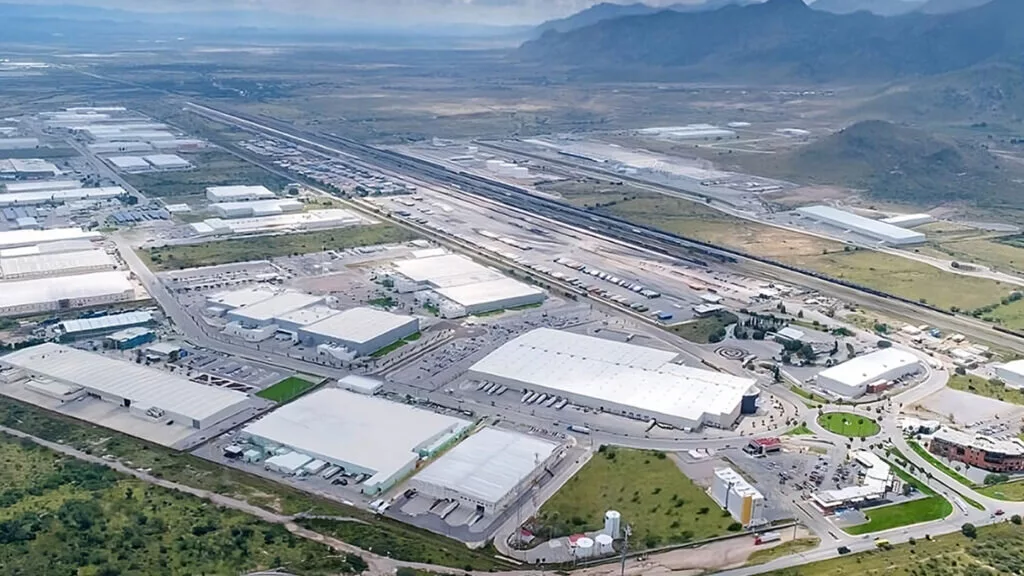
Northern Mexico accounted for 54.3% of all industrial built area in 2025, with the Bajío capturing most of the remainder. The January 2026 investment surge was concentrated across Nuevo León, Coahuila, Querétaro, Guanajuato, and Aguascalientes.
Challenges and Risks
Mexico’s nearshoring opportunity is genuine, but the gap between announced investment and operational production is where deals die. Several structural constraints test the country’s ability to convert the pipeline into real output.
Energy reliability is the most cited bottleneck. Mexico’s grid — dominated by the state utility CFE — has not expanded fast enough to serve new industrial loads in northern Mexico.
Brookings Institution research has noted that scaling nearshoring production will require resolving energy bottlenecks, and Q1 2026 market analysis confirmed utility diligence has become a core feasibility step in site selection. Companies face constraints on grid connectivity, power quality, and clean energy contracts, with many industrial parks requiring private investment in backup generation.
Water scarcity is a parallel constraint. Baja California, Sonora, Chihuahua, Coahuila, Nuevo León, and Tamaulipas — the core of Mexico’s industrial nearshoring belt — are among the country’s driest states.
Prolonged droughts in the Rio Grande and Colorado River basins have reduced shared water availability, and automotive, electronics, and medical device production all require significant water for cooling and processing. Existing municipal infrastructure was not designed for industrial-scale demand, and investors are now pricing water risk into site selection.
Security and rule of law remain persistent concerns. Organized crime affects logistics corridors and creates extortion risks for smaller suppliers.
The Sheinbaum administration’s judicial reforms — introducing direct popular election of judges — have drawn criticism for undermining legal predictability. The Baker Institute has noted that declining judicial reliability could encourage reshoring to the US for companies that weight contract enforcement heavily.
Chinese transshipment scrutiny is an emerging compliance risk. The USMCA does not prohibit Chinese-owned companies from manufacturing in Mexico, but goods must meet rules of origin to qualify for preferential treatment.
Chinese firms have leased over 5 million square meters of Mexican warehouse space partly to access US markets. The July 2026 USMCA review is expected to tighten transshipment rules — companies relying on Chinese-sourced inputs need to assess their exposure carefully.
Monetary conditions add complexity. Banxico cut its benchmark rate to 6.75% in March 2026, resuming an easing cycle paused in February as economic activity weakened.
The OECD revised Mexico’s growth forecast to 0.6% for 2026. Headline inflation rose to 4.63% in mid-March, above Banxico’s 3% target.
The central bank’s 325 basis-point premium over the Federal Reserve has supported the peso — which gained 22% against the dollar in 2025 — and sustained the carry trade that channels capital into Mexico’s financial markets.
The 2026 Outlook
Mexico is the structurally preferred nearshoring destination for North American supply chains in 2026 — but must now deliver on execution. President Sheinbaum’s Plan México provides formal policy backing: immediate deductions of up to 91% on new fixed asset investments through 2026 and a MXN 5.6 trillion public-private investment plan through 2030, with MXN 722 billion earmarked for 2026 across energy, transport, water, and airport infrastructure.
The government’s signal is clear: the bottleneck is supply-side, and enabling infrastructure must come before announced factories can go live.
The July 2026 USMCA review is the most consequential trade policy event of the year. Outcomes range from modest modernization — updating digital trade provisions and rules of origin documentation — to more disruptive changes tightening Chinese-content restrictions or revisiting automotive value content thresholds.
Companies with compliant supply chains are best positioned regardless; those relying on ambiguous origin determinations or Chinese-sourced inputs face material risk.
The clearest signal from 2025 is that USMCA compliance is no longer optional. The jump from 45% to 89% utilization represents the market pricing in that reality.
For investors, the question is not whether nearshoring Mexico is the right strategy — it almost certainly is — but which corridors, sectors, and operators can translate announced investment into operational factories. The gap between pipeline and production is where competitive advantage will be won or lost.
This article is part of The Rio Times’ Evergreen Guide series. Last updated: April 6, 2026.
Key Facts
— Deep Dive
— For the complete picture, read our in-depth guide: Mexico Economy 2026: GDP, Peso, Nearshoring, Banxico and Trade
Recent Developments · updated June 9, 2026
Mexico’s industrial story — the engine of the nearshoring thesis — sent mixed signals this week. Car production slipped even as exports and sales rose, underscoring how export demand is holding up better than domestic output.
At the same time, Mexico unveiled Olinia, its first homegrown electric vehicle, a bid to climb the manufacturing value chain that nearshoring is meant to accelerate.
The investment climate also drew headlines as Mexico won a mining arbitration while moving to end a mine blockade, a signal to USMCA investors weighing legal certainty before relocating supply chains. Tariff uncertainty and a strong dollar remain the swing factors for whether Mexico converts proximity into sustained factory investment.
The near-term test is whether export momentum and industrial policy can offset softer domestic demand and keep Mexico the default nearshoring destination through 2026, as competing hubs in Central America and Asia court the same supply chains.
This article was produced by The Rio Times’ automated newsroom system. How we use AI · Report an error · Editorial responsibility: Matthias Camenzind, Editor-in-Chief