How Latin America Turned Murder Into a Flourishing Global Industry
Key Facts
— — At least 108,838 people were murdered across Latin America and the Caribbean in 2025, with contract killings accounting for a growing share in countries from Colombia to Peru
— — In Bogotá, half of all homicides are now classified as sicariato — professional hits carried out as outsourced services between criminal networks, with firearms rented for as little as 15,000 Colombian pesos (US$3.50) per half hour
— — Ecuador recorded 9,216 homicides in 2025, its deadliest year in history, where 16-year-old hitmen were paid US$150 per kill and cartel fragmentation turned entire provinces into war zones
— — In Peru, sicariato and extortion cases rose nearly 500% in five years, killing at least 69 bus drivers in 2025 alone and forcing 80% of Lima’s transport companies to pay criminal protection fees
— — Brazil’s PCC has turned contract killing into both an initiation rite and a transnational business operating across 28 countries, while RUSI researchers describe sicariato as a “parallel punishment system” replacing absent state justice
RioTimes Deep Analysis | Series: The Global Lens
In Bogotá, you can rent a gun for US$3.50 and hire someone to use it for less than a bus driver earns in a week. In Manta, Ecuador, a teenager was paid US$150 to execute a man at a mechanic’s shop — and in Lima, 80% of public transport companies pay criminal protection fees because the alternative is a bullet. Latin America sicariato is no longer an underworld aberration; it is the business model of a continent.
The Rio Times, the Latin American financial news outlet, examines how Latin America sicariato — professional murder-for-hire — has evolved from a tool of drug lords into a decentralized service economy operating across at least a dozen countries. At least 108,838 people were killed across the region in 2025, according to InSight Crime’s annual homicide review, producing a median rate of 17.6 per 100,000 inhabitants. While the regional total fell roughly 5% from 2024, the composition of the violence has shifted: an increasing proportion of killings are commissioned executions carried out by paid professionals or desperate adolescents for whom murder is the only available job.
Bogotá: Where Latin America Sicariato Became an Outsourced Service
The Colombian capital provides the clearest window into how sicariato operates as an industry. Data obtained by Bogotá city councilor Julián Espinosa from the National Police’s criminal investigation directorate (DIJIN) shows that contract killings accounted for 606 of the city’s 1,214 homicides in 2024 — 49.9% of the total. The trajectory is unmistakable: sicariato cases rose from 431 in 2022 (42% of homicides) to 437 in 2023 (40.3%) to that 2024 peak.
Laura Suárez, director of urban security at the ProBogotá think tank, told El País that the phenomenon reflects the instrumentalization of violence by multiple competing criminal organizations. There is no single dominant cartel — instead, dozens of well-financed gangs fight for drug corridors and control of illicit economies. Colombia’s cocaine production, estimated by the United Nations at approximately 3,000 tonnes annually, feeds cash into urban criminal networks that translates directly into arms, ammunition, and recruitment capacity.
What distinguishes Bogotá’s model is the emergence of what security analyst Nieto calls the “criminal portfolio” — a system where different gangs specialize in different services and outsource to each other, with murder as one line item. Firearms can be rented in neighborhoods like San Bernardo for 15,000 Colombian pesos (roughly US$3.50) per half hour, with prices rising for untraceable weapons. This accessibility is linked to arms flowing through intermediaries from Venezuela and Ecuador’s borders, creating a supply chain that makes hiring a killer as transactional as hiring a courier.
Ecuador: Child Sicarios and a Country at War With Itself
Ecuador closed 2025 as the most violent year in its history: 9,216 intentional homicides, a 32% increase over 2024, producing a rate of 50.9 per 100,000 inhabitants. The country averaged one murder every hour. Six Ecuadorian cities ranked among the world’s 50 most violent, and the ACLED Conflict Watchlist estimated that 71% of Ecuador’s population — over 12 million people — was exposed to organized-crime violence.
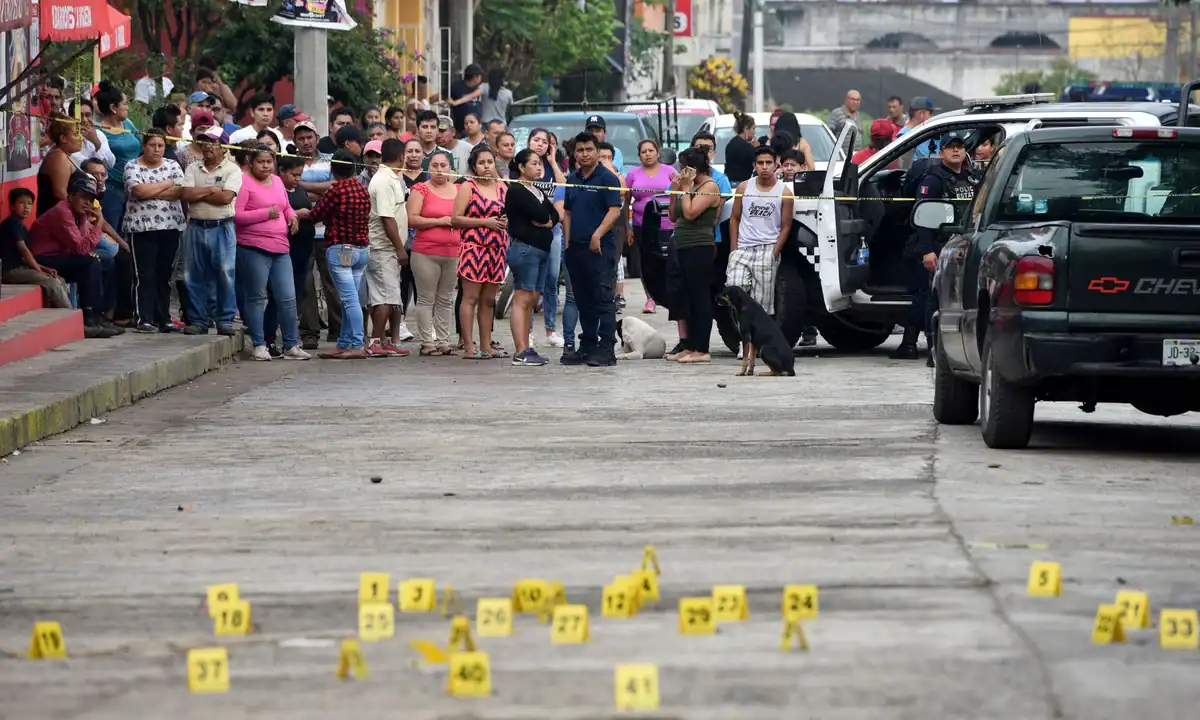
The sicariato dimension is particularly disturbing because of who is pulling the trigger. In January 2026, police in Manta apprehended a 16-year-old who had been paid US$150 to execute a 41-year-old man at a mechanic’s shop — a hit ordered by the Los Lobos gang as part of an internal dispute. Police linked the minor to additional violent incidents in the district, and the case was far from isolated.
The recruitment of minors is systematic: in December 2025, police dismantled a Los Choneros cell in Manabí that included two 16-year-old sicarios, one of whom already had a criminal record. Ecuador’s Observatorio Ecuatoriano de Crimen Organizado found that criminal organizations have developed extensive value chains where narcotrafficking is the primary revenue source, followed by illegal gold mining. The country’s transformation from a cocaine transit corridor into a major export platform — exploiting its Pacific ports and dollarized economy — has made violence the cost of doing business.
Peru: When Sicariato Targets the Economy
Peru represents a different evolution of the sicariato model — one in which contract killing has become the enforcement arm of a massive extortion economy. The Chamber of Commerce of Lima reported that extortion and sicariato cases rose nearly 500% over five years, threatening more than two million businesses. In the first quarter of 2025 alone, authorities documented 364 sicariato-style killings nationwide.
The transport sector has been decimated: at least 69 bus drivers and five fare collectors were killed during their working hours in 2025, and 80% of public transport companies acknowledged paying protection fees averaging 30,000 soles (roughly US$7,800) per month. Peru’s national death registry recorded 2,218 homicides in 2025, with the third quarter producing 575 killings — the highest quarterly figure since record-keeping began in 2017. Over 1,000 of Peru’s 1,880 districts are now operating under some form of emergency decree.
The government’s response has included banning two adults from sharing a motorcycle in Lima and Callao — targeting the classic sicariato mode of a driver and shooter on a motorbike. In early 2026, police reported over 4,000 extortion complaints in the first months, averaging 75 per day, though experts say the real figure is significantly higher because most victims do not report.
Brazil’s PCC: From Rite of Passage to Global Business
Brazil’s Primeiro Comando da Capital (PCC) represents the most sophisticated organizational model of sicariato in the region. The Royal United Services Institute (RUSI), the London-based defense think tank, describes the PCC as having adopted contract killing both as a rite of passage for new members and as an extraterritorial business — commissioning hits across borders as part of its operations in at least 28 countries.
The September 2024 assassination of São Paulo’s former police chief Ruy Ferraz Fontes — killed by three assailants using high-grade rifles on a busy road in Praia Grande — illustrated the PCC’s capacity for professional-grade targeted killings. The Global Initiative Against Transnational Organized Crime noted that Fontes had led the first task force to investigate the PCC in the late 1990s. Academic research published in ScienceDirect confirms the PCC operates a sophisticated parallel justice system that includes trials, punishment, dispute resolution for civilians, and contract enforcement — all functions normally reserved for the state.
The Trump administration’s push to designate the PCC and Comando Vermelho as Foreign Terrorist Organizations — and the Lula government’s resistance to that designation — reflects how contract killing has become a geopolitical issue. The PCC’s estimated 50,000 members and US$200 million annual revenue make it a criminal enterprise whose enforcement arm operates with military-level capabilities.
Argentina’s Rosario: A Decline That Proves the Rule
Rosario, Argentina — Lionel Messi’s birthplace — spent over a decade as the country’s narco-killing capital, with 260 homicides in 2023 driven by gang wars over drug territory. Under the Pullaro provincial government, homicides crashed 62% in 2024 to just 91. Infobae had previously reported that 70% of Rosario’s killings were sicariato-linked narco violence.
But 2025 saw a 27% rebound to 116 homicides — still far below the peak years, yet enough to signal that the underlying structures remain intact. Security analysts debate whether the 2024 drop reflected genuine enforcement success or an implicit truce between authorities and criminal gangs. Either way, Rosario demonstrates both the potential and the fragility of suppressing sicariato through enforcement alone.
Mexico: Where Cartels Turned Sicarios Into a Corporate Function
Mexico’s cartels have professionalized sicariato to a degree unmatched elsewhere in the region. The Jalisco New Generation Cartel (CJNG), led until his death in 2026 by Nemesio Oseguera Cervantes (“El Mencho”), maintained teams of highly trained sicarios who deployed armed drones, improvised landmines, and military-grade weapons. The US Treasury designated multiple cartel members specifically for overseeing sicario operations, including Carteles Unidos enforcer Edgar Valeriano Orozco Cabadas.
Academic ethnographic research on Ciudad Juárez sicarios found that contract killers follow a career path within what researchers describe as a “criminal corporate infrastructure” particularly robust in Mexican border cities. The Cartel del Noreste sent sicarios across the US border into Laredo, Texas, in a murder-for-hire operation that resulted in a life sentence for its leader. The Mexico Peace Index 2025 described cartels as having evolved from small smuggling organizations into multinational criminal enterprises that operate their own courts and enforce their own laws.
The Academic Framework: Sicariato as a Parallel Justice System
RUSI researcher Ludmila Quirós argues that sicariato should be understood not merely as murder-for-hire but as a “parallel punishment system” — a conflict resolution mechanism that emerges where state justice is absent. In her framework, contract killing functions as the criminal underworld’s equivalent of a court system: it resolves disputes, enforces agreements, punishes defectors, and deters competition. The sicario is not simply a killer but an intermediary who acts on behalf of actors who need enforcement without access to legitimate institutions.
This framework explains why sicariato grows in direct proportion to state weakness. In Ecuador, where the government has responded with successive states of emergency and military deployments, the violence has only intensified — because the fundamental absence of institutional justice in cartel-controlled territories remains unaddressed. In Peru, where over half the country’s administrative districts operate under emergency decree, the same dynamic applies.
Quirós also identifies an underexplored dimension: sicariato increasingly serves actors from the legal economy who use hired killers to resolve commercial disputes, intimidate competitors, or displace communities from valuable land. This “social cleansing” function means that contract killing has penetrated far beyond the drug trade into the legitimate economy itself.
The Regional Map
| Country / City | Sicariato Model | 2025 Homicides | Rate /100K |
|---|---|---|---|
| Colombia (Bogotá) | Outsourced gang services; “criminal portfolio” | 1,214 (2024) | 25.8 |
| Ecuador | Cartel wars; child recruitment; armed conflict | 9,216 | 50.9 |
| Peru | Extortion enforcement; transport targeting | 2,218 | 6.5 |
| Brazil | PCC parallel justice; extraterritorial ops | ~47,000 (est.) | ~22 |
| Argentina (Rosario) | Narco territorial wars; partial suppression | 116 (dept.) | ~4.7 |
| Mexico | Cartel corporate structure; military-grade ops | ~28,000 (est.) | ~21 |
| LATAM Total | Multiple models converging | 108,838 | 17.6 |
Sources: InSight Crime 2025 Homicide Round-Up; DIJIN via El País Colombia; Ministerio del Interior Ecuador; SINADEF Peru; RUSI; Global Initiative Against TOC.
What to Watch
Ecuador elections and security policy: President Noboa won reelection in April 2025 on a security-first platform, but the 32% homicide surge that followed suggests militarized responses alone cannot break the cycle. Watch whether the 35% border-province crime drop Noboa claims can extend nationally.
Peru’s election and extortion crisis: With elections in 2026 and extortion as the dominant voter concern, the next president inherits a security apparatus that has failed to protect the transport sector. The motorcycle ban experiment in Lima will be a test case.
PCC terror designation: The US-Brazil joint operations framework launched in April 2026 represents an alternative to designation. Whether it produces visible results before Brazil’s October elections will determine whether Washington escalates.
Investment risk repricing: For international investors assessing Latin American exposure, the sicariato map increasingly overlaps with the economic opportunity map — Ecuador’s ports handle agricultural exports, Peru’s Lima is the commercial engine, and Brazil’s PCC operates along the same corridors that move soybeans and iron ore to global markets.
The data leads to an uncomfortable conclusion: Latin America is not experiencing a crime wave. It is experiencing the maturation of a parallel economic system in which murder is a service, guns are rental products, teenagers are the labor force, and the state’s absence is the business plan.
The Global Lens Series
This article is part of The Rio Times’ Global Lens series, which provides deep-dive analysis of structural trends shaping Latin America’s security, economy, and politics.
Sources: El País Colombia (Andrés Ortiz, 2026) · InSight Crime 2025 Homicide Round-Up (March 2026) · RUSI, Ludmila Quirós (May 2023) · Ministerio del Interior Ecuador · El Universo / Extra Ecuador · OECO H1 2025 Report · Cámara de Comercio de Lima (Oct 2025) · Infobae Peru (Jan 2026) · ScienceDirect, Criminal Governance in Brazilian Peripheries (2021) · Global Initiative Against TOC · La Capital Rosario · US Treasury · Mexico Peace Index 2025 · ACLED Conflict Watchlist 2026
Related Coverage:
FBI Opens First Ecuador Office Amid Security Crisis
Ecuador Ends Two-Week Curfew With 1,200 Arrests
Peru Now Has Over 1,000 Districts Under Emergency
Brazil Scrambles to Block US Terror Label for Its Gangs
PCC Expands Global Operations to 28 Countries
Brazil and US Launch Joint Crime Operations
More: Argentina news in English, every day from The Rio Times.
This article was produced by The Rio Times’ automated newsroom system. How we use AI · Report an error
Read More from The Rio Times