Bolsonaro’s Son Faces Verdict for Urging US Sanctions on Judges
Key Facts
— —Justice Alexandre de Moraes, rapporteur of the Eduardo Bolsonaro trial at Brazil’s Supreme Court, opened on the afternoon of April 23 a 15-day window for final arguments by the defence, with the Prosecutor General’s office and the Public Defender’s office to follow in sequence.
— —The former federal deputy, who has lived in the United States since February 2025, is charged with coação no curso do processo — coercion in the course of a criminal proceeding — for allegedly lobbying the Trump administration to impose sanctions and tariffs on Brazil in response to the trial of his father Jair Bolsonaro.
— —With final arguments the last procedural step before a First Panel merits ruling, the Eduardo Bolsonaro trial is likely to be scheduled for judgement by the Supreme Court’s First Panel later in the second quarter — a moment that will sharpen the Brasília-Washington tension already driving US-Brazil reciprocity measures.
The Eduardo Bolsonaro trial is now entering the last corridor before a verdict — and carries the risk of a conviction delivered by Brazil’s Supreme Court against a political figure currently protected on United States soil.
The Rio Times, the Latin American financial news outlet, reports that Justice Alexandre de Moraes, rapporteur of the criminal action against former federal deputy Eduardo Bolsonaro, issued a decision on the afternoon of Thursday, April 23, opening a 15-day window for the presentation of final arguments. The Eduardo Bolsonaro trial is now in the final procedural phase before a merits judgement by the First Panel of the Supreme Court. Under the sequence set by Moraes, the defence — currently exercised by the Defensoria Pública da União because Eduardo has never appointed private counsel for the case — must file first, followed by the Procuradoria-Geral da República on the prosecution side and then the Defensoria again on final rebuttal, with each stage drawing its own 15-day clock.
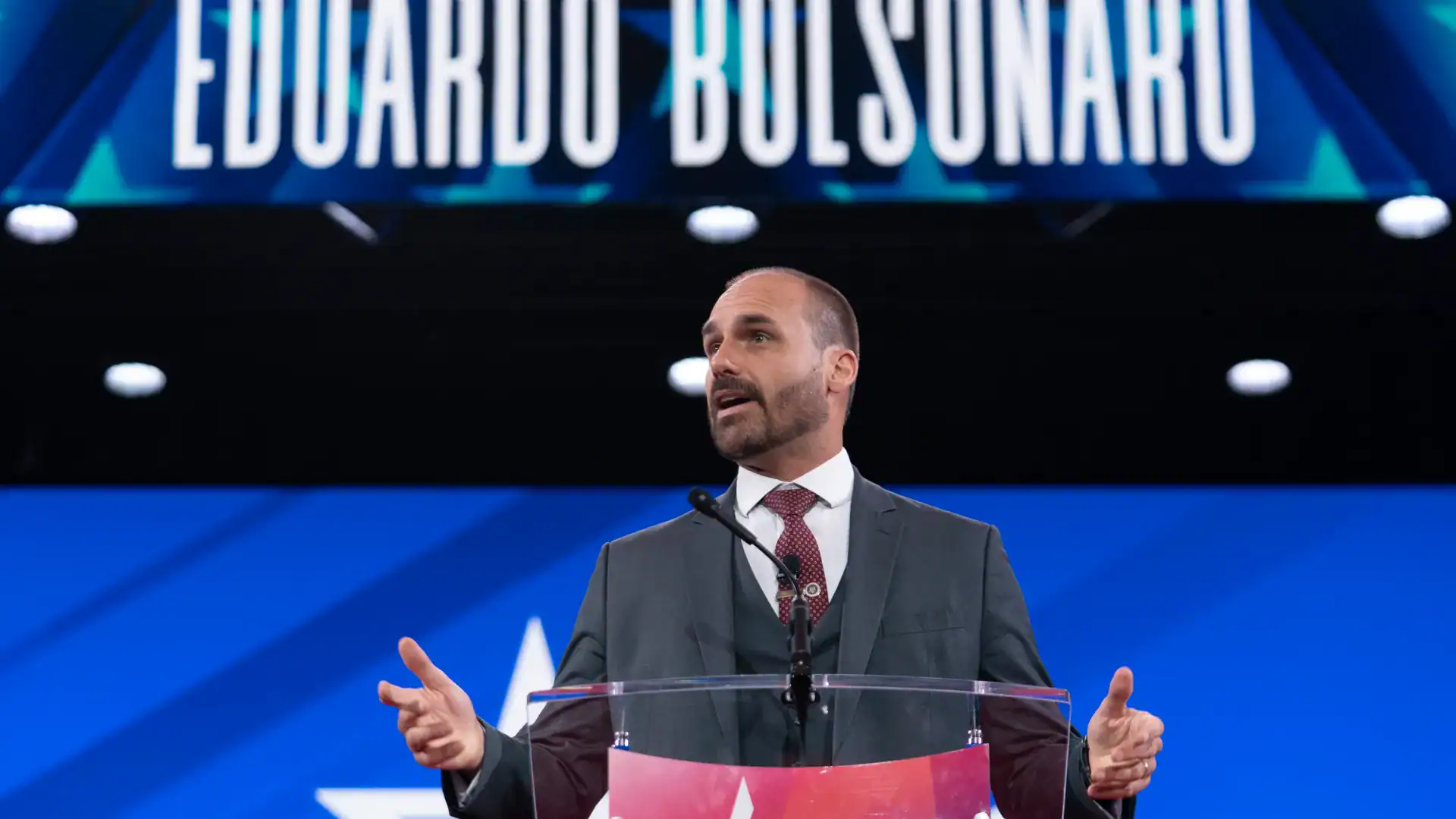
Eduardo, who has lived in the United States since February 2025, is charged with coação no curso do processo, a crime defined in Brazil’s Penal Code that punishes the use of violence or threats to influence a party, witness or judicial officer. The formal accusation, accepted by the First Panel in November 2025 after a unanimous vote, alleges that Eduardo coordinated with the incoming Donald Trump administration and with right-wing aligned legislators and officials in Washington to push for sanctions against Brazilian judges and prosecutors and for tariffs on Brazilian exports — pressure intended, in the Prosecutor General’s reading, to derail the separate criminal proceedings against his father. Moraes’s April 23 order states that because neither party requested additional diligences, the instructional phase is closed.
What the Eduardo Bolsonaro trial charges and what is next
The factual allegations in the Eduardo Bolsonaro trial rest on three buckets of conduct the prosecution has documented since the case was opened — first, the alleged effort to secure sanctions and tariffs from Washington as retaliation against the Brazilian judiciary. Second, alleged interference with the Brazilian Federal Police officers working on the investigation targeting his father, including public statements the prosecution argues amounted to threats against named investigators. Third, alleged coordination with members of the US Congress and administration figures to publicly attack the authority of Brazil’s Supreme Court.
Eduardo did not appear for his video-conference interrogation on April 14, a step that is formally part of the defence and not the prosecution. His absence, which allowed the instructional phase to close without a deposition, was interpreted by Brazilian legal commentators as a calculated refusal to engage with the Supreme Court from US soil. Moraes also ordered court tribunals to forward Eduardo’s criminal antecedents certificates to the Supreme Court within five days, a standard pre-sentencing step — because he was summoned by official publication, the Defensoria Pública da União assumed his defence when no private counsel appeared.
The diplomatic backdrop to the Eduardo Bolsonaro trial
The case arrives at a moment of acute Brasília-Washington friction. The Trump administration has already imposed Magnitsky-style sanctions on Justice Moraes personally, and on April 20 it expelled a Brazilian Federal Police delegado, Marcelo Ivo de Carvalho, who had worked in the ICE liaison post in Miami and was involved in the arrest of former federal deputy and Bolsonaro ally Alexandre Ramagem in Orlando. Brazil responded on April 22 by pulling the credentials of a US ICE agent working at the Federal Police’s Brasília headquarters, and President Luiz Inácio Lula da Silva endorsed the reciprocity move publicly, as covered in The Rio Times’s reporting on the reciprocity escalation.
A conviction in the Eduardo Bolsonaro trial would add a second Brazilian criminal ruling directed at an accused actor currently residing in the United States — Ramagem being the first — and put further pressure on the bilateral extradition and judicial-cooperation architecture. For the Brazilian election calendar the stakes are also internal: Eduardo’s alleged conduct has been a rallying cry for the hardcore Bolsonarista base, and a conviction would likely strengthen both the case for Flávio Bolsonaro as the family standard-bearer in 2026 and the harder-edged reciprocity posture Lula has been road-testing.
Timing, the First Panel and what a verdict would change
Once the final-arguments window closes — the defence, then the PGR, then the defence again — Moraes as rapporteur can ask the First Panel’s president to schedule the merits judgement. The First Panel of the Supreme Court, which includes Moraes alongside Justices Cármen Lúcia, Cristiano Zanin, Flávio Dino and Luiz Fux, has handled every phase of the Bolsonaro-family criminal docket to date and is expected to hear the Eduardo case before the end of the second quarter. Any appeal would return to the same panel in the form of embargos de declaração before being definitively closed.
For international readers tracking Brazilian institutional continuity, the Eduardo Bolsonaro trial is a case study in how the post-coup judicial architecture is maintaining procedural regularity even when the defendant has deliberately removed himself from the court’s physical reach. The verdict will matter less for its immediate enforceability than for the precedent it sets — that pressuring foreign powers to sanction Brazilian judges is criminalised under existing law, and that Brazilian citizenship does not protect against that criminalisation when the conduct is alleged to have occurred abroad. The wider context for investors is captured in The Rio Times’s 2026 Brazil outlook.
Related coverage: Brazil-US Reciprocity and the Ramagem Case • Bolsonaro Surgery Under Moraes’s Penal-Execution Oversight • Brazil Economic Outlook 2026
More: Brazil news in English, every day from The Rio Times.
This article was produced by The Rio Times’ automated newsroom system. How we use AI · Report an error
Read More from The Rio Times