CIA Director Lands in Havana as Cuba Runs Out of Fuel
Key Facts
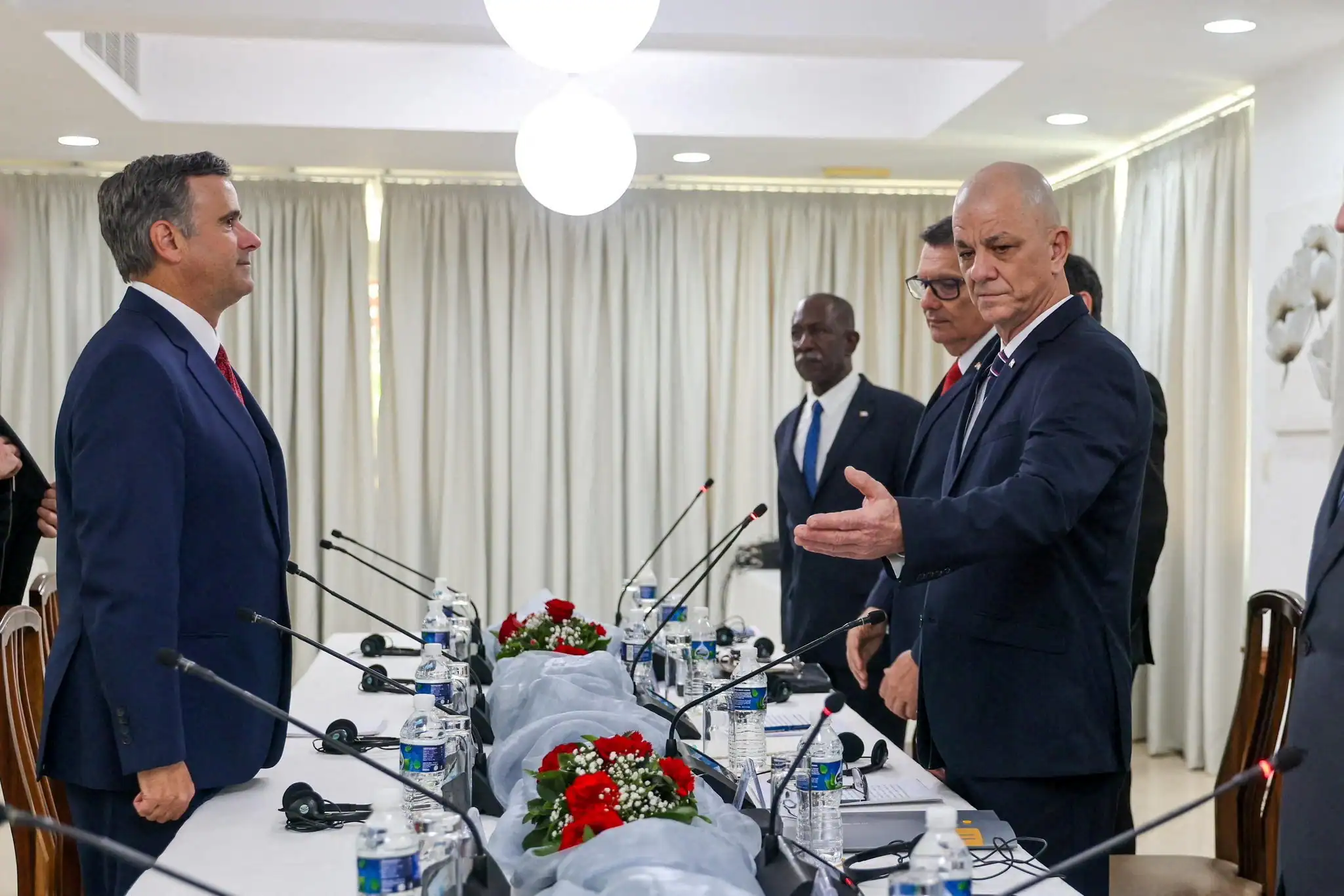
—The visit. CIA Director John Ratcliffe led a U.S. delegation that landed at Havana’s José Martí airport around 13:00 UTC on May 14 aboard a Boeing C-40B Clipper from Joint Base Andrews.
—The history. First U.S. government aircraft to land in Cuba, outside Guantánamo, since President Barack Obama’s 2016 visit.
—The counterpart. Ratcliffe met Interior Minister Lázaro Álvarez Casas and security advisor Raúl Rodríguez Castro, a grandson of Raúl Castro who had already met Secretary of State Marco Rubio in February at a CARICOM summit.
—The energy collapse. Energy Minister Vicente de la O Levy confirmed Cuba has “absolutely no” diesel or fuel oil reserves. Generation deficit hit a record 2,113 MW Wednesday, with blackouts of 22 to 24 hours in Havana.
—The aid offer. Washington formalized a $100 million humanitarian package through the Catholic Church. Havana confirmed willingness to evaluate it.
A CIA director landed at José Martí airport on the same day Havana admitted it had no fuel left to keep the lights on. The two events were not coincidence. Washington is testing whether energy starvation produces what military pressure never has: a regime willing to negotiate from the floor.
What happened in Havana on May 14?
A Boeing C-40B Clipper of the U.S. Air Force, call sign SAM554, landed at José Martí International Airport around 13:00 UTC after departing Joint Base Andrews outside Washington. The aircraft’s onward leg was logged toward MacDill Air Force Base in Tampa, home to U.S. Southern Command. Hours after landing, the Cuban government confirmed via a Granma communiqué that CIA Director John Ratcliffe led the delegation and met with senior Interior Ministry officials. The CIA’s official X account posted three photographs captioned only “Havana, Cuba.” U.S. Ambassador Mike Hammer is visible receiving the delegation.
According to Univision sources, Ratcliffe met directly with Raúl Rodríguez Castro, nicknamed “El Cangrejo,” a grandson of Raúl Castro who serves as a senior security advisor. Rodríguez Castro had already held a secret encounter with Secretary of State Marco Rubio in February on the sidelines of a CARICOM summit in St. Kitts and Nevis. Interior Minister Lázaro Álvarez Casas also participated.
Why is this the highest-level U.S.-Cuba contact in a decade?
The Rio Times, the Latin American financial news outlet, reports that no U.S. government aircraft had landed in Cuba, outside the Guantánamo base, since Barack Obama’s March 2016 visit. The Trump administration has spent 2026 tightening pressure through sanctions, an oil blockade imposed in January, and expanded military surveillance. According to a U.S. source cited by CNN, Ratcliffe demanded that Cuba release political prisoners and increase political freedoms, and expressed concern about “foreign intelligence, military and terrorist groups” operating with Cuban government permission less than 161 kilometers from U.S. territory.
Havana’s readout was different. According to Granma, Cuban officials told the delegation that the country “does not constitute a threat to the national security of the United States” and that no Chinese military or intelligence bases operate on the island. Cuba also pressed for removal from the U.S. State Sponsors of Terrorism list. Both governments described the meeting as “complex” but expressed shared interest in cooperation on law enforcement and regional security. Trump previewed the contact on Truth Social on May 12: “Cuba is asking for help, and we are going to talk!!!”
How serious is Cuba’s energy collapse?
On May 13, Energy Minister Vicente de la O Levy declared on state television: “We have absolutely no fuel oil. We have absolutely no diesel. We have no reserves.” The 730,000 barrels of Russian crude delivered by tanker Anatoly Kolodkin on March 31 were exhausted by early May. A second Russian tanker, Universal, carrying 270,000 barrels of diesel, has been adrift in the Atlantic around 1,600 kilometers from Cuba, with arrival pushed to May 15. Only two fuel tankers have officially unloaded in Cuba in all of 2026, against a stated need of eight per month.
The grid deficit reached a 2026 record of 2,113 MW Wednesday, with 1,230 MW available against 3,250 MW demand. The island has suffered seven total collapses of its National Electric System in 18 months. Independent estimates relayed by EFE suggest $8 billion to $10 billion would be needed to restore the grid. On the night of May 13 to 14, residents in at least ten Havana municipalities staged cacerolazos, the largest protest wave in the capital since the July 11, 2021 demonstrations.
Cuba’s energy emergency by the numbers
| Indicator | Reading on May 14, 2026 |
|---|---|
| Fuel oil and diesel reserves | Zero (official admission) |
| Generation deficit (record) | 2,113 MW |
| Havana blackout duration | 22 to 24 consecutive hours |
| Tankers delivered in 2026 | 2 (need: 8 per month) |
| Grid collapses in past 18 months | 7 |
| Estimated grid rehab cost | $8 to $10 billion |
What is the $100 million U.S. aid offer worth?
On May 14, Cuban Foreign Minister Bruno Rodríguez announced via X that the State Department had publicly formalized, for the first time, a $100 million humanitarian aid offer channelled through the Catholic Church and contemplating fuel, food and medicine. Rodríguez said Cuba was willing to “evaluate the proposal.” Díaz-Canel followed with a statement saying Cuba’s experience receiving international aid has been “ample and constructive,” while reiterating that lifting the embargo would be “the easiest and most expeditious” relief.
The figure is small relative to structural need. Grid rehabilitation alone is estimated at 80 to 100 times that amount. Secretary Rubio posted via the U.S. Embassy that wealth in Cuba is “controlled by a company owned by military generals,” a reference to GAESA, the military-run holding estimated at $16 billion in assets. Washington also welcomed the release of dissident Sissi Abascal, who will leave Cuba for exile.
What should investors and analysts watch next?
- Arrival of the Russian tanker Universal. If 270,000 barrels of diesel reach port, blackouts may ease for weeks. If it remains adrift, leverage shifts further toward Washington.
- Migration to Florida. Cumulative Cuban departures since 2020 are estimated at 2.75 million. A new wave triggered by 22-hour blackouts would land in a hostile political environment.
- The aid mechanism. Whether Cuba accepts the package on U.S. distribution terms, including Catholic Church oversight, is the immediate test of whether the May 14 meeting opens a sustained channel.
- Political prisoners. Further releases beyond Sissi Abascal would signal Havana is willing to make symbolic concessions for energy relief.
- Regional ripple. Brazil, Mexico, and Colombia are watching whether Washington shifts toward humanitarian engagement.
More: Cuba news in English, every day from The Rio Times.
Connected Coverage
The Ratcliffe visit lands inside a five-month Cuba squeeze tracked across our coverage. The opening move, after Maduro’s capture, sits in our Trump-bets-on-oil-collapse readout. The structural playbook of grid starvation as policy is detailed in the Cuba playbook analysis. The regional isolation that left Havana without defenders sits in our regional-pick-sides analysis. The 7.2% GDP contraction projection and Díaz-Canel’s earlier overture to U.S. firms is framed in our economic-contraction piece.
Reported by The Rio Times — Latin American financial news. Filed May 15, 2026.
This article was produced by The Rio Times’ automated newsroom system. How we use AI · Report an error · Editorial responsibility: Matthias Camenzind, Editor-in-Chief
Frequently Asked Questions
Was the visit announced in advance?
No. The aircraft’s arrival was first detected by open-source flight-tracking accounts on X. The Cuban government confirmed Ratcliffe’s identity hours later through Granma. Washington did not issue a broad public statement.
Does the visit signal a thaw?
Not yet. The administration has kept tightening sanctions in parallel. The meeting confirms direct channels exist, but Washington’s conditions, including political prisoner releases and deep reforms, remain off the table for Havana.
Why has Cuba run out of fuel now?
Venezuela halted shipments in November 2025. Mexico suspended deliveries under U.S. tariff threat in January 2026. The structural need is around 110,000 barrels per day; domestic production covers less than half. The crisis accelerated after the U.S. capture of Nicolás Maduro on January 3, 2026.
What is Rodríguez Castro’s role?
A grandson of Raúl Castro, nicknamed “El Cangrejo,” he holds a senior security-advisory role. His direct interlocution with both Rubio in February and Ratcliffe in May suggests he is the regime’s preferred back channel to the Trump administration.