Chile Joins US Minerals Push With New Signed Agreements
Key Facts
— — Chile and the United States signed two bilateral agreements in Santiago on Monday covering mining cooperation and security, building on the March 12 joint declaration that established a consultation mechanism on critical minerals and rare earths.
— — The US delegation was led by Under Secretary of State for Arms Control and International Security Thomas DiNanno, signaling that the security track extends beyond civilian law enforcement into strategic materials and arms-control territory.
— — For President José Antonio Kast, the signing lands six weeks into office and alongside a domestic approval slide, sharpening the contrast between a strong Washington alignment and weakening support at home.
— Deep Dive
— For the complete picture, see our guide: Chile Economy 2026.
The Chile US mining security agreements signed in Santiago on Monday mark the first operational output of the bilateral critical-minerals channel opened last month. The Chilean government confirmed the signing ceremony would take place in the capital with senior officials from both administrations in attendance, according to Reuters reporting picked up across Chilean and regional press.
The Rio Times, the Latin American financial news outlet, reports that the Chilean side was represented by Foreign Minister Francisco Pérez Mackenna, Mining and Economy Minister Daniel Mas, and Public Security Minister Trinidad Steinert. For the United States, Under Secretary of State for Arms Control and International Security Thomas DiNanno led the delegation.
Chile’s government did not disclose the full text of the accords at the time of the signing. The presence of three Chilean ministers and a US arms-control official indicates the package covers at least two distinct tracks: mineral supply-chain cooperation, and a security framework that touches strategic materials and hemispheric defense industrial policy.
What Was Signed and Why It Matters
Last month’s joint declaration, signed March 12 at La Moneda in the presence of President Kast and then-Deputy Secretary of State Christopher Landau, created a consultation mechanism with four explicit workstreams: strengthening critical-minerals supply chains, identifying priority joint projects, addressing mining scrap and recycling, and exploring public and private financing tools.
“The mechanism will seek to institutionalize itself, aiming to consolidate cooperation between both countries on critical minerals and rare earths,” the Chilean Foreign Ministry said in its March announcement. The April 20 signing is the first tangible output that Chilean officials have indicated will emerge from the new channel.
The Kast government has moved quickly on this track. As documented in the Rio Times Chile Economy 2026 guide, the president took office on March 11 and signed the Landau declaration within 24 hours. Monday’s agreements turn that opening statement into binding instruments.
Why the DiNanno Signature Matters
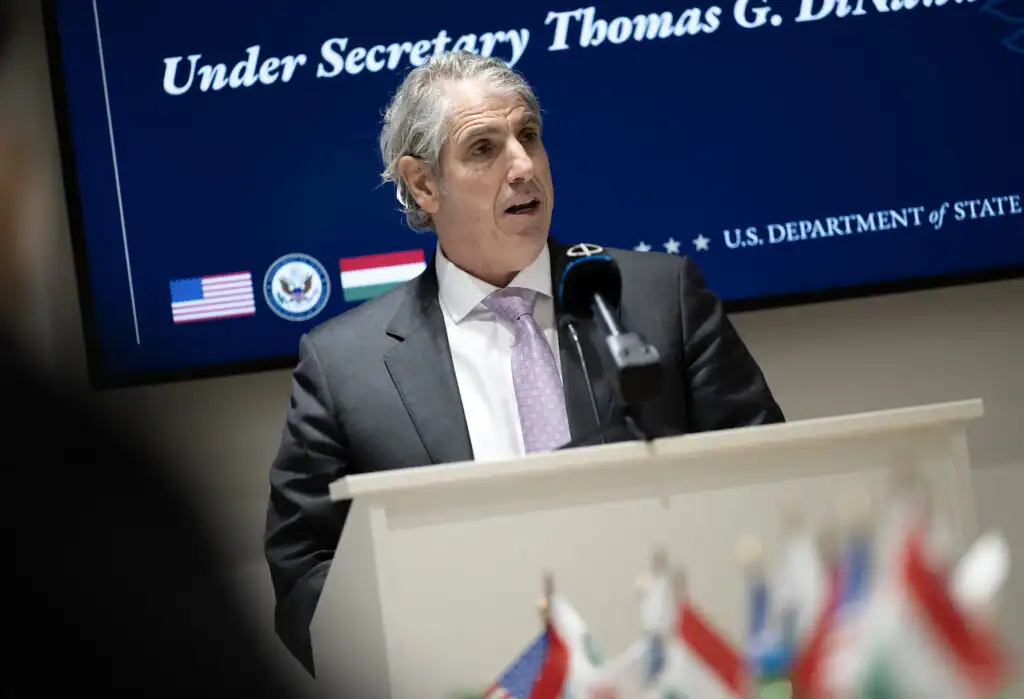
Thomas DiNanno is not the usual US signatory for commercial minerals agreements. As Under Secretary for Arms Control and International Security, he runs the State Department bureau that handles strategic-materials export controls, defense-trade policy and nonproliferation. Pairing his signature with a joint Chilean delegation that includes the Mining Minister tells markets that Washington is treating Chilean copper, lithium and rare earths as national-security inputs, not simply commercial commodities.
That framing has a direct operational implication. Projects cleared under a national-security cooperation structure can qualify for US International Development Finance Corporation backing, Defense Production Act Title III authorities, and preferential offtake by Pentagon suppliers. Chile, as the world’s largest copper producer and second-largest lithium producer, is one of a handful of countries where that architecture can move at scale.
Mining and Economy Minister Daniel Mas now sits at the center of the delivery chain. The portfolio consolidation Kast announced in March, combining the economy and mining ministries, was designed precisely for this moment: a single ministerial point of contact capable of approving US-aligned projects without inter-agency friction.
Stakes for Chilean Mining and the China Question
Copper accounts for roughly half of Chilean export revenue, and China absorbs about 39% of total Chilean exports. The US-backed realignment does not replace that relationship — it complicates it. As documented in the Rio Times analysis of Chile’s US$104.5 billion mining pipeline, nearly 90% of that investment is tied to copper, and the country’s largest state miner Codelco carries over US$20 billion in debt from its modernization program.
The lithium side is structurally different. The Nova Andino Litio SpA joint venture between SQM and Codelco governs Salar de Atacama production through 2060 and was structured under the Boric government’s National Lithium Strategy requiring state ownership of at least 51%. How the Kast administration reconciles those domestic constraints with new US-aligned offtake commitments is the central question for investors.
Washington revoked entry visas for three senior officials of the Boric administration after a January 2026 lithium tender was awarded to a Chinese state entity, Mobile China, and then canceled two days later. That sanction signaled the US expectation that Chinese-state acquisition of Chilean strategic minerals would carry a personal political cost.
The Kast Calculation and the Domestic Cost
The Santiago signing ceremony lands against a difficult domestic backdrop. Sunday polling from Cadem, Criteria and Pulso Ciudadano showed the Kast government’s approval rating stuck at 43%, with disapproval at 51% and 49% of respondents saying his Reconstrucción Nacional economic plan mainly benefits the wealthy. The same electorate is being asked to absorb an aggressive external realignment.
Senate arithmetic compounds the problem. Kast controls neither chamber outright, and several of the structural reforms that would give the US agreements full commercial bite — corporate tax reduction from 27% to 23%, faster environmental permitting, and a new lithium code — still need legislative passage. The Partido de la Gente, a right-populist bloc, holds the swing votes.
Foreign Minister Pérez Mackenna has positioned the US track as a ballast against those domestic headwinds. The logic is that if Washington-backed investment begins to flow in visible volumes — copper expansions at El Abra and Collahuasi, lithium offtake contracts, rare-earth processing commitments at projects such as Aclara in Penco — the political case for Kast’s broader agenda strengthens.
What Markets Will Watch Next on Chile US Mining Security Ties
Three follow-on signals will determine whether Monday’s signing translates into capital. The first is the release of the full agreement texts or joint statement, which will clarify whether the accords impose supply-chain exclusivity, transparency on Chinese equity, or preferential offtake to US defense contractors.
The second is the identity of the projects that emerge first under the consultation mechanism. Aclara Resources’ Penco rare-earth deposit, Codelco’s copper expansion pipeline, and ENAMI-Rio Tinto’s Salares Altoandinos lithium project are the most commercially advanced candidates.
The third is China’s reaction — Beijing’s Ministry of Commerce has so far not responded publicly to the March declaration, and a formal statement on the April 20 agreements would signal whether Chinese state-owned enterprises with existing Chilean exposure face new constraints. As the Rio Times Chile Economy 2026 outlook noted, Chile’s China exposure remains its largest single macro variable. Monday’s signatures just raised the stakes on both sides of that ledger.
More: Chile news in English, every day from The Rio Times.
This article was produced by The Rio Times’ automated newsroom system. How we use AI · Report an error
Read More from The Rio Times