Boa Safra Earnings: Q4 Loss as Seed Margins Fall
Boa Safra posted a Q4 R$8.4M net loss vs. R$80.3M profit a year earlier. Full-year income fell 37% as soybean seed margins collapsed. Key numbers inside.

Boa Safra Q4 2025 Earnings: What Happened
Boa Safra Sementes S.A. (SOJA3) is Brazil’s largest soybean seed producer by volume, operating 16 units across the Centro-Oeste, Sudeste, Norte, and Nordeste regions with a beneficiamento capacity of 280,000 big bags annually. Founded in 2009 in Formosa, Goiás, by CEO and co-founder Marino Colpo, the company licenses biotechnology from multinationals including Syngenta, Bayer, and BASF, then multiplies and treats seeds through a network of 160 integrated farm partners before distributing through 600+ retail points. Listed on B3’s Novo Mercado since its 2021 IPO, Boa Safra has been diversifying beyond soy into wheat, corn, sorghum, and beans. Boa Safra earnings for Q4 2025 are covered by The Rio Times as part of its Latin American financial news reporting on B3-listed agribusiness companies.
The Q4 loss was the culmination of a year-long margin squeeze across Brazil’s agricultural input chain. CEO Colpo acknowledged the result fell “well below what analysts estimated and our own initial expectations,” as analysts at firms like BTG Pactual had initially projected full-year revenue near R$3 billion ($570M) — a target that proved unreachable as the seed market deteriorated. Both BTG Pactual and Itaú BBA have pulled their Buy recommendations, while Bradesco BBI downgraded to Neutral with a slashed price target of R$9 (from R$14).
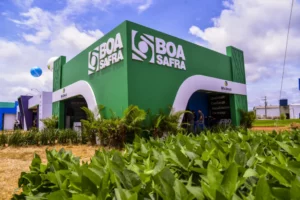
Shares of SOJA3 traded around R$8.06 ($1.53), down approximately 25% over 12 months and 11% year-to-date from R$9.04 at the start of 2026, with a market capitalization of approximately R$1.15 billion ($219M). The stock trades at roughly 11x trailing P/E on the depressed 2025 earnings, with a dividend yield of approximately 3.7% after paying R$0.30 per share in December 2025. XP Investimentos recently cut its price target to R$11.80 (from R$15.10), while Bradesco BBI’s R$9 target is the lowest on the Street. The stock hit an all-time low of R$7.81 on March 5, 2026.
Key Drivers Behind Boa Safra’s Q4 2025 Results
Seed Market Deterioration and Pricing Pressure
The core problem is economic, not operational. Since 2024, Brazilian farmers have faced compressed margins from lower grain prices, tighter credit, and rising input costs — conditions that reduce their willingness and ability to pay premium prices for high-technology treated seeds. Colpo described an environment of “restricted credit and lower farmer margins that limit the intent to purchase high-tech seeds.” This forced Boa Safra into price concessions that eroded the average selling price in Q4 specifically. The full-year EBITDA margin collapse from 10% to 6% captures the magnitude of the pricing deterioration — Boa Safra is selling more volume at lower margins, a classic share-for-margin trade-off.
Climate Disruption and Seed Discard
Dry spells (veranicos) before harvest in key seed-production regions forced Boa Safra to discard a higher-than-normal volume of seeds that failed to meet its quality standards. The company typically converts approximately 80% of its beneficiamento capacity into commercial seeds, with the remainder sold as lower-margin commodity grain. In 2025, the conversion rate fell to 76% — meaning a larger share of production was sold at grain prices rather than seed premiums. This 4 percentage point shortfall directly reduced operating leverage, as fixed production costs were spread across fewer high-margin seed units.
Market Share Gains Despite Margin Compression
Boa Safra grew soybean seed market share by 2 percentage points to reach 10% — a milestone the company calls “historic” given the adverse environment. Full-year soy seed volume grew 34%, reflecting the company’s ability to take share from smaller competitors who lack Boa Safra’s balance sheet strength and distribution network. The question — flagged explicitly by Bradesco BBI — is whether this share was gained at prices and margins that destroy economic value, or whether the scale advantage will eventually translate into profitability once the agricultural cycle normalizes.
Boa Safra Q4 2025 Financial Detail
Full-year adjusted EBITDA of R$130.4 million ($24.8M) fell 16%, with the margin compressing 400 basis points to 6%. XP Investimentos estimated that Q4 alone contributed an adjusted EBITDA of approximately R$67 million ($12.7M), down 49% year-over-year — what the brokerage called “a quarter to forget.” The EBITDA margin contraction from ~13% in Q4 2024 to an estimated ~7% in Q4 2025 represents a 600 basis point compression driven by the pricing, discard, and cost dynamics described above.
Bradesco BBI estimates that ROIC has collapsed from 26.4% in 2023 to approximately 7.8% in 2025, reflecting both the margin compression and the more capital-intensive business model that resulted from the company’s expansion. After doubling beneficiamento capacity to 280,000 big bags since its 2021 IPO, Boa Safra now carries a significantly larger asset base — but without the margins to generate adequate returns on that investment. Production is expected to remain flat in 2026 at approximately 280,000 big bags, suggesting the expansion phase has ended and the focus must shift to extracting profitability from existing capacity.
The balance sheet provides a meaningful buffer. Cash and investments of R$1.1 billion ($209M) dwarf the R$62 million ($12M) in short-term debt maturities, with 95% of gross debt maturing beyond 2028. CFO Felipe Marques highlighted that the extended maturity structure — built through two CRA (Certificados de Recebíveis do Agronegócio) issuances totaling R$1 billion in 2025 — differentiates Boa Safra from competitors. Provisions for bad debts stood at R$13 million, representing 1.7% of the R$773 million ($147M) receivables portfolio — elevated versus history but manageable given the agricultural downturn.
Management Signals from Boa Safra
Key Facts
— CEO Colpo’s 2026 outlook was candid: challenges persist, but the company is “prepared to embrace new opportunities.” He framed Boa Safra’s competitive position around attributes that matter more in a tight credit environment — financial solidity, proven delivery capability, and farmer credibility — suggesting the company sees opportunity in smaller competitors being squeezed out by the downturn. The implication is that market share consolidation will accelerate precisely because weaker players cannot fund operations through a prolonged low-margin cycle.
— The diversification strategy is gaining traction. Revenue from non-soy crops — wheat, corn, sorghum, beans, and forage seeds — has grown from 10% of 2024 annual revenue to a meaningful contributor, with these categories generating 65% of Q1 2025 revenue (a seasonally soy-light period) and 288% year-over-year growth in the new-crops category during Q3. The March 24, 2026 announcement of a four-year lease of a Syngenta Seeds corn processing facility in Ituiutaba, Minas Gerais, expands Bestway Seeds’ capacity to 2.5 million bags per year — a concrete step toward becoming a multi-crop seed platform rather than a pure soybean play.
— Colpo also noted that compressed farmer margins should paradoxically drive demand for high-quality seeds: “lower margins push producers to seek solutions that guarantee greater productivity — that is, quality seeds that are offered by the company.” This is the structural bull case for Boa Safra — when times are tough, farmers cannot afford the yield risk of low-quality seeds, creating a flight-to-quality dynamic that benefits the market leader.
What to Watch Next for Boa Safra
The 2025/26 planting season order book will signal whether pricing has stabilized. Boa Safra’s Q3 2025 soybean order backlog of R$761 million ($145M) grew only 18% year-over-year despite the 34% volume increase, implying per-unit pricing declined. If the upcoming season’s order book shows improved pricing alongside maintained volumes, it would indicate the margin trough has passed. Conversely, further price erosion would confirm that the excess supply problem in Brazil’s seed market is structural rather than cyclical.
Agricultural credit conditions are the key macro variable. The Selic was cut to 14.75% on March 19 by the Copom, but rural credit flows operate through dedicated channels (Plano Safra, CRAs, LCAs) that don’t always track the benchmark rate. If government-directed rural credit allocation for the 2026/27 Plano Safra increases — or if CRA spreads compress following the Selic cut — farmers’ purchasing power for premium seeds would improve directly.
The Bestway/Syngenta corn processing lease represents Boa Safra’s most concrete diversification catalyst. Corn is Brazil’s second-largest crop with an estimated 138 million tons in the 2025/26 safrinha, and Boa Safra’s corn seed presence has been minimal. The 2.5 million bags/year capacity — operational from May 2026 — could meaningfully reduce earnings dependence on soybean seed pricing and partially offset the margin pressure from the soy segment.
Boa Safra Quarterly Results (Q4 2025 vs Q4 2024)
| Metric | Q4 2024 | Q4 2025 | Chg |
|---|---|---|---|
| Net Income | R$80.3 mn | -R$8.4 mn (-$1.6M) | Loss |
| Adj. EBITDA (Q4 est.) | ~R$131 mn | ~R$67 mn ($12.7M) | ~-49% |
| Adj. EBITDA Margin (Q4 est.) | ~13% | ~7% | ~-6.0pp |
| Seed Conversion Rate | ~80% | 76% (FY) | -4pp |
Boa Safra Annual and Strategic Summary (FY2025)
| Metric | Value |
|---|---|
| FY Net Income | R$101.1 mn ($19.2M) (-37%) |
| FY Adj. EBITDA | R$130.4 mn ($24.8M) (-16%) |
| FY Adj. EBITDA Margin | 6% (2024: 10%) |
| ROIC (BBI est.) | ~7.8% (2023: 26.4%) |
| Soy Seed Market Share | ~10% (+2pp YoY) |
| Soy Seed Volume Growth | +34% (historic record) |
| Cash & Investments | R$1.1 bn ($209M) |
| Short-Term Debt | R$62 mn ($12M) | 5% of gross |
| Beneficiamento Capacity | 280,000 big bags/yr (flat 2026) |
| Share Price (SOJA3) | ~R$8.06 ($1.53) |
| P/E | DY | Mkt Cap | ~11x | ~3.7% | R$1.15 bn ($219M) |
Risks Facing Boa Safra
Prolonged agricultural margin compression could make the ROIC decline structural. The ROIC collapse from 26.4% to ~7.8% in two years raises the question of whether Boa Safra doubled its capacity into a market that cannot support the returns needed to justify the capital deployed. If grain prices remain low and farmer purchasing power stays constrained through the 2026/27 season, the market share gains could prove to be a value-destructive volume chase rather than a platform for future profitability — which is precisely why Bradesco BBI cut its recommendation.
Weather and seed quality risk is inherent and unhedgeable. The 2025 experience — where veranicos before harvest caused seed discards that reduced the conversion rate from 80% to 76% — can repeat in any year. Each percentage point of conversion rate loss translates directly into lost revenue and operating deleverage, as the fixed costs of beneficiamento facilities remain regardless of output quality. Climate volatility in Brazil’s cerrado and cerradão regions is intensifying, making this risk structural rather than episodic.
Competitive intensity in Brazil’s seed market may prevent margin recovery even when the cycle turns. The seed market remains highly fragmented — Boa Safra‘s 10% share makes it the leader, but 90% of the market is served by smaller players, cooperatives, and farmer-saved seed. As the agricultural cycle eventually normalizes, these competitors will also recover, potentially preventing Boa Safra from recapturing the pricing power needed to return EBITDA margins to the 10%+ levels that justified its IPO valuation.
Brazilian Seed and Agribusiness Sector Context
Key Facts
— Brazil’s agricultural input sector is in a downcycle that began in 2024 and shows limited signs of reversal. The confluence of low grain prices — soybean prices are well below the 2022–2023 peaks — tighter rural credit (the Plano Safra allocation has not kept pace with inflation-adjusted demand), and the lingering effects of 2023/24 weather disruptions has compressed farmer margins across the cerrado belt. For seed companies, this translates into price resistance from buyers, delayed purchasing decisions, and a shift toward lower-cost seed options — dynamics that hit premium seed specialists like Boa Safra disproportionately.
— The structural growth story for Brazil’s seed industry remains intact. The country is the world’s largest soybean exporter, expected to produce over 160 million tons in the 2025/26 season, and the penetration of treated, certified seeds — as opposed to farmer-saved seed — continues to increase. Boa Safra occupies a unique position as the only pure-play seed company listed on B3 (SLC Agrícola and BrasilAgro are farmers, not input suppliers), giving it scarcity value but also leaving it fully exposed to the cyclicality of a single input category.
— The Copom’s March 19 rate cut to 14.75% provides a marginal positive for rural credit conditions, but the transmission to farmer purchasing power is indirect and lagged. The more immediate catalyst would be a recovery in soybean and corn prices, which would directly improve farmer margins and their willingness to invest in premium seeds. Until that price recovery materializes, Boa Safra’s 10% market share and R$1.1 billion cash position provide a defensive foundation — but one that generates a 7.8% ROIC on a stock priced for significantly more.
Boa Safra earnings | SOJA3 Q4 2025 results | Brazil soybean seed producer | agribusiness earnings | Latin American financial news | The Rio Times
This article was produced by The Rio Times’ automated newsroom system. How we use AI · Report an error · Editorial responsibility: Matthias Camenzind, Editor-in-Chief