Caracas Oil Money Now Has Two Sets of Auditors, One U.S.
Key Facts
— — Venezuelan Central Bank President Luis Pérez González confirmed Monday April 27 that the Trump administration contracted a private auditing firm to monitor Venezuela’s oil sales revenue. The Venezuela oil revenue audit is the first concrete financial-control mechanism imposed by Washington under the post-Maduro transition government of Delcy Rodríguez. Caracas separately contracted its own auditor to ensure “imparciality” between the two readings.
— — Production has begun recovering: PDVSA pumping reached 1.1 million barrels per day in February 2026, up 10 percent year-on-year, according to OPEC data. Chevron, Eni, and Repsol have resumed drilling under new US licenses. Amber Energy committed US$11 billion to Citgo Petroleum Corporation contingent on closing the contested acquisition. The National Assembly’s February 2026 hydrocarbon law reform allows direct PDVSA-foreign company contracts without joint ventures.
— — The macro frame remains brutal. Venezuela’s CPI closed 2025 at 475 percent and reached 51.9 percent in just January-February 2026. Real GDP is approximately 36 percent of its 2012 level. Minimum wage has been frozen for four years near 130 bolívares — equivalent to US$0.27 at official rates. Delcy Rodríguez visited Barbados Monday in her second international trip since taking power on January 5, 2026.
The Venezuela oil revenue audit confirmed by the central bank Monday completes the architecture of US financial control over Caracas — a Treasury-supervised flow of oil dollars that fundamentally rewrites how Venezuela monetizes its 304-billion-barrel reserves.
Venezuela’s central bank Monday confirmed the most consequential financial-control architecture imposed on the country since the 1989 IMF program. The Rio Times, the Latin American financial news outlet, reports that the Venezuela oil revenue audit announced by Banco Central de Venezuela (BCV) President Luis Pérez González will see a US-contracted private firm tracking the proceeds of Venezuelan oil sales — a direct mechanism by which the Trump administration ensures that revenues flow to legitimate uses rather than back to remnants of the Maduro network.
“There are reasons to think that the national economy will perform well in the coming quarters and that inflation will descend,” Pérez González told a closed-door meeting with Venezuelan public and private bankers. The optimism reflects Trump and Secretary of State Marco Rubio’s framing that revenue from Venezuelan crude — sold at real prices rather than at the heavy discounts Maduro provided to allies — would actually flow to Venezuelans for the first time.
How the Venezuela Oil Revenue Audit Works
The dual-auditor structure is unusual. Washington contracted a private firm — name not disclosed — to audit revenues generated by Venezuelan crude exports.
Caracas separately contracted a second auditor to ensure independence. Pérez González did not specify either firm or quantify how much revenue has flowed through the system since the January 2026 transition.
The audit follows the broader US oversight architecture installed after Maduro’s January 3 capture in Operation Determinación Absoluta. The Trump administration formally lifted Treasury Department sanctions on Delcy Rodríguez on April 1, 2026.
Restored diplomatic relations followed in March, with John Barrett arriving as US Chargé d’Affaires in Caracas. New Chevron, Eni, and Repsol licenses have been issued allowing operational activity.
The political signaling matters. Trump has stated publicly that he is “in charge of Venezuela and the sale of its oil.” The audit mechanism converts that statement from rhetoric into operational reality — every barrel exported, every dollar received, audited by a Washington-contracted firm.
Why Production Has Started Recovering
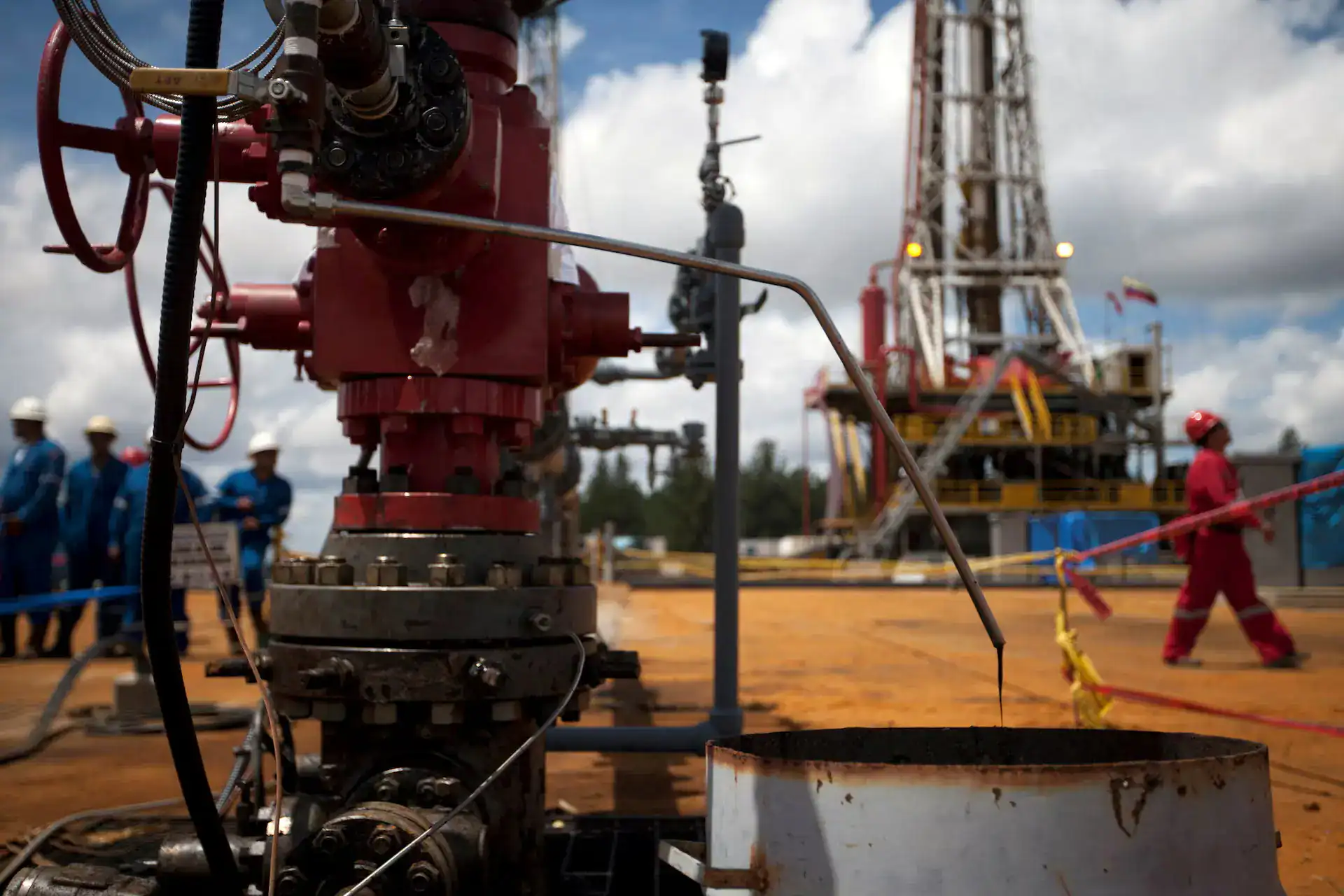
Venezuelan crude production has accelerated since the transition. PDVSA reported 1.1 million barrels per day in February 2026, up 10 percent year-on-year, according to OPEC.
Chevron — Venezuela’s largest foreign producer with approximately 170,000 barrels per day before 2019 sanctions tightening — is targeting 300,000 barrels per day by 2028. Eni and Repsol have separately resumed drilling activity.
The hydrocarbon law reform passed by the National Assembly on February 1, 2026, permits direct contracts between PDVSA and private companies without the joint-venture requirement that characterized the Chávez-Maduro era. The structural change reduces friction for foreign capital and allows operators to avoid the expropriation-risk premium that had constrained investment for two decades.
Amber Energy’s commitment of US$11 billion contingent on the Citgo Petroleum Corporation acquisition is the largest individual investment announced. The Citgo case remains contested — multiple parties have claimed rights to the asset — but the Amber commitment indicates the appetite for Venezuelan refining infrastructure is real.
The Macro Reality Behind the Optimism
The numbers behind Pérez González’s optimism remain devastating. Venezuelan CPI ended 2025 at 475 percent and reached 51.9 percent in just January-February 2026. Real GDP is approximately 36 percent of its 2012 peak — meaning Venezuela’s economy has lost two-thirds of its value in 14 years.
Minimum wage remains frozen at approximately 130 bolívares — about US$0.27 at the official exchange rate. Delcy Rodríguez announced in her April address that a “responsible” minimum wage adjustment would be unveiled May 1, Workers’ Day.
Venezuelan economists have been skeptical. As Andrés Giussepe of Polidata put it: “The announcement is more of the same. It seems like an attempt to calm social tension.”
The pension system imbalance is structural. Venezuela has roughly 5.3 million active workers (mostly public sector) and 5.7 million pensioners — more retirees than workers funding them. The system depends on oil revenue rather than payroll contributions, which makes the audit mechanism doubly consequential: every dollar of audited revenue determines the floor of pension viability.
What This Means for the Transition
The audit completes the financial spine of the Trump-Rubio Venezuela transition framework. The political backbone is John Barrett’s diplomatic mission and the gradual sanctions normalization process.
The economic backbone is the hydrocarbon law reform and the licensed return of Chevron, Eni, and Repsol. The financial-control backbone is the Treasury-contracted audit announced Monday.
For investors, the audit signals that revenue flows can be tracked credibly — meaning the macro recovery story is no longer entirely dependent on trusting Caracas accounting. For Delcy Rodríguez, the audit is a constraint on personal enrichment but also a credibility mechanism that supports her interim presidency. For Trump, the audit is the receipt that justifies sanctions normalization at home.
The deeper question is what comes next. Rodríguez has now passed her hundredth day in office without giving any concrete timeline for democratic transition or elections.
The audit ensures that oil dollars flow to the state. It does not ensure that the state flows back to its people.
More: Latin America news in English, every day from The Rio Times.
This article was produced by The Rio Times’ automated newsroom system. How we use AI · Report an error · Editorial responsibility: Matthias Camenzind, Editor-in-Chief