U.S. Army Approves First New Lethal Grenade Since 1968 — It Kills With a Pressure Wave, Not Shrapnel

Key Facts
— — The US Army approved the M111 Offensive Hand Grenade for full material release on March 10 — the first new lethal hand grenade cleared for production since the Vietnam War era in 1968
— — Instead of metal shrapnel, the M111 kills using blast overpressure — a shock wave that violently compresses human tissue and cannot be blocked by walls, furniture, or interior obstacles
— — The weapon was designed specifically for urban combat, where the standard M67 fragmentation grenade posed unacceptable fratricide risk — a lesson learned from door-to-door fighting in Iraq
For nearly six decades, US soldiers cleared rooms with a grenade designed for open battlefields. The M111 is the weapon that finally catches up to how modern wars are actually fought.
The US Army M111 grenade was cleared for full material release on March 10, the Army announced from Picatinny Arsenal in New Jersey. The approval authorizes large-scale production and fielding of the weapon across the force — the first time a new lethal hand grenade has reached this stage since the M67 fragmentation grenade and MK3A2 concussion grenade entered service in 1968 during the Vietnam War.
How It Works
Traditional grenades like the M67 kill by fragmentation — a steel casing shatters into high-velocity shrapnel that radiates in all directions. The M67 has a lethal radius of 5 meters and can project fragments up to 230 meters. In open terrain, it is devastatingly effective. Inside a building, those same fragments ricochet off concrete walls, penetrate thin partitions, and pose lethal risk to friendly forces in adjacent rooms.
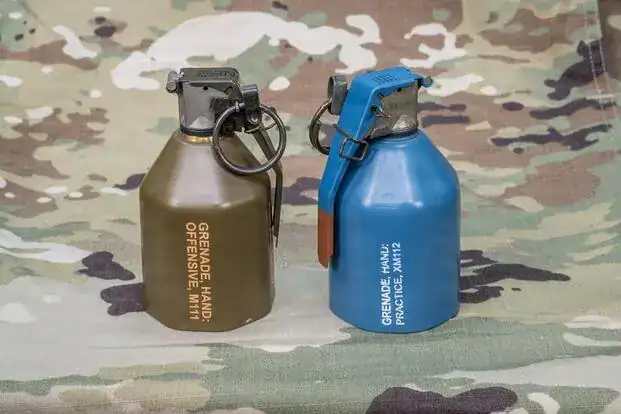
The M111 operates on an entirely different principle. Its plastic casing vaporizes completely on detonation, releasing a blast overpressure wave — a rapid compression and decompression of air that propagates through enclosed space and cannot be stopped by interior walls, furniture, or doorframes. The effect on the human body is severe: the pressure wave can rupture lungs, eardrums, and eyes, and cause traumatic brain injury. Every corner of a room is reached. There is no cover.
The Iraq Lesson
The M111 exists because of a specific operational failure. During the intense house-to-house fighting in Iraq — particularly in Fallujah and other urban operations — US soldiers routinely used M67 fragmentation grenades to clear rooms. The problem was fratricide: shrapnel passing through interior walls killed or wounded friendly troops on the other side.
“One of the key lessons learned from the door-to-door urban fighting in Iraq was the M67 grenade wasn’t always the right tool for the job,” said Col. Vince Morris, the Army’s project manager for Close Combat Systems. “The risk of fratricide on the other side of the wall was too high. But a grenade utilizing blast overpressure can clear a room of enemy combatants quickly, leaving nowhere to hide while ensuring the safety of friendly forces.”
Replacing an Asbestos-Era Weapon
The M111 formally replaces the MK3A2 concussion grenade, which was withdrawn from service in the 1970s because its body was manufactured with asbestos — a carcinogenic material. The gap left by the MK3A2‘s retirement was never filled, leaving soldiers without a dedicated close-quarters option for nearly five decades. The M111’s plastic body eliminates the health hazard entirely, as it is fully consumed during detonation.
The M67 is not being retired. The Army envisions a dual system: M67 for open terrain where fragmentation maximizes lethality, M111 for enclosed and restricted environments — buildings, tunnels, bunkers, caves — where blast overpressure is tactically superior. Weighing 12.6 ounces, the M111 has a distinctive bottle-like shape to help soldiers distinguish it from the baseball-sized M67 by touch alone in high-stress situations.
Fielding and Cost Efficiency
To minimize transition friction, the M111 uses the same five-step arming process as the M67, allowing soldiers to rely on existing muscle memory. It also shares fuze components with the M67 and its M69 training variant, enabling common production lines. The government owns the design rights, meaning multiple manufacturers can compete on price. The M111 will be issued first to the Army’s Immediate Response Force — units capable of deploying anywhere in the world within 18 hours — with broader fielding planned from 2028.
The US Marine Corps is separately acquiring the M21 blast overpressure grenade from Norwegian manufacturer Nammo, indicating that the shift away from fragmentation-only doctrine extends beyond the Army. As military planners increasingly anticipate operations in dense urban terrain — from the Middle East to the Indo-Pacific — the M111 represents a targeted modernization for the environment where most future combat will take place. The weapon also has relevance for Latin American defense procurement, where urban security operations dominate military planning and the demand for close-quarters munitions is growing.
This article was drafted with automated assistance and reviewed before publication. How we use AI · Report an error · Editorial responsibility: Matthias Camenzind, Editor-in-Chief
Read More from The Rio Times