The crazy story of a couple who decided to cross the Atlantic in a car boat
By Jorge de Souza
The year was 1946, shortly after the end of the Second World War.
Australian Frederick Benjamin Carlin, whom everyone just called Ben Carlin, an engineer who had worked on military bases in India during the conflict, was visiting a former American army camp when he saw a kind of boat lying in a corner that resembled a raft but, oddly enough, had wheels.
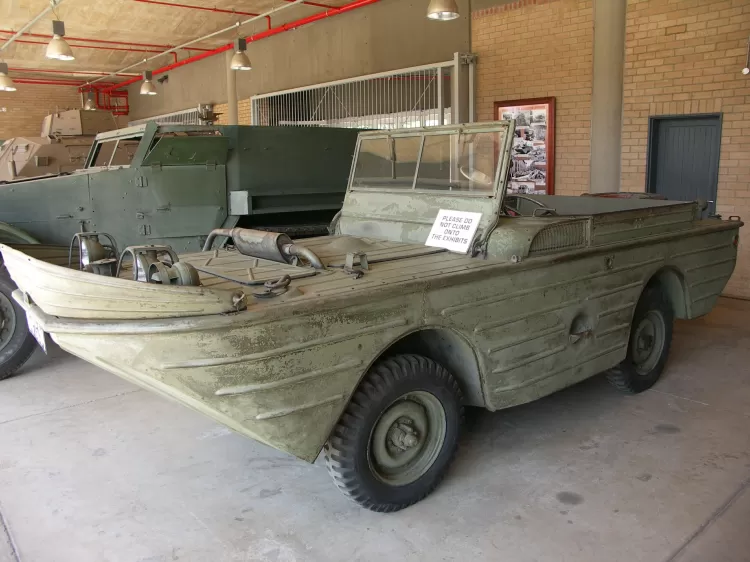
It also had a steering wheel, headlights, and a windshield.
It looked like a jeep.
And it was a jeep!
The American answer to the hybrid Volkswagen the Germans had developed during the war was an amphibious Jeep.
In other words, a vehicle that could be used on land and water.
HE WANTED TO CONQUER THE SEA
It was passion at first sight.
And Carlin would not rest until he bought one of these strange boat cars, but they were built only for crossing rivers and lakes, not the sea, as he intended.
Worse, Carlin wanted to cross the Atlantic in one of those strange hybrid vehicles – something that is unthinkable and most likely won’t work.
AN IDEA TOO ABSURD
But the Australian was too stubborn to give up in the face of the simple claim that this vehicle could not be used at sea.
True to the slogan of the time, “A Jeep can overcome any obstacle,” why not an ocean?
The first problem arose when he tried to buy one of these Jeeps since they had all been built only for the U.S. Army.
Carlin first sought out the factory, where he received a resounding “no.”
The manufacturer knew that the vehicle had severe structural problems, having been hastily constructed for war demands.
Moreover, the idea of crossing the Atlantic in a car sounded too absurd to be taken seriously – how was he to deal with the question of fuel, for example?
COMPLETE MADNESS
The American amphibious Jeep was too heavy, dangerously unstable on the water, and too slow because its engine (the same one used in the conventional automobile) had only 60 horsepower.
As Carlin intended, crossing an ocean with this vehicle was complete madness.
No one believed it was possible except him.
THE CAR BARELY HOVERED
For months, Carlin searched junkyards for an amphibious Jeep until he heard there would be an auction of U.S. Army war scrap.
He went there and – bingo! – he bought a Jeep that looked exactly like the one he had seen years before.
I mean, almost the same because it had severe mechanical problems.
The transmission was stuck, the gas tank was rotted, the engine was corroded, and there was rust everywhere.
But he didn’t give up: He took the car to a shop and had it completely rebuilt and reinforced.
The service was good but with a dire consequence: the chassis reinforcement made the Australian’s nautical Jeep so heavy that it barely floated.
The Jeep was only half as deep in the water, and any bump would fill it with water. The project had to be perfected.

HOW TRANSPORT SO MUCH GASOLINE?
The first step was to fit the Jeep with a cabin since it was a convertible and a bow-shaped front and rudder.
The car looked like a pointy shoebox, but it worked.
The second problem was far more challenging to solve: the problem of the car’s limited fuel capacity – a fundamental problem for those who wanted to cross an entire ocean.
How could the problem be solved?
The first alternative was to install a large gasoline tank under the vehicle, much like a keel on the hull of a boat.
It was a complete disaster.
When the tank is full, the Jeep sinks almost like a rock. And as soon as it was empty, it pushed it up like a buoy.
It was impossible to navigate that way.
Then came the second idea: to have an extra tank in tow, like a kind of nautical train.

FIRST ATTEMPT
Although the plan is a bit bizarre, it was put into action in Carlin’s first attempt (which failed, by the way) to cross the Atlantic in this amphibious vehicle in 1948.
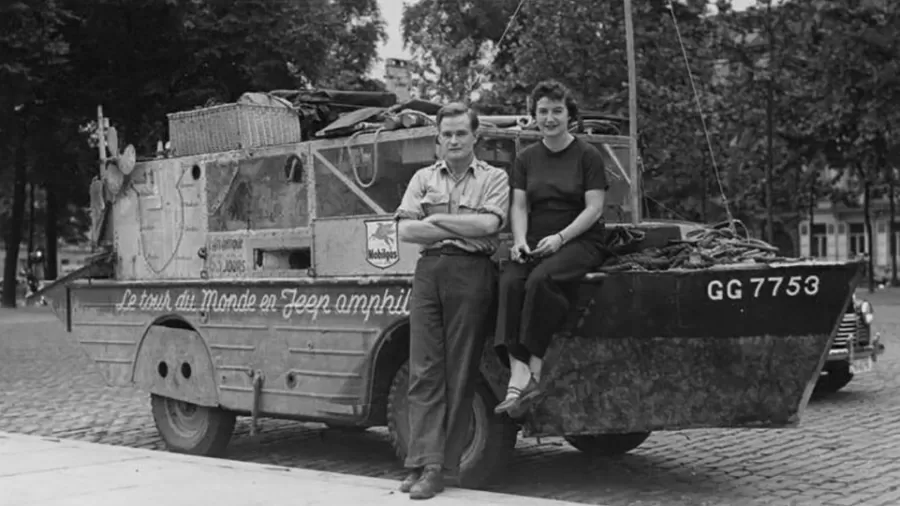
But he was no longer alone in his daring endeavor: He was now accompanied by his wife, the American Elinore, whom he had married shortly before and who had decided to embark on this crazy adventure with her husband as a “honeymoon at sea,” so to speak.
On June 16, 1948, the couple left New York for the Azores on the other side of the Atlantic, but the adventure was not over yet.
CABIN FULL OF SMOKE
Hours later, Carlin sensed that all was not well with his car boat. It was jerking too much, not holding the desired course, and was desperately slow in the water.
To make matters worse, smoke from the engine was seeping into the cabin, nearly choking them both.
Still, they kept going. But not for long.
Five days later, they gave up and returned. But they didn’t consider themselves defeated.

SECOND ATTEMPT
The stunt caught the attention of a vaudeville magazine, which paid big bucks for the story of this particular pair.
With the money, Carlin improved the device, which even got a name, like a real boat: Half-Safe, a playful title with a double meaning since it was also the slogan of a famous deodorant of the time, which he tried to sponsor, but failed.
Two months later, the duo tried again to cross the Atlantic in their hybrid Jeep. But again, they didn’t get far.
DRIFTING
After about 500 kilometers on the open sea, the propeller of the car boat broke.
Since there were no spare parts on board, they were left in the lurch. But fortunately, they were soon rescued by a passing ship.
That was just as well: Carlin had already concluded that even with the extra fuel from this tanker, there would not be enough gasoline to cross the entire ocean.

But even then, he did not give up his plans.
THEY FINALLY SUCCEEDED
The Australian increased the capacity of the tank, developed a balancing system that compensated for the lighter weight of fuel consumed with seawater, and made three more attempts, all equally unsuccessful.
Until a year and a half later, in July 1950, he set out once again with his wife from Halifax on the Canadian coast and, against all logic, reached his destination.
He crossed the Atlantic in a car!

REPAIRS ON HIGH SEAS
But it wasn’t easy.
During the trip, the radio soon broke because the sea air corroded the metal contacts, and the scarce food (because of the lack of space in the trunk) forced them to go fishing every day to avoid starving.
The engine constantly threatened to fail because it was not made to travel at the same speed for so many hours.
From time to time, it was necessary to stop the vehicle in the middle of the sea and partially disassemble the engine to decarbonize it – situations in which Carlin had to balance on the hood to avoid falling into the water.
But he wasn’t complaining. He would cross the Atlantic in his amphibious vehicle, even if he had to swim, pulling his own Jeep.
But he didn’t even have to do that.

ON THE OTHER SIDE OF THE ATLANTIC
On the 32nd day of the crossing, despite a mechanical problem that forced the couple to travel the last kilometers in second gear only (yes, this “boat” even had a gearbox!), the Azores island of Flores appeared in front of the windshield of the Jeep they were traveling in.
On the island, they stayed for a long time, perfecting and repairing the vehicle.
THEY ARRIVED ROLLING
But the worst was yet to come: On the crossing between the Azores and the island of Madeira, they got caught in a hurricane that made the trip twice as long as planned, and they narrowly escaped sinking.
With great difficulty, they then made their way to the Canary Islands and Morocco before finally reaching European soil – where they landed rolling like a conventional car.
For Carlin, this was the great advantage of amphibious vehicles: when they ran out of land, they kept going in the water. Or the other way around.

WAS THE GOAL ACHIEVED? NOT QUITE!
Thrilled by this feat – and pleased with the attention his feat had garnered in Europe – Carlin now wanted more: to drive his amphibious Jeep around the world.
And that’s what they both did.
In April 1955, the pair put the second part of the Australian’s new plan into action.
They started from London in their strange vehicle (which had a bizarre appearance and even had a mast to move on the water with the help of a sail) and, after crossing the English Channel, traveled overland to Asia, interrupting the journey with more water passages.

THE WOMAN GAVE UP
But when they reached India, the Australian’s wife, complaining about the inconvenience for some time, finally gave up – on the trip, her husband, and the whole madness.
“Adventure is one thing; masochism is another,” she said before leaving Carlin and returning to the United States, where she never wanted to broach the subject again.
In the meantime, the Australian recruited a new victim to help him with the rigors of taking the car boat out to sea.
Carlin persuaded a compatriot named Barry Hanley to embark on the adventure. Still, his new companion lasted only as far as Japan, where he also abandoned the boat – which at the time, with its many modifications, looked more like a glorified car.
DEMENTIA ON BOARD
In Japan, Carlin found another crew member for the next leg of the journey: a young American reporter named Lafayette De Mente, whose last name helped to understand why he had accepted the invitation to cross the largest of oceans, the Pacific, in a simple automobile.
The couple’s goal was to sail from Japan to the United States, completing the world voyage.
EVEN RUSSIAN ESPIONAGE
Two months later, after a long crossing that included everything (from terrible storms to being spied on by a Russian submarine whose crew didn’t believe the two men were making the trip out of sheer willpower), they had made it: they landed on a beach in Alaska and made their way to New York, where Carlin finally finished his journey, which had long since become not just a challenge, but a life goal.

And so, 23 years later, Ben Carlin died contentedly in his Australian hometown, where his strange Jeep was also displayed in the school’s museum where he had studied, as proof that what seems impossible is sometimes merely improbable.
Although Carlin’s feat has never been repeated, nearly half a century later, in 2000, two young (and equally brainless?) Italians Marco Amoretti, 24, and Marcolino de Candia, 21, did something similar – only worse in practice.
Aboard two old conventional cars, a 1981 Ford Taurus and a 1987 Volkswagen Passat, which weren’t even amphibious vehicles and had been converted by the father of one of them at home only to float, the duo crossed the Atlantic for four months, practically adrift, powered by sails instead of an engine, a feat as impressive as it was unappreciated since few knew about it at the time – click here for this other extraordinary true story.
“Ben Carlin inspired my father to do his own project,” says one of the Italians, Marco Amoretti, who is still trying to turn that crazy crossing into a movie in honor of his father, who died shortly before the pair arrived across the Atlantic in two equally improbable floating cars.
“They said we were crazy, but we did what we set out to do,” says the Italian, who now lives in Genoa and still sails floating cars.
Editorial responsibility: Matthias Camenzind, Editor-in-Chief · Editorial standards · Report an error
Read More from The Rio Times