

Brazil is pushing forward with a significant transformation of its armed forces, aiming to consolidate their standing as the premier military power in Latin America by 2040.
The country’s ambitious Strategic Armored Forces Program outlines plans to inject over $5.3 billion into modernizing and expanding its armored vehicle fleet.
This initiative will enhance Brazil’s military capabilities and reaffirm its leadership in the region.
The program’s highlights include:
- Procurement of 98 cutting-edge Centauro II 8×8 armored vehicles from Italy, with the initial delivery scheduled for mid-August 2024.
- Plans to bolster the fleet with 65 new main battle tanks and 78 infantry fighting vehicles.
- Upgrades to 98 existing Cascavel armored reconnaissance vehicles.
- The addition of 36 wheeled self-propelled howitzers.
- The purchase of 420 Iveco LMV 4×4 infantry mobility vehicles, 48 of which are already operational.
- Continued acquisition of Iveco Guarani 6×6 armored personnel carriers, totaling over 700 units since 2012.
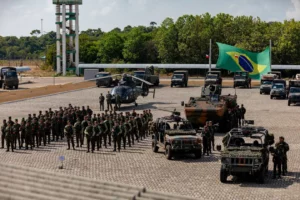
Beyond its army, Brazil is also enhancing its naval and air forces.
- The navy is building five submarines, at least one of which is nuclear-powered, under a $10 billion initiative.
- The air force is adding 36 JAS 39 Gripen fighters and 19 KC-390 Millennium transport aircraft, amounting to a $5.4 billion investment.
- The acquisition of 50 H225M helicopters and the development of a new air defense system further bolster Brazil’s joint military capabilities.
In 2023, Brazil’s defense budget was about $22.9 billion. It is projected to increase to $24.7 billion in 2024.
This amount significantly exceeds the spending of its regional neighbors. Colombia spent $10.2 billion, Argentina $4.7 billion, and Chile $5.6 billion.
Even Mexico, which spent $8.5 billion, allocates only a third of Brazil’s projected 2024 defense budget.
In addition, this financial commitment underscores Brazil’s intent to fortify its defenses and enhance its geopolitical influence.
This vast expenditure in military modernization not only aims to safeguard Brazil but also to invigorate its defense industry.
The contrast in military strength within the region became clear when Brazil transferred 25 M41C light tanks to Uruguay in 2018, showcasing the vast disparity in capabilities.
Brazil’s military advancements serve a dual purpose: bolstering national security and positioning itself as a formidable global player.
Through these efforts, Brazil not only secures its own borders but also supports its industry and asserts its sovereignty and influence across South America and beyond.