Proposal for a common South American currency is the target of criticism and warnings
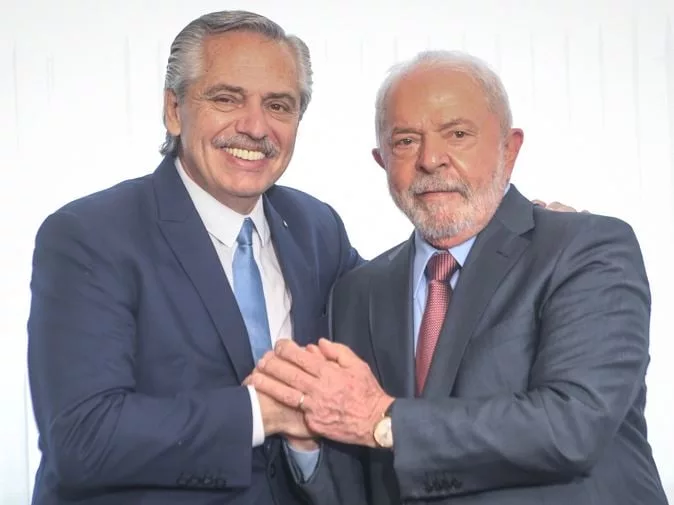
Since the joint announcement by the presidents of Brazil, Luiz Inácio Lula da Silva, and Argentina, Alberto Fernández, on Saturday 21st, that the creation of a common currency for South America is under study, politicians and economists have shown apprehension and alerted to the risks of the measure.
Argentina closed 2022 with inflation at around 95%, while in Brazil, the official inflation index measured by the Brazilian Institute of Geography and Statistics (IBGE) for the 12 months of last year was 5.79%.
In posts on Twitter, politicians, businessmen and economists criticized the intention of creating a common currency, especially due to the economic and political crisis that the neighboring country is going through.
Congressman Paulo Martins (PL-PR) wrote: “A single currency with Argentina will be the biggest imbecility of republican Brazil. In fact, it will be the end of it.”
Brazilian businessman and writer Flávio Augusto said that if the initiative fails “it would be an unprecedented humanitarian tragedy for the country”.
“If it worked, which would be unlikely, it would bring insignificant benefits to Brazil. If it went wrong, it would be an unprecedented humanitarian tragedy for the country. It would be hard for the National Congress not to veto an irresponsible adventure like this,” published Flávio Augusto.
São Paulo state congressman Alexandre Freitas (Podemos) said that the common currency could “destroy” the results of the Real Plan, created in 1994, during the government of Itamar Franco, when Fernando Henrique Cardoso was Minister of Economy, and take the country to hyperinflation.
“Rock bottom is the only certainty we have.”
Senator-elect Sergio Moro (União Brasil-PR) said that “proposing a common currency with Argentina is a smokescreen for the non existence, so far, of any substantial project for the Brazilian economy”.
Economist Alan Ghani also warned of the return of hyperinflation. “They will sink Argentina even further and generate hyperinflation in Brazil. It will be the embrace of the drowned.”
Businessman Leandro Ruschel mentioned “the completely broken Argentina” and quoted a phrase from the Russian communist leader Vladimir Lenin: “The interests of socialism are above the self-determination of nations.”
SINGLE CURRENCY AND COMMON CURRENCY
In the text published on Saturday in the Argentine newspaper Perfil, Lula and Fernández said that they had decided to “also move forward in discussions on a common South American currency”.
According to the two presidents, the currency would be “used for financial and commercial flows”, which would reduce “the operational costs and the external vulnerability of the countries”.
In an interview with the British newspaper Financial Times, the Argentine Minister of Economy, Sergio Massa, said that the study encompasses everything, “from fiscal issues to the size of the economy and the role of central banks”.
Massa also told the press that the currency could be called Sur (South, in Spanish) and that, at first, it would work in parallel with the Argentine peso and the real. But it could be supported by other countries in the region.
It is still unclear, therefore, what type of currency would be under study, since there are differences between a single currency and a common currency.
In the first case, the situation would be similar to the euro, the single currency of the European Union, which necessarily implies the creation of a common central bank and the loss of monetary sovereignty by the countries.
The common currency between the two countries would be used by Brazilian and Argentine companies, but not by individuals, and would serve as a reference for your commercial transactions between the two countries, instead of using the dollar.
At today’s exchange rate, US$1 corresponds to 183 Argentine pesos.
With information from Revista Oeste
More: Argentina news in English, every day from The Rio Times.
Editorial responsibility: Matthias Camenzind, Editor-in-Chief · Editorial standards · Report an error