

Key Points
— Canada and Mercosur are advancing toward a free trade agreement that could be signed by September or October 2026, with the next negotiating round scheduled for April in Brasilia
— Three government sources from Canada, Argentina, and Brazil told Reuters that talks are moving at “record speed,” driven by what Ontario’s trade minister called the “Trump acceleration effect” on Canadian trade diversification
— The deal would follow the EU-Mercosur agreement signed in January after 25 years of negotiations, whose key trade provisions take provisional effect on May 1
A Mercosur Canada trade agreement is advancing faster than any previous negotiation between the two sides, with government officials from both telling Reuters they expect a deal to be concluded in 2026. The Rio Times, the Latin American financial news outlet, reports that the next round of talks is scheduled for April in Brasilia, with an Argentine official projecting a signature in September or October — roughly one year after negotiations formally restarted following a five-year stall.
A Brazilian diplomat described the pace as “record speed,” while a Canadian government official directly involved in the talks said Trade Minister Maninder Sidhu was “very keen” to finalize the agreement this year. Sidhu is meeting his Brazilian counterpart on the sidelines of the World Trade Organization meetings in Cameroon on March 28.
The Trump Effect Driving the Mercosur Canada Talks
Canada has intensified its trade diversification efforts since US tariffs under President Trump destabilized the bilateral relationship that accounts for roughly 80 percent of Ontario’s trade. Victor Fedeli, Ontario’s minister for economic development, called it the “Trump acceleration effect” during a Reuters interview in Montevideo after visiting Argentina and Uruguay in early March to lay groundwork for the deal.
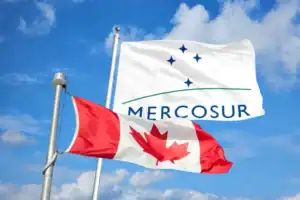
“The Canadian government is serious about diversifying away from the US, working to unlock new opportunities for trade, partnership, and investment,” Fedeli said. Canadian Prime Minister Mark Carney is expected to visit Brazil in the next quarter, though neither government plans to announce a deal during the trip. The visit could nonetheless serve as a catalyst to accelerate the final stages of negotiation.
What Both Sides Gain
For Mercosur — composed of Argentina, Brazil, Paraguay, and Uruguay, with Bolivia expected to join as a full member in 2028 — the agreement would expand access to a developed G7 market and attract investment in key industries including mining, agriculture, and energy. The bloc is a major global exporter of beef, soybeans, iron ore, and minerals that Brazilian states like Minas Gerais produce at record volumes.
For Canada, the deal offers an alternative supply chain for commodities and manufactured goods at a moment when dependence on the United States has become a strategic liability. Fedeli met with technology and mining industry representatives during his South American tour, signaling that the agreement would go beyond traditional agricultural trade.
A Mercosur Trade Breakthrough Year
If concluded, the Canada deal would cap a historic year for Mercosur trade diplomacy. The bloc signed its long-awaited agreement with the European Union in January after 25 years of negotiations, and the European Commission announced that key trade provisions will apply provisionally from May 1. Closing a second major deal with a G7 economy within the same year would significantly expand the bloc’s integration with developed markets.
The Canadian government ran a public consultation on the negotiations from December 13 to January 27, soliciting input from businesses, workers, and civil society. A spokesperson told Reuters that Canada is “committed to concluding an ambitious, comprehensive agreement that creates real opportunities for Canadian businesses, workers, and investors.” For a region that spent decades watching trade deals stall, two agreements with G7 partners in a single year would represent a fundamental shift in how the world trades with South America.