Lula Opens Hannover Messe With a Biofuels Challenge and 10 German Agreements
Key Facts
— — Lula and German Chancellor Friedrich Merz opened the Hannover Messe 2026 on Sunday, with Brazil as official partner country — six pavilions, 140+ companies, 800+ Brazilian executives, and the largest Brazilian industrial showcase abroad in decades
— — Lula challenged European biofuel barriers in his keynote: “Creating additional barriers to biofuels access is counterproductive environmentally and energetically” — citing Brazil’s 30% ethanol blend, 15% biodiesel, 90% clean electricity, and 50% Amazon deforestation reduction
— — Approximately 10 bilateral agreements are expected across defense, AI, infrastructure, bioeconomy, climate finance, and digital services — two weeks before the Mercosul-EU agreement enters provisional force on May 1, creating a market of 720 million people and US$22 trillion in GDP
— Deep Dive
— For the complete picture, see our guide: Lula Government 2026.
The Rio Times, the Latin American financial news outlet, reports that the Lula Hannover Messe opening on Sunday represented the culmination of a European diplomatic offensive that began in Barcelona with 15 Spain agreements and now moves to Germany — Brazil’s fourth-largest trading partner with US$20.9 billion in bilateral commerce last year and the only country that maintains intergovernmental consultations at ministerial level with Brazil in Latin America.
Lula and Merz met privately at the Herrenhausen Palace before joining delegations for expanded talks, followed by the official opening ceremony at the fair and a dinner with business leaders. The Hannover Messe — founded in 1947 and considered the world’s premier industrial exhibition — draws approximately 200,000 visitors and 5,000 exhibitors annually.
The Biofuels Challenge at Lula Hannover Messe
Lula’s keynote speech — delivered alongside Merz before government and business representatives — was a direct pitch for European markets to accept Brazilian biofuels without discriminatory barriers. He had previously challenged Merz and Mercedes-Benz CEO Denis Güven to compare emissions: “I want to go to Hannover to prove which diesel emits the least CO₂ on planet Earth — I want to prove it’s the Brazilian one.”
The president backed the rhetoric with numbers: Brazil already mandates a 30% ethanol blend in gasoline and 15% biodiesel mix in diesel, produces biofuels “sustainably without compromising food cultivation or destroying forests,” generates 90% of its electricity from clean sources, and has the potential to produce the cheapest green hydrogen in the world. He cited a 50% reduction in Amazon deforestation over three years and a 32% reduction in Cerrado destruction.
He also used the platform for a pointed geopolitical critique, warning that “artificial intelligence makes us more productive but is also used to select military targets without legal or moral parameters” — a reference widely interpreted as directed at the US-led Iran campaign and Israeli operations in Lebanon.
Monday’s Agenda: VW, Business Forum, and Bilateral Agreements
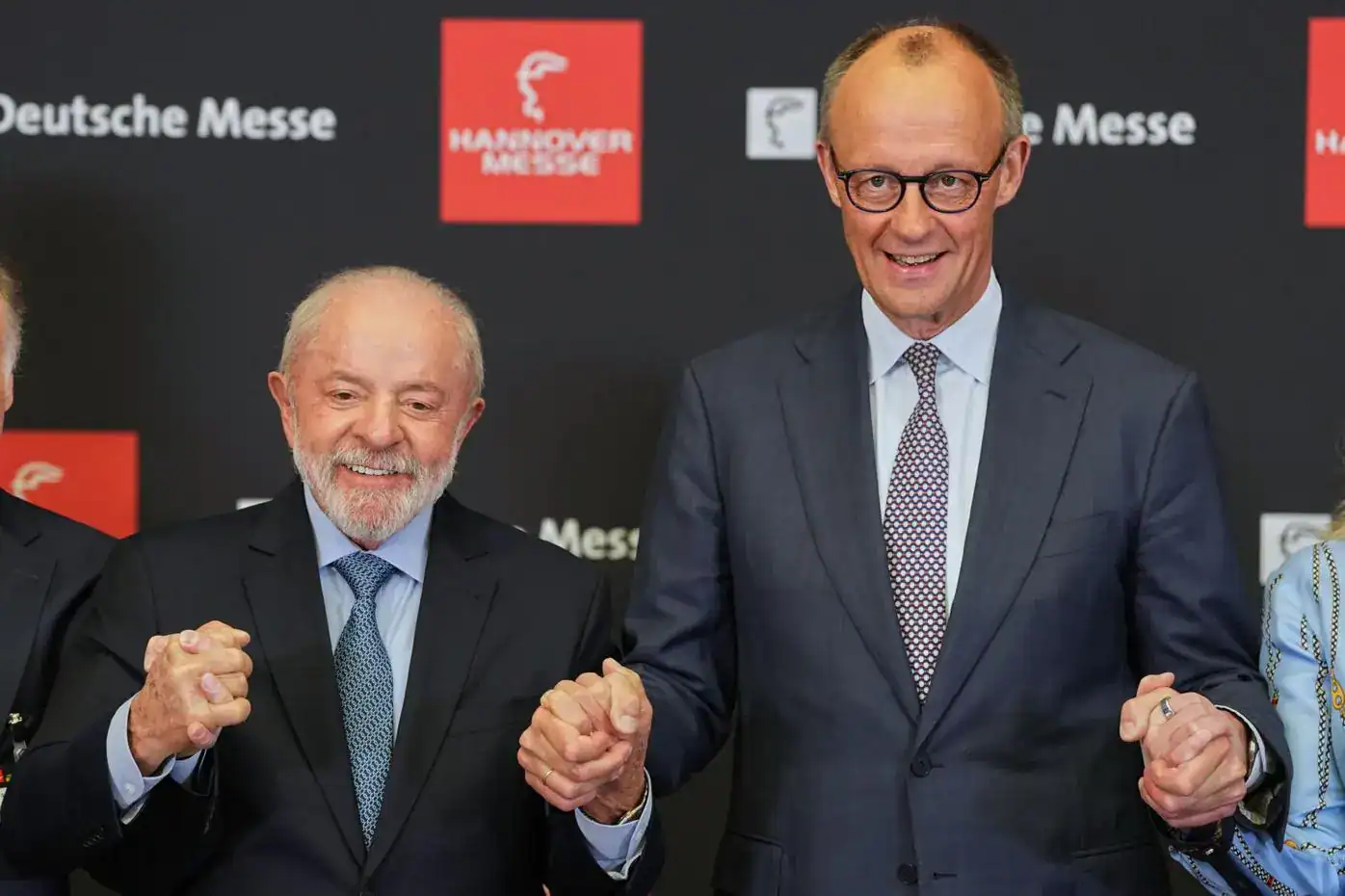
Monday’s program (April 20) is the commercial heart of the visit. Lula opens the 42nd Brazil-Germany Economic Meeting, which brings together executives from both countries, followed by the 3rd Intergovernmental Consultations — a mechanism involving ministers and senior officials across multiple policy areas that Germany maintains with fewer than ten countries worldwide. Brazil is the only Latin American nation with this level of institutional access.
Lula will also visit Volkswagen’s headquarters in Wolfsburg, accompanied by union leaders from the ABC region, Taubaté, and Curitiba — the cities where VW operates factories in Brazil. The visit signals that the reindustrialization agenda and labor relations remain central to Lula’s European pitch. Environmental groups are pushing for Germany to triple its €1 billion contribution to the Forests Forever Fund, while industry associations await agreements on defense, critical minerals, and armaments cooperation.
The Mercosul-EU Countdown
The commercial backdrop to the entire European tour is the Mercosul-EU trade agreement entering provisional force on May 1 — less than two weeks away. Lula told the Hannover audience: “In less than two weeks, an agreement will enter force that creates a market of nearly 720 million people and US$22 trillion in GDP.” Germany and Brazil are the largest economies and principal advocates of the deal within their respective blocs.
For Brazilian exporters exhibiting at Hannover — from biofuel-powered trucks to digital services startups — the agreement transforms market access from aspiration to legal reality. For German companies already operating in Brazil through more than 1,600 subsidiaries, it reduces trade friction and creates regulatory convergence. The Barcelona-Hannover sequence is designed to ensure that when the agreement takes effect, both the diplomatic relationships and the business pipelines are already operational.
More: Brazil news in English, every day from The Rio Times.
This article was produced by The Rio Times’ automated newsroom system. How we use AI · Report an error · Editorial responsibility: Matthias Camenzind, Editor-in-Chief