

— President Petro reported 27 charred bodies near the Colombian border with Ecuador and said bombs “dropped from aircraft” were found near farming families — denying any Colombian military involvement
— President Noboa flatly denied any incursion into Colombian territory, saying Ecuador’s military is conducting anti-narcotics bombings “exclusively on our own soil” against mostly Colombian criminal groups
— The sovereignty dispute comes atop an already severe trade war — with 50% tariffs, suspended electricity exports, and a 900% pipeline fee hike — making this the worst bilateral crisis since 2008
The Colombia Ecuador border has become the most dangerous diplomatic flashpoint in South America. President Gustavo Petro announced on Tuesday that 27 charred bodies had been found near the frontier and accused Ecuador of bombing Colombian territory — a claim his counterpart Daniel Noboa immediately rejected as “false.”
The exchange marks a dramatic escalation in a relationship already fractured by a trade war involving reciprocal tariffs, suspended electricity sales, and a 900% pipeline fee hike. The Rio Times, the Latin American financial news outlet, examines how the crisis is pushing two historically close neighbors toward their most dangerous confrontation in nearly two decades.
What Happened at the Colombia Ecuador Border
On Monday evening, Petro told his cabinet that a bomb “dropped from an aircraft” had been found near the border in the Jardines de Sucumbíos area. He said he had a recording that appeared to confirm aerial attacks originating from Ecuador. By Tuesday morning, he posted on X that 27 bodies had been found, that armed groups “don’t have aircraft,” and that Colombian forces were not responsible. “I did not give that order,” he wrote.
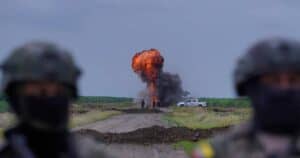
Petro noted that the bombs were found “near families, many of whom have peacefully replaced their coca crops with legal crops” such as coffee and cacao now being exported. Colombia’s defense minister dispatched military investigators and explosives experts to the zone. However, no independent verification of the bombings’ origin has been produced, and the defense minister acknowledged the findings could turn out to be inconclusive.
Noboa responded within hours, also on X: “President Petro, your statements are false. We are operating in our territory, not yours.” He said Ecuador’s military is bombing hideouts used by “narcoterrorist groups, largely Colombian, that your own government allowed to infiltrate our country through neglect of your border.” Ecuador’s defense ministry issued a formal statement confirming operations were conducted “solely and exclusively within Ecuadorian territory.”
A Crisis Built on Trade, Security, and Distrust
The sovereignty dispute sits on top of months of economic warfare. In January, Noboa imposed a 30% “security tariff” on Colombian imports, later raised to 50%, accusing Bogotá of failing to fight narcotrafficking at the border. Colombia retaliated with matching tariffs on dozens of Ecuadorian products and suspended electricity exports. Ecuador responded by hiking pipeline transit fees for Colombian crude by 900%. A February summit in Quito failed to produce any agreement.
The bombing accusations coincide with a massive US-backed Ecuadorian military operation launched on March 16. The two-week campaign has deployed more than 40,000 troops with American advisory support, nighttime curfews in four provinces, and airstrikes against criminal camps near the border — precisely the operations Noboa says Petro is mischaracterizing.
Petro revealed he had called President Trump to intervene, saying: “We don’t want to go to war.” Noboa, who has aligned closely with the Trump administration on security, has framed his military campaign as essential for national survival in a country that recorded 9,235 homicides in 2025.
Analysts at the International Crisis Group have warned that the Colombia Ecuador border conflict benefits the very transnational criminal networks both presidents claim to be fighting — organizations that thrive when formal cooperation collapses and intelligence sharing stops.
With no verification of the bombings’ origin, no diplomatic channel functioning, and both presidents locked into election-year narratives of strength, the risk of miscalculation along one of South America’s most trafficked corridors has never been higher.