

Seven years ago, roughly one in six cars imported into Chile came from China. Today, it is one in three. The speed of the shift has stunned an industry that assumed Chilean buyers would remain loyal to the Japanese, Korean, European and American marques that dominated showrooms for decades.
A Market Reshaped by New Entrants
Data from the National Automotive Association (ANAC) tell the story in sharp relief. China now accounts for 32.4% of all cars imported into Chile, followed by Japan at 26.3% and South Korea at 14%. The United States (13.2%), France (7.4%) and Germany (5.2%) have all lost ground.
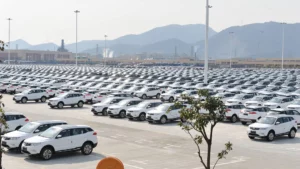
The number of brands competing in Chile has swelled from 53 before the pandemic to 88, and 41 of those are Chinese. GWM and Changan have broken into the top ten alongside Toyota, Hyundai and Kia. Of the ten best-selling brands, seven are Asian, two are American and just one is European.
Collectively, Chinese brands sold over 100,000 units in 2025, outpacing Japanese marques (around 81,000) and Korean ones (roughly 43,000). European and American brands managed about 40,000 each. In all, Asian manufacturers claimed 72% of the Chilean market.
Why Chile Opened the Door
Chile’s openness is no accident. In 2005 it became the first Latin American country to sign a free-trade agreement with Beijing, and an upgraded version in 2019 extended tariff exemptions to 98% of goods, including vehicles. That framework, combined with 35 trade agreements covering 64 economies, has made Chile one of the most accessible car markets in the developing world.
The contrast with Europe is instructive. Brussels imposed tariffs of up to 35% on Chinese EVs in 2024, yet Chinese car sales in the EU still nearly doubled in 2025 as manufacturers pivoted to hybrids subject only to a 10% duty. Chile, with no such barriers, has become a testing ground for the full force of Chinese automotive competition.
Consumer Attitudes Have Shifted
Beyond tariffs, a generational change in consumer psychology has played a decisive role. ANAC’s operations manager Daniel Nunes noted that historical resistance toward Asian-made cars has “reduced significantly,” driven by better-informed buyers comparing price and features rather than relying on brand heritage. Chery’s marketing chief Nicolás Rodríguez put it bluntly: seeing Chinese brands compete on equal terms with Japanese and Korean rivals was “unthinkable” just a few years ago.
A Preview for the Rest of Latin America
Chile’s experience carries implications far beyond its borders. In Brazil, Chinese market share rose from 6.8% in 2024 to 9.1% in 2025. In Colombia, BYD entered the top ten, displacing Ford. Globally, Chinese exporters shipped 7.1 million vehicles in 2025, a 21% increase, with BYD alone growing overseas sales by 140%.
Free-trade advocates see Chile as proof that open markets deliver lower prices and wider choice. Critics in Washington and Brussels counter that Chinese manufacturers benefit from state subsidies and overcapacity that distort global competition, and that countries without tariffs risk hollowing out industrial ecosystems. Chile has no domestic car industry to protect, which makes the calculus simpler than in Brazil or Mexico.
What is clear is that the old order in Chile’s showrooms is finished. The market sold over 310,000 units in 2025, still below the record years of 2021–2022, but the composition has changed irreversibly. The question for the rest of Latin America is not whether Chinese brands will arrive in force, but how fast the same transformation will unfold in markets with higher barriers and domestic industries to defend.