

The Big Three
IPSA sinks −1.6% on MSCI rebalancing avalanche. The index closed at 10,877.74, capping February with a 4.8% loss — its worst monthly performance since October 2023. Turnover exploded to CLP $640 billion on MSCI index rebalancing flows. Cencosud (−6%), Cenco Malls (−5.2%), and Itaú (−4.6%) were crushed, while banks Bci (−2.8%), Banco de Chile (−2.7%), and Santander (−2.6%) added to the pain.
Peso weakens to CLP $873 as macro data disappoints. The dollar surged CLP $16 in two sessions to close at $873.4 on Friday, hitting February highs. A surprise jump in unemployment to 8.3% and weak Imacec expectations near 1% dealt a double blow to the peso. Copper held at US$6.04/lb but was insufficient to offset the macro headwinds.
Iran crisis transforms Monday’s outlook for copper Chile. Joint U.S.–Israeli strikes killed Iran’s Supreme Leader Khamenei over the weekend, sending Brent crude surging 13% toward $80/bbl. For Chile, the key channel is copper: geopolitical risk tends to push the metal higher via supply-chain hedging and China stimulus expectations. But global risk-off could overpower commodity tailwinds, testing the peso and equities simultaneously.
Market Snapshot
| Indicator | Value | Change |
|---|---|---|
| S&P IPSA Close | 10,877.74 | −1.6% |
| IPSA Monthly (Feb) | — | −4.8% |
| IPSA 52-Week Range | 7,136–11,721 | +54.9% (12m) |
| USD/CLP Close | $873.4 | +$6.6 |
| USD/CLP Annual | — | −12.6% (peso gains) |
| Copper Comex (Feb 27) | US$6.04/lb | +0.5% |
| Brent Crude (Feb 27) | $72.87 | +2.87% |
| Gold (Feb 27) | $5,247.90 | +1.03% |
| S&P 500 | 6,878.88 | −0.43% |
| BCCh Rate (TPM) | 4.50% | Cut expected Mar |
| Chile Unemployment | 8.3% | Surprise ↑ |
| DXY | 98.89 | −0.20% |
| U.S. 10Y Treasury | 3.96% | ↓ |
| Bitcoin (Feb 27) | $65,669 | −1.57% |
| Fed Funds Rate | 3.50–3.75% | — |
Equities — MSCI Rebalancing Amplifies Selloff
The S&P IPSA dropped 1.6% to close at 10,877.74, its second consecutive session of losses, capping February with a 4.8% decline — the worst monthly performance since October 2023. Session volume exploded to approximately CLP $640 billion, with Enel Américas alone accounting for around CLP $266 billion in transactions driven by MSCI’s index rebalancing executed “as of the close” on February 27.
Retail giant Cencosud plunged 6%, followed by Cenco Shopping Malls at −5.2% and Itaú Corpbanca at −4.6%. Banks were hit hard across the board: Bci fell 2.8%, Banco de Chile dropped 2.7%, and Santander shed 2.6%. The broad-based selling erased almost the entire week’s prior gains. Diario Financiero noted that the losses were driven by a cocktail of AI-related concerns spilling over from Wall Street, hotter-than-expected U.S. PPI data, and a resurgence of geopolitical tension.
At the broader level, the IPSA’s 54.9% trailing twelve-month gain means the index remains in a secular uptrend despite February’s correction. The all-time high of 11,721 set in late January is now 7.2% above Friday’s close. In 2025, the selectivo achieved 72 record closes.
Currency — Peso Stumbles on Jobs Surprise
The dollar surged CLP $6.6 to close at $873.4 on Friday, its highest level of February and the steepest two-day climb of the month ($16 in total since Wednesday). The peso was the weakest emerging-market currency in the session despite copper trading above US$6/lb. Diario Financiero reported that Chile’s surprise unemployment spike to 8.3% in the November–January trimester, combined with weak sectoral data pointing to an Imacec near 1% for January, drove the selloff.
Ebury economist Enrique Díaz noted that the peso weakness is primarily a short-term response to the employment data and flagged a divergence between copper prices and the peso that is unlikely to persist. February still ended with the dollar narrowly lower month-over-month, marking a seventh consecutive monthly decline. The U.S. 10-year Treasury yield fell to 3.96%, and the DXY index eased to 98.89, factors that structurally support EM currencies including the peso.
The Banco Central de Chile holds the TPM at 4.50% after its December 2025 cut of 25 bps. Minutes from the last meeting revealed one board member proposed a 50 bps cut, and market consensus expects a 25 bps reduction at the March meeting. The 75 bps differential with the U.S. Fed (3.50–3.75%) keeps the carry trade modestly in Chile’s favor.
Technical Analysis — S&P IPSA Daily
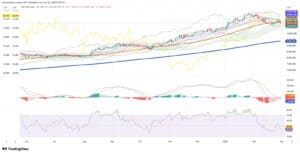
The daily chart shows the IPSA pulling back from its all-time high zone into the Ichimoku cloud, a technically precarious position. Friday’s candle (O: 11,049.69, H: 11,071.31, L: 10,877.11, C: 10,877.74) closed at its session low, indicating persistent selling pressure with no late-session recovery.
The MACD has turned negative: the signal line at −16.27, the MACD line at −21.57, and the histogram at −37.84. While the magnitude remains small, the directional shift from positive to negative confirms a loss of bullish momentum. RSI at 45.00/43.79 sits in no-man’s-land — neither overbought nor oversold — leaving room for further downside without triggering a technical bounce signal.
Price now trades inside the Ichimoku cloud, which is a zone of indecision. The upper cloud boundary near 10,933 provided resistance on Friday. A clean break below the lower cloud boundary (approximately 10,630) would confirm a bearish shift. The 200-day SMA at approximately 9,393 remains a distant support, reflecting the strength of the underlying secular uptrend — the IPSA trades 16% above this level.
Key Levels
| Level | IPSA | Significance |
|---|---|---|
| Resistance 3 | 11,721 | All-time high (Jan 28) |
| Resistance 2 | 10,933 | Ichimoku cloud upper band |
| Resistance 1 | 10,917 | Kijun-sen / Tenkan-sen |
| Last Close | 10,878 | — |
| Support 1 | 10,631 | Ichimoku cloud lower band |
| Support 2 | 9,590 | Oct–Nov congestion zone |
| Support 3 | 9,393 | 200-day SMA |
Global Context
Wall Street closed February in the red. The S&P 500 fell 0.43% to 6,878.88, the Dow dropped 1.05%, and the Nasdaq shed 0.92%, with Nvidia (−4.2%) at the center of AI fears. PPI data came in hot: headline at +0.5% vs +0.3% expected, core at +0.8% vs +0.3%. For the month, the S&P 500 lost 0.9%, nearly erasing all 2026 gains, while the Nasdaq plummeted 3.4%. CoreWeave crashed 18.5% after reporting higher-than-expected CapEx, deepening AI infrastructure spending concerns.
The weekend’s seismic event was the joint U.S.–Israeli strikes that killed Iran’s Supreme Leader Khamenei. Brent surged 13% toward $80/bbl, S&P futures fell 1.3%, and gold spiked 3.3–3.5%. For Chile, the primary transmission channel is copper. Geopolitical uncertainty tends to support metals as a hedge, and China’s Politburo this same Friday stressed expanding domestic demand in its quinquennial plan discussion — bullish for copper. However, an extended conflict disrupting global supply chains could slow industrial demand, creating an offsetting drag.
Copper at US$6.04/lb remains near cycle highs, supported by the China demand narrative and constrained mine supply. Codelco’s El Teniente production is expected to hold at approximately 300,000 metric tonnes annually through decade-end, limiting Chilean supply growth.
Looking Ahead
The Iran crisis will dominate Monday’s open, with Chilean copper exporters and mining stocks (SQM, Antofagasta) as the key barometer. If copper holds above US$6/lb amid global risk-off, it signals robust underlying demand. The January Imacec report is due next week and is expected near 1%, confirming the domestic economic slowdown that could accelerate the BCCh rate cut timeline.
The March monetary policy meeting is the major domestic event. With unemployment at 8.3%, industrial production falling 1.6% in January, and inflation converging toward 3%, the case for a 25 bps cut to 4.25% has strengthened. BofA expects the cut, and one board member already proposed 50 bps at the last meeting. The U.S. February jobs report on Friday will shape Fed expectations. Chile’s November presidential elections continue to draw attention from international investors, with UBS noting the regional right-wing shift as favorable for business confidence.
Verdict
Chile’s February correction feels more like profit-taking after an extraordinary run than a fundamental breakdown. The IPSA’s 54.9% gain over twelve months and 72 all-time highs in 2025 left it overextended — a 4.8% pullback is healthy in context. The secular drivers — copper near record highs, a right-leaning political shift boosting business confidence, and a BCCh on the cusp of further easing — remain intact.
Monday’s Iran shock will test the correction’s depth. The IPSA is inside the Ichimoku cloud at 10,878, a zone of indecision. If the lower cloud at 10,631 holds, buyers should re-emerge for a test of 11,000. A break below 10,631 opens the door to the 9,590 congestion zone — a deeper correction that would represent a genuine buying opportunity given the structural copper-and-elections bull thesis. The peso at CLP $873 is vulnerable to a further spike toward $890–900 if Iran escalates, but the trend over the past seven months has been relentlessly in the peso’s favor.