Argentina’s Peso Floats: A Gamble for Stability Faces Market Test
On April 22, 2025, Argentina’s currency market opened with the peso trading near 1,126 per US dollar on the official market, following a volatile stretch triggered by President Javier Milei’s abrupt removal of currency and capital controls.
The black market, or “blue dollar,” hovered between 1,355 and 1,400 pesos per dollar, reflecting a gap of roughly 20 percent. These figures come from trading data and market sources.
Milei’s government ended years of tight currency management by allowing the peso to float within a band of 1,000 to 1,400 per dollar. The move followed the securing of a $20 billion loan from the IMF, with $12 billion delivered immediately to reinforce central bank reserves.
The government’s goal is clear: attract foreign investment and boost exports by letting the market, not the state, set the exchange rate. The transition did not go smoothly.
The peso fell 10 percent on the first day of the new regime, dropping from 1,074 to nearly 1,200 per dollar. Traders responded to the removal of artificial supports by selling pesos, while the government avoided labeling the move a devaluation.
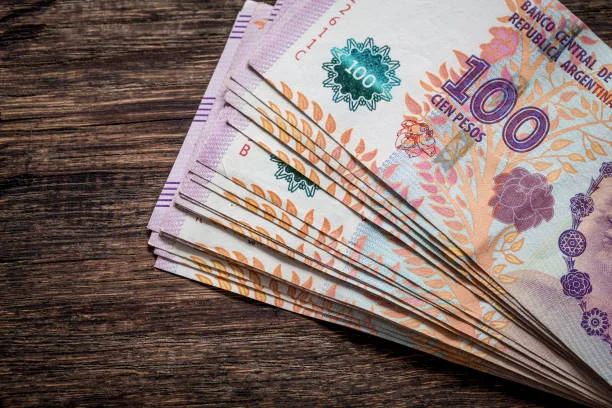
The blue dollar rate, a key indicator for businesses and individuals shut out of the official market, surged as well. Market participants saw the official and parallel rates converge, with the gap narrowing from 28 percent to about 5 percent at one point.
This reflected both the weakening of the official rate and stabilization in the parallel market. However, the gap widened again as uncertainty persisted about inflation, reserve levels, and the government’s ability to maintain discipline.
Argentina Faces Currency Pressure Amid Recovery
Bond markets reacted with a rally in international issues, while local peso assets sold off. The Merval stock index rose 4.7 percent, but the central bank had to spend over $1 billion in reserves in six days to support the peso.
Futures markets priced in further depreciation, with contracts implying a 60 percent annualized drop for the shortest terms. The government faces a balancing act. It needs to rebuild reserves, keep inflation in check, and avoid a politically costly devaluation ahead of midterm elections.
Analysts expect the official rate to reach 1,132 by the end of April and possibly 1,400 by year-end. The IMF deal and support from other lenders provide a buffer, but market confidence remains fragile.
Argentina’s real economy has started to recover, with GDP expected to grow by 5.5 percent this year, but the pace of disinflation and the durability of reforms remain in question. The next weeks will reveal whether Milei’s gamble pays off or if the peso faces renewed pressure.
More: Argentina news in English, every day from The Rio Times.
Live Market IntelligenceArgentina — Live Market Board
Rio Times · Live Market Intelligence
Argentina — Live Market Board
-0.76%
186,595.60
+0.74%
63,133.88
-0.38%
11,357.82
-0.21%
2,998,956
-0.76%
2,565.55
+0.68%
59,344.04
+0.31%
| Instrument | Last | Change | YoY | Prev. | High | Low | Volume |
|---|---|---|---|---|---|---|---|
| MERVAL | 2,998,956 | -0.76% | +30.51% | 3,022,485 | 3,042,365 | 2,991,150 | — |
| USD/ARS | 1,493 | +0.10% | +12.96% | 1,491 | 1,494 | 1,480 | — |
| YPF | 7,810 | +0.26% | +72.84% | 7,790 | 7,850 | 7,600 | 1,763,858 |
| GGAL | 6,980 | -0.78% | +1.82% | 7,035 | 7,115 | 6,920 | 1,564,062 |
| PAMPA | 5,115 | +0.69% | +26.70% | 5,080 | 5,140 | 5,000 | 721,190 |
| TXAR | 747.50 | -2.35% | +18.67% | 765.50 | 770.00 | 742.50 | 771,892 |
| ALUAR | 938.00 | -1.21% | +29.83% | 949.50 | 951.00 | 932.50 | 135,426 |
| TGS | 8,870 | -0.17% | +15.05% | 8,885 | 9,075 | 8,720 | 143,546 |
| CEPU | 2,156 | +1.84% | +28.36% | 2,117 | 2,165 | 2,086 | 404,146 |
| MIRGOR | 1,650 | -1.20% | -92.90% | 1,670 | 1,670 | 1,635 | 20,877 |
| COME | 40.93 | -0.73% | -30.47% | 41.23 | 41.60 | 40.50 | 4,258,884 |
| LOMA NEGRA | 3,130 | +0.08% | +5.80% | 3,128 | 3,205 | 3,090 | 182,992 |
| BYMA | 275.00 | -1.70% | +35.14% | 279.75 | 282.50 | 272.00 | 1,409,575 |
| TELECOM ARG | 4,233 | -0.70% | +55.19% | 4,263 | 4,335 | 4,160 | 31,896 |
| GLOBANT | 38.10 | -2.26% | -49.65% | 38.98 | 38.70 | 36.77 | 793,552 |
| MERCADOLIBRE | 1,870 | -3.59% | -20.71% | 1,940 | 1,927 | 1,870 | 329,640 |
This article was produced by The Rio Times’ automated newsroom system. How we use AI · Report an error
In depth
Read More from The Rio Times