Why Argentine Households Are Substituting Beef With Donkey
Key Facts
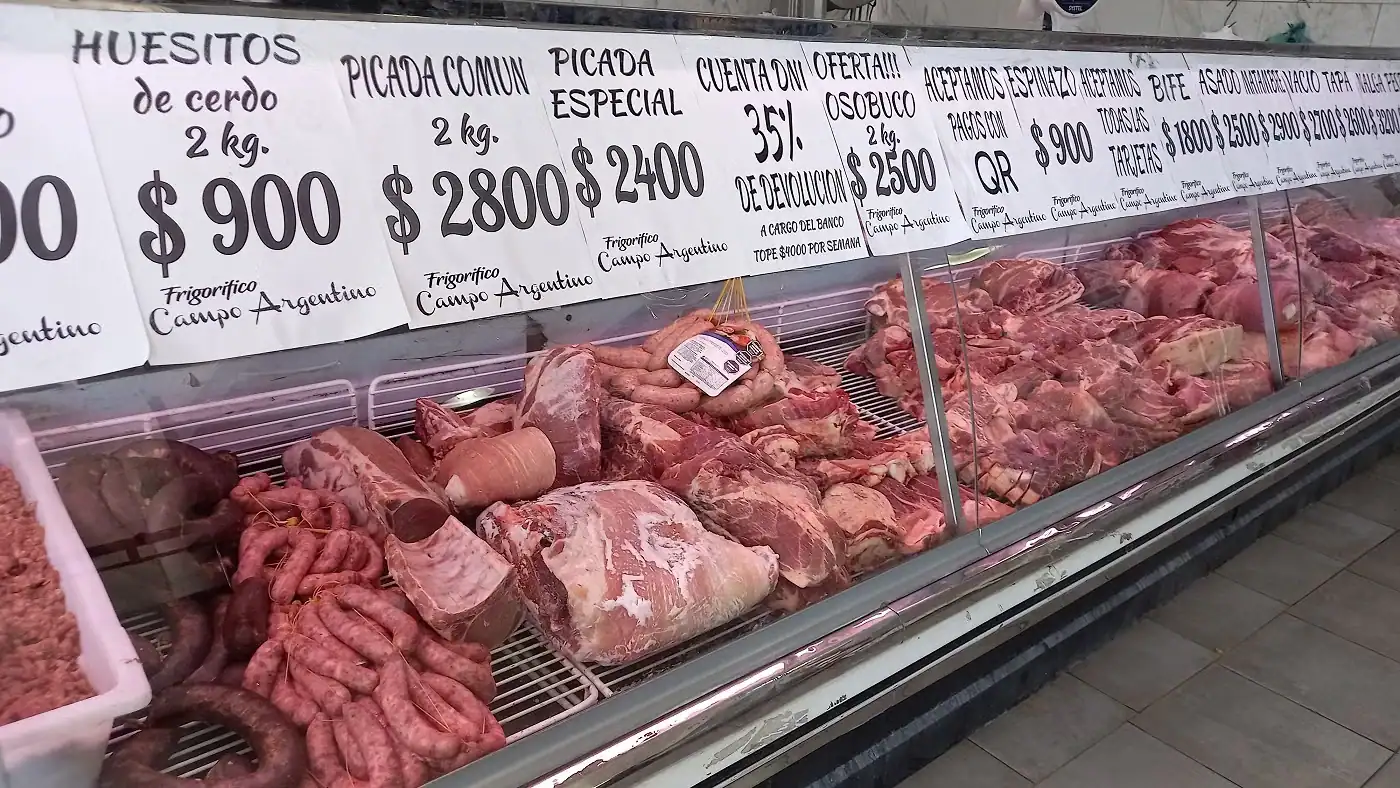
— — The INDEC consumer price index reported beef and derivatives rose 55.1% year-on-year in March 2026, with asado up 68.9%, paleta 66.5%, and cuadril 64.7% — all far above the 32.6% twelve-month average inflation.
— — Annual per-capita beef consumption in Argentina has fallen to approximately 47.3 kg, the lowest level in 20 years and 22 kg below the 2008 peak; Q1 2026 consumption declined an additional 10% despite export volume rising 11.4%.
— — Chubut producer Julio Cittadini’s “Burros Patagones” project began commercial sales of donkey meat in April at 7,500 pesos per kilogram, compared to approximately 18,564 pesos per kilogram for beef — roughly 40% of the bovine price.
— Deep Dive
— For the complete picture, see our guide: Argentina Economy 2026.
The Argentina beef prices trajectory in 2026 has crossed a threshold that even the country’s worst historical inflation crises did not reach. Beef has doubled the inflation rate for twelve consecutive months.
Per-capita consumption is at a 20-year low. The Rio Times, the Latin American financial news outlet, reports that donkey meat is now commercially viable as a beef substitute in Patagonia because the economics of the traditional protein have moved beyond household affordability.
March 2026 was the most disruptive month in two decades for the Argentine beef consumer. The headline monthly inflation figure of 3.4% was the highest of 2026 so far, but the sector-specific 6.9% monthly move in meat and derivatives was nearly double the headline — continuing a pattern in which meat prices consistently outpace overall inflation by 20-plus percentage points year over year.
The Cámara de la Industria y Comercio de Carnes (Ciccra) attributes the structural price pressure to the rising cost of cattle-on-hoof between March 2025 and March 2026, which has fed through to retail cuts. Chicken prices rose 41.2% over the same period, above headline inflation but still providing a measurable relative-price discount to beef.
Behind the Argentina Beef Prices Surge
The price surge is not a demand phenomenon. Domestic consumption is declining steadily. The INDEC and Bolsa de Comercio de Rosario data show per-capita consumption at 47.3 kg annually — the lowest level since the 2004 post-crisis period and 22 kilograms below the 2008 peak of 69 kg.
The supply side explains the price dynamic. Argentine cattle exports grew 11.4% in Q1 2026 as international prices held firm and the peso remained competitive in international trade. Export growth effectively withdraws domestic-market supply, pushing retail prices higher even as domestic consumers buy less.
The Fundación Mediterránea documented that February 2026 retail beef reached 15,895 pesos per kilogram on average — the highest real-terms price in 20 years. March readings have pushed that further, with cuts at popular butchers in Buenos Aires reaching 25,000 pesos per kilogram for premium selections.
The Donkey-Meat Substitution
Julio Cittadini’s Burros Patagones project at Punta Tombo, Chubut, is the first commercial-scale donkey meat operation in Argentina. The initiative emerged not as a novelty but as a response to the collapse of regional sheep ranching, which has been hit by drought, wildlife predation, and low wool profitability across Patagonia.
The 150-donkey herd at Punta Tombo was genetically selected for meat production. The cuts offered include vacío, entraña, costillar and lomo — essentially the same categories as bovine meat. Cittadini projects that prices will stabilize at no more than 50% of traditional beef values, meaning the current 60% discount is the maximum rather than the norm.
The experimental sales at a Trelew butcher reportedly cleared the initial eight-half-carcass stock within three days. The rapid sellout suggests that the cultural resistance to donkey meat — which most observers expected to be the limiting factor — has been overwhelmed by the price signal.
Live Market IntelligenceArgentina — Live Market Board
Rio Times · Live Market Intelligence
Argentina — Live Market Board
-1.29%
185,229.17
-0.41%
63,375.93
-0.78%
11,381.18
+1.30%
3,021,926
-1.29%
2,548.22
+1.05%
60,023.65
-1.13%
| Instrument | Last | Change | YoY | Prev. | High | Low | Volume |
|---|---|---|---|---|---|---|---|
| MERVAL | 3,021,926 | -1.29% | +30.51% | 3,022,485 | 3,042,365 | 2,991,150 | — |
| USD/ARS | 1,493 | +0.10% | +12.96% | 1,491 | 1,494 | 1,480 | — |
| YPF | 7,810 | +0.26% | +72.84% | 7,790 | 7,850 | 7,600 | 1,763,858 |
| GGAL | 6,980 | -0.78% | +1.82% | 7,035 | 7,115 | 6,920 | 1,564,062 |
| PAMPA | 5,115 | +0.69% | +26.70% | 5,080 | 5,140 | 5,000 | 721,190 |
| TXAR | 747.50 | -2.35% | +18.67% | 765.50 | 770.00 | 742.50 | 771,892 |
| ALUAR | 938.00 | -1.21% | +29.83% | 949.50 | 951.00 | 932.50 | 135,426 |
| TGS | 8,870 | -0.17% | +15.05% | 8,885 | 9,075 | 8,720 | 143,546 |
| CEPU | 2,156 | +1.84% | +28.36% | 2,117 | 2,165 | 2,086 | 404,146 |
| MIRGOR | 1,650 | -1.20% | -92.90% | 1,670 | 1,670 | 1,635 | 20,877 |
| COME | 40.93 | -0.73% | -30.47% | 41.23 | 41.60 | 40.50 | 4,258,884 |
| LOMA NEGRA | 3,130 | +0.08% | +5.80% | 3,128 | 3,205 | 3,090 | 182,992 |
| BYMA | 275.00 | -1.70% | +35.14% | 279.75 | 282.50 | 272.00 | 1,409,575 |
| TELECOM ARG | 4,233 | -0.70% | +55.19% | 4,263 | 4,335 | 4,160 | 31,896 |
| GLOBANT | 38.10 | -2.26% | -49.65% | 38.98 | 38.70 | 36.77 | 793,552 |
| MERCADOLIBRE | 1,870 | -3.59% | -20.71% | 1,940 | 1,927 | 1,870 | 329,640 |
The Legal and Health Framework
Argentine food code classifies donkey meat under the “non-habitual consumption” category alongside horse and various game meats. Sale is legal subject to sanitary controls covering breeding, slaughter, and distribution.
The Servicio Nacional de Sanidad y Calidad Agroalimentaria (Senasa) has not issued specific guidance on donkey meat production scaling, but the initial Chubut operation has operated under the standard non-bovine livestock framework. Expansion to other provinces would require provincial-level sanitary and commercial approvals that have not yet been formally sought.
Cittadini has indicated that several other regional producers are watching the Burros Patagones results with an eye to diversification. A formal Patagonian donkey-meat association could emerge in the next 12-18 months if the Chubut commercial case proves sustainable beyond the initial experimental phase.
The Broader Protein Reallocation
Argentine protein consumption is undergoing a structural reallocation. Pork per-capita consumption hit a 2010-onward record of 18.4 kg in 2025 according to the Bolsa de Comercio de Rosario. Chicken continues to gain share despite its own 41.2% year-on-year price increase because the relative position versus beef has still improved.
Within beef, consumers are shifting toward the cheapest cuts. The carne para puchero cut — used for stews and traditionally considered a low-end option — has become the protagonist of Argentine consumer purchases in Q1 2026. Premium cuts like bife de chorizo and ojo de bife have seen the steepest declines in retail volume.
The combination of cut-downgrading plus protein substitution plus volume decline represents a full-spectrum consumer adjustment that will take years to reverse even if prices stabilize. The Argentine beef-centric diet that characterized the country throughout the 20th century is now meaningfully altered.
The Political Dimension
The donkey-meat story has become a symbol of the Milei-era economic adjustment in domestic and international press coverage. The image of Argentines substituting donkey meat for beef is particularly powerful because beef consumption has been a cultural marker of Argentine national identity for generations.
As Rio Times coverage of regional consumer dynamics has documented, the protein consumption patterns in Argentina are now closer to Brazilian urban working-class patterns than to the traditional Argentine middle-class model. That convergence reflects the broader compression of Argentine living standards toward regional norms the country spent the 20th century distinguishing itself from.
Milei government officials have characterized the price pressure as a transition cost of the stabilization program. Opposition politicians and consumer-rights advocates have emphasized the per-capita consumption figures as the more durable measure of welfare loss. Neither framing fully captures the cultural-political weight of the donkey-meat story.
What to Watch
Three variables will shape the next six months. First, the April INDEC CPI release due in early May. Monthly inflation moderation below 3% would signal the price pressure is easing; a sustained reading above 3% would confirm that the beef-specific dynamics are embedded in the broader price trajectory.
Second, the export cattle flows. Government intervention restricting export volumes would redirect supply to the domestic market and partially ease retail prices; continued export growth would lock in the current supply-demand dynamic. As Rio Times reporting on Latin American commodity-export patterns has noted, export restrictions have historically produced short-term consumer relief at the cost of longer-term producer disinvestment.
Third, the scale of the donkey-meat commercial expansion. If additional Patagonian producers enter the market through mid-2026, a formal Burros Patagones cooperative or association could emerge, reclassifying donkey meat from novelty to permanent part of the protein retail architecture.
More: Argentina news in English, every day from The Rio Times.
This article was produced by The Rio Times’ automated newsroom system. How we use AI · Report an error
Read More from The Rio Times