

The Forest That Built — and Almost Killed — Brazil
When Portuguese colonizers landed on the coast of Bahia in 1500, the first thing they cut down was the Atlantic Forest. Five centuries later, Brazil is trying to put it back — and the science being used may be the most advanced restoration effort on the planet.
The Mata Atlântica once covered 130 million hectares. Only 24 percent retains any vegetation, and just 12.4 percent exists as mature forest across 17 states. Yet 72 percent of Brazil’s population — including São Paulo and Rio — lives within its borders. Its destruction is not history. It is infrastructure.
Genetic Mapping of Survivor Trees
In southern Bahia, the company Symbiosis has spent a decade building Brazil’s first commercial breeding program for native species. Teams searched four states for centuries-old mother trees of jacarandá, jequitibá, ipê, and angico that survived colonial logging, rubber booms, and cattle ranching.
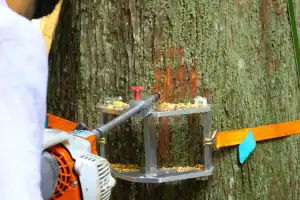
Their genetic profiles were mapped for climate resilience — drought tolerance, pest resistance, growth speed. The result: forests that develop 50 percent faster, designed with 45 native species to maximize biodiversity while avoiding genetic uniformity. About 1,000 hectares have been restored, with a nursery producing over 500,000 seedlings per year.
The Scale of What’s Left — and What’s Needed
A national coalition — the Pact for the Restoration of the Atlantic Forest, created in 2009 — set a target of 15 million hectares by 2050. Between 1993 and 2022, 4.9 million hectares began regenerating, but 1.1 million were deforested again. The net gain of 3.8 million hectares shows progress, but the 2050 goal remains distant.
The fundamental obstacle is ownership. Roughly 90 percent of the biome sits on private land. Without economic incentives, landowners have little reason to restore forest on productive pasture. Rafael Bitante Fernandes of the SOS Mata Atlântica Foundation says payments for environmental services — carbon credits, water regulation, non-timber products like oils and essences — are essential to scaling up.
Jobs, Carbon, and Global Attention
Industry estimates suggest every two restored hectares — roughly two soccer fields — generates one permanent job. If the 15-million-hectare target is met, the employment impact would be transformative for rural communities across Brazil‘s coast. Private investors are beginning to treat restoration not as philanthropy but as a sustainable asset class.
In international forums, the Atlantic Forest is now ranked among the world’s ten priority restoration initiatives for potential replication. For a biome that was the first thing Europeans destroyed in the Americas, becoming a global model for how to rebuild what was lost would be a remarkable reversal — if the economics can keep up with the science.