

Art That Only Exists When You Show Up
Place your hand under a sensor and watch 3,000 light bulbs pulse in time with your heartbeat. Walk through a corridor and hear a poem in Tzotzil erupt from speakers triggered by the heat of your body. Stand still and a lighthouse-like beacon translates invisible cosmic radiation into patterns of light. This is “Jardín Inconcluso” — Incomplete Garden — a nighttime exhibition at Mexico City’s Museum of Modern Art that turns visitors into the medium through which art comes alive.
The show, open since February 11 and running through April 25, features nine interactive installations by Rafael Lozano-Hemmer, a Mexican-Canadian artist widely regarded as one of the leading figures in digital art worldwide. In 2007 he became the first artist to officially represent Mexico at the Venice Biennale. His work has since traveled through biennales in Havana, Istanbul, Shanghai, Sydney, and Singapore. After a decade of not exhibiting in his home country, the return carries weight.
Heartbeats, Voices, Cosmic Rays
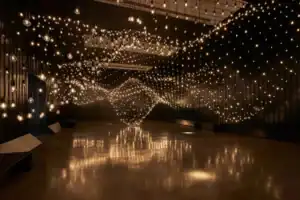
The centerpiece is “Jardín de Corazonadas” (Garden of Hunches), a field of more than 3,000 bulbs that flicker on and off synchronized to visitors’ cardiac rhythms. The installation draws from the final scene of Macario, a 1960 Mexican film in which a cavern filled with candles represents individual human lives — each flame burning for as long as its owner survives. Lozano-Hemmer’s version gradually erases older heartbeat recordings to make room for new ones, creating a living archive that constantly renews itself.
“Calzada de Voces” (Voice Walkway) projects images of speakers’ vocal cords as a camera travels through the throats of those who read aloud from the Mexican National Sound Archive. “Faro Colisionador” (Collider Lighthouse) detects cosmic radiation invisible to the human eye and converts it into light signals. Other pieces project poetry by indigenous writers in languages including Maya and Zapotec, activated by body-movement sensors. “Atmosfonía de Campo” deploys 3,000 speakers containing 17 different audio tracks; the system detects your exact position and activates only the speakers directly above you, creating a personal sound shadow that follows your path through the gallery.
The Incomplete as a Political Act
The kilometer-long nighttime route winds through the museum’s Sala Gamboa, its central rotunda, and the Sculpture Garden set within Chapultepec, one of the largest urban forests in the Western Hemisphere. Twenty-one collaborators from Lozano-Hemmer‘s Montreal studio, Antimodular Research, built the installation, which includes three works created specifically for the museum’s architecture. The exhibition is part of the studio’s Art Parcours series of outdoor nighttime shows, previously staged at the Crystal Bridges Museum of American Art in Arkansas and on a desert island in Abu Dhabi.
For the artist, the title is both conceptual and political. Delegating the completion of a work to the audience, he has said, is a recognition that meaning cannot be found without interaction. The show also incorporates environmental protections uncommon in large-scale digital installations: UV filters prevent the disorientation of migratory birds passing through Chapultepec, while solar-powered luminaries and high-efficiency LED systems reduce the energy footprint of what is, in effect, an outdoor light show running four nights a week.
Curator Silverio Orduña described the exhibition as a dialogue between Mexico’s artistic tradition and the possibilities of contemporary technology — one that only happens at night, only in person, and only because someone showed up. The show is open Wednesday through Saturday evenings, with timed entry every 15 minutes and a walkthrough lasting roughly 60 to 90 minutes.