

American and Ecuadorian military forces launched joint operations against drug trafficking organizations inside Ecuador on Tuesday, US Southern Command announced, marking the first publicly disclosed US ground mission in South America since the capture of Venezuelan president Nicolás Maduro two months ago.
SOUTHCOM said the operations targeted designated terrorist organizations but provided almost no operational detail. Ecuador’s Defense Ministry confirmed participation in what it called an “offensive” and said specifics were classified. A 30-second video released by SOUTHCOM showed soldiers boarding a helicopter, with black-and-white footage consistent with overhead surveillance of ground forces.
From Sea Strikes to Boots on the Ground
The Ecuador operation represents a significant expansion of the Trump administration’s counter-narcotics campaign in Latin America, which until now has focused primarily on strikes against suspected drug-trafficking vessels in the Caribbean and Eastern Pacific. Since September, at least 44 airstrikes on alleged smuggling boats have killed roughly 150 people, according to SOUTHCOM tallies. Moving onto land inside a cooperating sovereign nation marks a qualitative shift in the campaign’s scope and ambition.
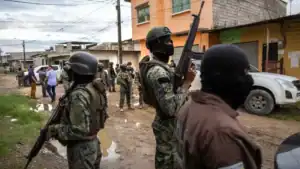
US Army Special Forces appear to be serving in an advisory role, providing intelligence and logistical support while Ecuadorian soldiers conduct the physical operations, according to the New York Times. The scope and expected duration of the mission remain unclear. SOUTHCOM did not respond to follow-up questions beyond its initial announcement.
Ecuador’s Cartel Crisis
President Daniel Noboa had telegraphed the operation a day earlier, announcing on social media that his government would carry out joint operations with the United States and regional allies in March, calling it “a new phase against narco-terrorism and illegal mining.” SOUTHCOM commander General Francis Donovan had visited Quito over the weekend to meet with Noboa and senior Ecuadorian officials.
Ecuador has been engulfed by cartel violence in recent years, with Los Lobos and Los Choneros emerging as the country’s dominant criminal organizations. Both were designated as foreign terrorist organizations by the US State Department in September 2025, providing the legal basis for American military involvement. The groups have been linked to Mexican and Colombian cartels and have turned Ecuador’s Pacific coast into a major cocaine transit corridor.
A Parallel Europol Operation
On the same day, the US Embassy in Ecuador announced the successful conclusion of a separate joint operation with Europol and Ecuadorian authorities that dismantled the Hernán Ruilova Barzola transnational drug trafficking organization, described as linked to Los Lobos. The timing of both announcements suggests a coordinated law enforcement and military push against the cartel’s operational infrastructure on multiple fronts simultaneously.
The Manta Question
US troops returned to Ecuador’s Manta air base in December under what SOUTHCOM described as a short-term mission within existing bilateral agreements. The base had been a major American counter-narcotics hub until Ecuador’s then-president Rafael Correa refused to renew the lease in 2009. Noboa pushed for a referendum last year that would have authorized the return of foreign military bases, but voters rejected it in November. The current deployment operates under a legal framework that avoids the need for a formal basing agreement, though the line between a temporary advisory mission and an enduring military presence may prove difficult to maintain as operations escalate. For Washington, Ecuador offers something rare in the region: a willing partner in a drug war that is rapidly moving from the open ocean onto sovereign territory.